7
7


ISLAMABAD: Speakers at a conference on national security argued that radicalisation of traditional religious narratives was a dangerous phenomenon that could lead to an outbreak of violence in the society.
Speaking during a session on ‘Narratives on Militancy and Radicalism’ at the Institute of Strategic Studies on Tuesday, Mohammad Amir Rana of the Pakistan Institute of Peace Studies (PIPS) said religious organisations, especially Deobandi groups, are looking to reassert their relevance by marketing themselves as a non-violent alternative to militant groups, but in doing so, they are using the same extreme rhetoric that such groups use.
This phenomenon, which he referred to as the ‘Daish-isation’ of conservative discourse, was already underway, he said. Daish is the Arabic acronym for the Islamic State (IS).
“Today, there is a range of urban-based violent groups that are operating in our cities. The threat is there and it is real. In the short run, such groups can trigger sectarian violence. Look at groups that have pledged allegiance to IS; they all have sectarian tendencies. Even the Taliban splinter groups that have hailed IS belong to areas where sectarian divides are present, such as Orakzai Agency,” Rana said.
Talking about the roots of militancy in the country, Political Analyst Nasim Zehra said militancy was institutionalised in the country through state patronage, particularly during the late 70s and 80s.
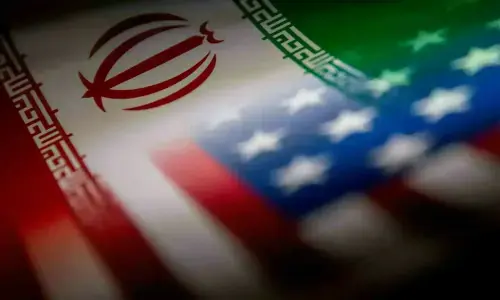
She explained that sectarian nature of most of these organisations owed to the fact that at the time, the US wanted to counter the threat from Iran, and propping up groups that were adversaries of Shia sect made sense at the time.
Speakers at conference on national security warn of large-scale sectarian violence in the short term
Talking about the ‘National Security Dilemma’ during an earlier session, Dr Sunil Dasgupta, director of the political science programme at the University of Maryland, Baltimore and senior journalist Ejaz Haider also touched upon the dangers posed by militancy in the modern context.
During his larger talk about the role of narratives, Dr Dasgupta told the audience that in issues such as radicalism, those who did not have a great deal of nuance tended to paint all religious organisations with the same brush. However, he said, they failed to note important distinctions.
As an example, he said that while Deobandi groups may constitute the bulk of militant and/or terrorist organisations, it was the Barelvi groups – traditionally viewed as more tolerant – who always got fired up on the issue of blasphemy.
Mr Haider spoke at length about the changing paradigm of modern warfare and talked about hybrid warfare that was carried out by ‘non-kinetic means’ at least as much as traditional military methods.
He said role of non-military means in achieving political gains was increasingly being discussed at the international level and quoted the Gerasimov doctrine, which he said was already being used by Russian leader Vladimir Putin to reinvent warfare. “Obama seems to be stuck in the past,” he observed.
Focusing on local policies, he said military strength flowed from non-military factors, but Pakistan’s decision to prioritise building of military strength has weakened the country and made it susceptible to non-linear attacks.
Aasim Sajjad Akhtar, who teaches at Quaid-i-Azam University and is also a leader of Awami Workers Party, talked about the state’s treatment of Balochistan and deplored the way the country was in denial that there were problems in that part of the country.
He said the state did not have a uniform approach towards different violent groups. A group from Balochistan is not treated the same as a militant group, he said, referring to a complete blackout of any detailed information regarding the ongoing separatist conflict in the province from the national media.
Published in Dawn, November 26th, 2014