THE PTI and Tahirul Qadri have separately played their cards — they have showed the kind of street support they command and they have made known their set of demands. To the extent that Imran Khan has demanded electoral reforms be enacted by the government, the PTI’s claim can and should be countenanced and worked on by parliament. As for much of the rest of the PTI’s and Mr Qadri’s demands, the PML-N government, mainstream political parties and parliament can rightly dismiss them. For why should Prime Minister Nawaz Sharif resign a year after winning an election widely perceived to be credible and acceptable? Surely, street power cannot once again become an acceptable means to bring down a democratically elected government — because if the PTI and Mr Qadri’s supporters were to achieve it today, then what is to stop anyone else from marching to oust the government that will replace it or the one after that?
Consider also the contradictions that riddle the PTI’s stance. The chief minister of Khyber Pakhtunkhwa Pervez Khattak stood in Islamabad to call for the resignation of Prime Minister Sharif — when the two men head governments elected under the same framework of rules and in an election where voters simultaneously voted for the provincial and national assemblies. If the entire electoral system is fundamentally flawed and prone to massive rigging, then why is the PTI’s government in KP not tainted by the same flaws? Furthermore, consider the commitment to rectifying electoral flaws that the PTI has had in other arenas: neither has the PTI-led KP government held local government elections nor has it offered up a raft of proposals to ensure that, when held, the local government polls in KP will serve as a template of fairness and transparency for other provinces and the federation to follow.
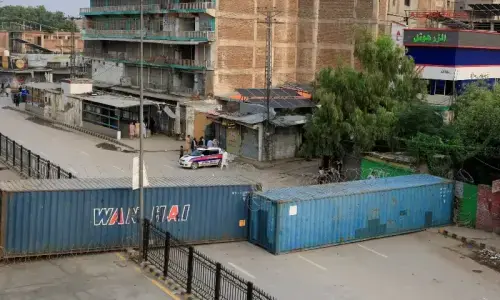
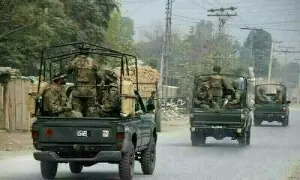
Yet, even if there are no acceptable grounds for the PML-N government and Prime Minister Sharif to resign simply because the PTI and Mr Qadri have called for the resignations, there is surely much that the government must adjust in its approach to politics and governance. The present crisis only truly became a crisis when the government panicked and tried to scuttle the protests, whether by trying to dismantle the barricades around Mr Qadri’s headquarters in Lahore or by invoking Article 245 to draft in the army to help protect Islamabad and finally by barricading Lahore and Islamabad and the roads in between. Until the very end, when the government finally showed restraint and calm, it was more the mishandling by the government of the evolving situation that raised the political temperature than anything the PTI or Mr Qadri had done. Now, if electoral reforms are not taken up seriously and urgently, perhaps the seeds of another crisis in the future will be inadvertently sowed by the PML-N again.
Published in Dawn, August 17th, 2014