0
0

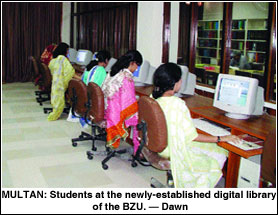 MULTAN, June 30: The Bahauddin Zakariya University is set to launch in July a digital library established with a seed capital of Rs4.5 million, according to Vice-Chancellor Dr Ghulam Mustafa Chaudhry.
“The university is perhaps the first among the public sector universities in the country to have allocated such a sizable amount to take benefit of the modern tools of learning and research,” the VC told Dawn on Sunday.
Digital library project in-charge Prof Dr Mujahid Ali said the research and science journals usually cost much to the students and scholars. The digital library would bring down the cost to 25 per cent of hard-copy price, he added.
He said the university would buy the digital copies of the research journals in bundles. Search engines would fish out a maximum number of articles on a particular subject with one keystroke, making it convenient for the people to browse.
Dr Ali said the university was trying to get free of cost journals and links had been developed with the reputed foreign universities in this regard. The Oxford University had allowed the BZU a free access to its 130 journals while the British Medical Journal and Barkley University had also provided the same facility to the university.
All the 22 buildings of the university, including campuses, hostels and administrative blocks, had been interlinked with the Local Area Network after laying 8.5km-long fibre optic cable. The university has 800 workstations of which 650 are installed at the university’s computer science department.
The BZU has also been running a Universal Computer Literacy programme for the last two years for its students, who have to undergo a four-week computer training programme which includes operating system, database, spreadsheet, graphics and report-writing. The university charges Rs1,000 for the course from the students at the time of admission.
When contacted, computer science department head Dr Amanullah said the university had set up computer rooms at each of the boys and girls’ hostel where the boarders had free Internet access. It was working to provide Internet connections at each of the hostel rooms and any boarder having a personal computer could have round-the-clock free access to the facility.
Initially, the access to the digital library could be possible from 35 terminals installed at the central library, but it would soon be accessible from anywhere in the university. Dr Amanullah said the institute’s current networking system had the maximum speed of 100mbs, which was being upgraded to 1000mbs. The university was also exploring the possibility of setting up its own Internet Service Provider domain, he added.