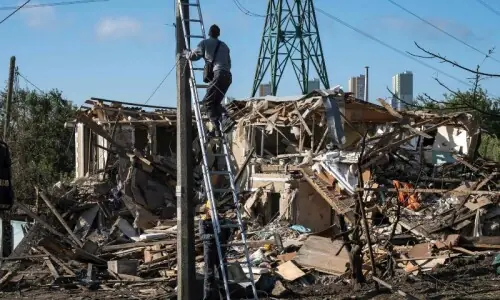
DAMASCUS: The Syrian air force was on Monday accused of killing 76 people by unleashing barrels packed with explosives on Aleppo, a focal point for fighting between regime and rebel forces.
The bombardment, which activists described as “unprecedented”, came as the United Nations said the number of Syrian war refugees in the Middle East was likely to double to 4.1 million by the end of 2014.
The number of people slain in Sunday’s bombing of Aleppo “with explosive-packed barrels... rose to 76,” including “28 children and four women,” said the Syrian Observatory for Human Rights, updating its previous toll of 36 dead.
Observatory director Rami Abdel Rahman said it was “one of the heaviest tolls from air raids since the beginning of the war” that flared after a brutal regime crackdown on Arab Spring-inspired democracy protests that erupted in March 2011.
Explosive-laden barrels were dropped on six rebel-controlled districts in the east, including Sakhur, Ard al-Hamra and Haydariyeh, Abdel Rahman said.
The Observatory and activists said government forces frequently drop the barrels filled with TNT on rebel-held areas of the war-torn country from helicopters and warplanes.
“The barrels of explosives are not like bombs. Their impact is not accurate as they are dropped without any guidance system, and that is why they cause a large number of victims,” said Abdel Rahman.
The devices are made up of metal barrels that have a layer of concrete inside them “so that they cause as much destruction and death as possible,” according to Abdel Rahman.
There are two types of barrel bombs, one of which is home-made, and the other of which is made in factories.
A Syrian security official said the army prefers the TNT-packed barrels because they are cheaper than regular bombs, which need to be imported from Russia.
The Aleppo Media Centre, a network of activists on the ground, called Sunday’s raids on the northern city “unprecedented”.
“Everyone is looking up at the skies and watching the planes. But there’s nothing to be done,” AMC activist Mohammed al-Khatieb said.
Aleppo, Syria’s second city and pre-war commercial hub, is now divided between areas occupied by troops loyal to President Bashar al-Assad and rebel fighters.
Fighting that erupted with a rebel offensive in July last year has caused massive damage to the historic city.
Activists posted video footage online of the aftermath of Sunday’s barrel bomb attacks, showing bulldozers clearing rubble from the streets as men searched for survivors in wrecked buildings.
The barrel bombings came as Swedish expert Ake Sellstrom prepared to brief the United Nations Security Council on the use of internationally-banned chemical weapons in the unrelenting war.
Sellstrom led an investigation into the alleged use of chemical weapons in Syria.
His team published a report on Thursday, saying there was “credible evidence” that the controversial arms had been used five times since the conflict broke out 33 months ago.
The United States was on the brink of launching air strikes against Assad in August after a deadly chemical weapons attack in the Eastern Ghouta area on the outskirts of the capital Damascus.
It and other world powers blamed regime forces for the attack, but a deal for Assad to surrender his chemical arsenal narrowly averted the strikes.
Under UN Security Council Resolution 2118 passed in September, all of Syria’s chemical weapons are to be destroyed by June 30.
More than 126,000 people have been killed in the Syrian conflict, and millions more have fled their homes.
According to a fresh UN estimate, some 4.1 million Syrians will be living as refugees in Lebanon, Jordan, Turkey, Iraq and Egypt by the end of 2014, up from an estimated 2.4 million today.—AFP