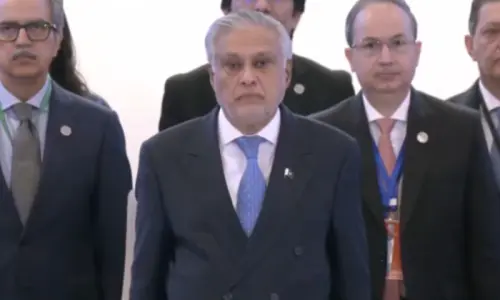
WASHINGTON: Pakistani Prime Minister Nawaz Sharif Tuesday reiterated his country's stance on US drone strikes saying they violate its sovereignty prior to his scheduled meeting with President Barack Obama on Wednesday.
He urged the United States to stop drone strikes in tribal areas of Pakistan bordering Afghanistan.
The statement came the same day as release of a report by Amnesty International which said killing of Pakistanis in US-led drone strikes may amount to war crimes or extrajudicial executions.
Sharif called for warmer ties with the United States and offered Pakistan's assistance in Afghanistan as US forces prepare to withdraw next year.
However, he said that the unmanned strikes – which penetrate extremist havens deep in Pakistan's most lawless areas – represented a “major irritant” in relations. “I would therefore stress the need for an end to drone attacks,” he added.
Sharif said Pakistan's political parties believed that drones violated the country's territorial integrity as well as its own efforts to fight extremism.
The prime minister spoke only briefly about drones in his main public address in Washington and vowed cooperation on Afghanistan – seen as the main topic which Obama will want to address on Wednesday.
US officials want access for removal of equipment next year but also believe that Pakistan – the prime backer of the extremist Taliban regime before the September 11, 2001 attacks – can play a key role in peace talks in Afghanistan.
The Pakistani leader said that his country supported a “peaceful, stable and unified” Afghanistan.
Sharif said he has assured Afghan President Hamid Karzai “that we wish neither to interfere in Afghanistan's internal affairs, nor do we have any favorites.”
Going the 'extra mile' with India
Sharif also vowed to go the “extra mile” to make peace with India, saying the historic rivals can resolve all issues through dialogue.
The prime minister, addressing the US Institute of Peace in Washington, said that Pakistan “will not be found wanting in walking the extra mile” with India. He regretted that periodic incidents such as violence on the disputed border in Kashmir had set back peace attempts.
“I wish to assure this august audience that Pakistan desires to live in peace with its neighbor. We would not be found wanting in walking the extra mile,” said the Pakistani premier.
“If we sit down together, if we seriously address these issues, I don't think we will face any problem.”
“Kashmir, of course, is a very difficult issue and very difficult to resolve but I think, by sitting and talking, we will be able to find some way of resolving that, too,” he said.
“Because that is a flashpoint not only in the region, but the whole world,” he said of Kashmir.
Sharif, who swept back to power in May, noted that he was involved in a major peace initiative with India in 1999 when his then counterpart Atal Bihari Vajpayee visited Pakistan.
The effort collapsed within months as Pakistan-backed forces infiltrated the Indian zone of Kashmir, which has been the source of two full-fledged wars between the nuclear powers.
Sharif blamed the 1999 Kargil conflict on army chief Pervez Musharraf, who later ousted him from power, and repeated his past criticism of the focus on military spending.
“Had our countries not wasted their precious resources in a never-ending arms race, we would not only have avoided the futile conflicts, but also emerged as stable and prosperous nations,” he said.