11
11
IN the aftermath of a terrorist attack, scapegoating tends to appear.
This time, Khyber Pakhtunkhwa Chief Minister Pervez Khattak has called for Afghan refugees to be returned to their home country — because ostensibly Afghan refugees are involved in criminal activities and facilitating terrorism inside Pakistan.
Missing, as ever, was proof. Each time a call is made for the repatriation of Afghan refugees, the demand is accompanied by hyperbole about what the refugees are allegedly doing to destabilise Pakistan.
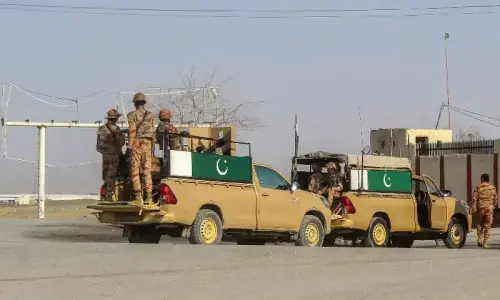
But examples are rarely, if ever, provided. In the case of the Charsadda attack, all of the individuals identified so far as being involved in the attack or its planning are Pakistani. No intelligence or law-enforcement agency has suggested any refugee connection whatsoever.
Yet, because they are vulnerable and deemed to be unworthy of further help, the Afghan refugees are routinely targeted by politicians looking for scapegoats.
Thankfully, the federal government appears to be cognisant of its humanitarian and international responsibilities.
Earlier this month, Prime Minister Nawaz Sharif extended the validity of the Proof of Registration for 1.5 legally registered Afghan refugees until June 30, 2016.
While that measure itself was a compromise — rights groups have called for the extension of PoR cards until the end of the year — it came after a year of public vilification of refugees in the aftermath of the APS school attack and the creation of the National Action Plan.
Had that measure not been taken, it is likely that the registered refugees would simply have joined the unregistered ones — estimated to be as many as, or even greater in number than, those holding PoRs — and been driven further to the margins of Pakistani society.
Are Afghan refugees a threat to Pakistan? Surely, after residing on Pakistani soil for three decades in many cases, Afghan refugees should be able to ask Pakistan the reverse question — do they not have a right to live here?
Refugees are not in voluntary exile. Afghan President Ashraf Ghani made this point when he referred to Pakistanis who have left Fata for parts of eastern Afghanistan following the military operations in the tribal areas.
When Pakistani politicians try to score political points by blaming Afghan refugees for this country’s security woes they ought to remember that many of their countrymen are either IDPs or refugees in Afghanistan.
A far more helpful approach would be to work with the Afghan communities to understand their needs and to address any law-enforcement and security concerns that exist in those communities.
There is no suggestion that the Afghan refugees would resist any legitimate concerns of the Pakistani state.
In fact, given the precariousness of their legal status, they are likely to cooperate wherever possible.
Mr Khattak may find that if he reaches out to the Afghan populace in Pakistan, he could discover more allies than enemies.
Published in Dawn, January 25th, 2016