21
21


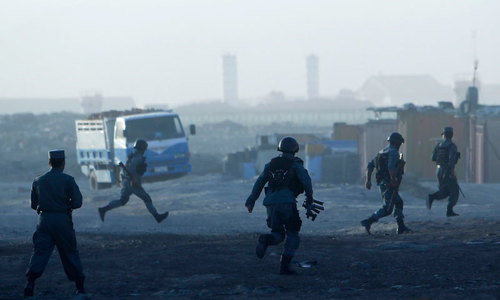
MAZAR-I-SHARIF: A 25-hour gun and bomb siege near the Indian consulate in the Afghan city of Mazar-i-Sharif ended late Monday after all the attackers were killed, officials said.
“The clearance operation is over and all the terrorists have all been killed,” said provincial police chief Sayed Kamal Sadat.
Government spokesman Shir Jan Durrani said three armed assailants had been killed after they mounted an attack on the diplomatic mission from a nearby building late Sunday.
“Our search operation is still going on inside the building,” he said, adding that the fighting left one policeman dead and 11 others wounded.
No group has so far claimed responsibility for the attack in northern Afghanistan, the latest in a series of assaults on Indian installations in the country.
The attack began late on Sunday after gunmen tried unsuccessfully to break into the consulate, taking advantage of the fact that many people were watching the final of a football championship between Afghanistan and India.
After a heavy exchange of fire that went on until well into the night, security forces had suspended operations before resuming in the morning, firing rocket-propelled grenades and heavy machine guns at the building.
Gunfire rang out as a helicopters circled overhead in a residential area of the city, in Balkh province, bordering Uzbekistan.
An Indian official, who was hunkered down in a secure area within the diplomatic enclave, said all consulate employees were safe and accounted for.
"We are being attacked," the official had told AFP by telephone from inside the heavily-guarded compound. "Fighting is going on," he said soon after the fighting erupted late Sunday evening.
Vikas Swarup, an Indian foreign ministry spokesman, also told AFP that no Indian casualties had been reported so far.
The attack followed a deadly raid over the weekend by suspected insurgents on an air force base in India's Pathankot.
Seven soldiers were confirmed killed in the raid on the Indian Air Force (IAF) base, which triggered a 14-hour gun battle Saturday and spurred Indian forces to be scrambled again on Sunday.
The attack on the consulate in Mazar-i-Sharif marks the latest attack on high-profile Indian targets in Afghanistan.
In 2008, a car bomb at the Indian embassy in Kabul killed 60 people and the facility was again hit by a suicide strike in 2009.
Nine civilians, including seven children, were killed in August 2013 when suicide bombers targeted the Indian consulate in the main eastern Afghan city of Jalalabad.
And in May 2014, gunmen launched a pre-dawn attack on India's consulate in the main western Afghan city of Herat before being repelled by security forces.
The spike in violence comes a week after Indian Prime Minister Narendra Modi inaugurated an Indian-built parliament complex and gifted three Russian-made helicopters to the Afghan government.
Following his whirlwind tour of Kabul, the Indian premier paid a surprise visit to Pakistan, the first by an Indian premier in 11 years.
India has been a key supporter of Kabul's post-Taliban government.
The latest unrest coincides with a renewed international push to revive peace talks with the resurgent militant movement.
Afghanistan and Pakistan are set to hold a first round of dialogue between Afghanistan, Pakistan, the United States and China on January 11 to lay out a comprehensive roadmap for peace.
Pakistan hosted a milestone first round of talks in July but the negotiations stalled when the insurgents belatedly confirmed the death of longtime leader Mullah Omar.