161
161
MINA: Witnesses to a stampede that left more than 700 people dead at the Haj in Saudi Arabia on Thursday blamed Saudi authorities and said they were afraid to continue the rituals.
The worst tragedy in 25 years at the annual Muslim pilgrimage occurred during the symbolic stoning of the devil at Mina, just outside the holy city of Makkah.
At least 717 people were killed and 863 people were hurt, spurring King Salman to order "a revision" of Haj organisation while authorities started a probe into the disaster.
At the scene, bodies lay in piles, surrounded by discarded personal belongings and flattened water bottles, while rescue workers laid bodies in long rows on stretchers, limbs protruding from beneath white sheets. The Saudi civil defence service said it was still counting the dead, who included pilgrims from different countries.
Who is to blame?
A Saudi minister blamed the pilgrims for the tragedy, saying they had not followed Haj rules.
"There was crowding. The police had closed all entrances and exits to the pilgrims' camp, leaving only one," said Ahmed Abu Bakr, a 45-year-old Libyan who escaped the stampede with his mother.
"I saw dead bodies in front of me and injuries and suffocation. We removed the victims with the police." He added that police at the scene appeared inexperienced.
"They don't even know the roads and the places around here," he said as others nodded in agreement.
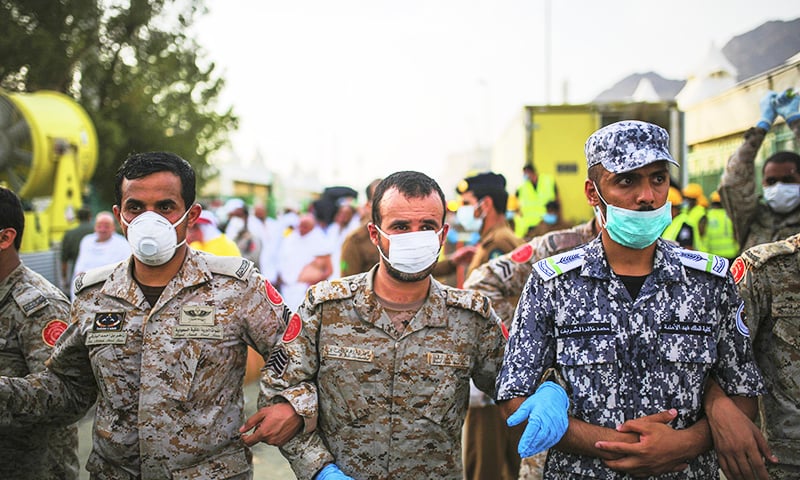
Pilgrims in Mina stay in a complex of white fireproof tents big enough to hold more than two million people, and the interior ministry said it deployed 100,000 police to secure Haj, maintain safety and manage traffic and crowds.
'Great heat and fatigue'
The stampede began at around 9:00 am (0600 GMT), shortly after the civil defence said on Twitter it was dealing with a "crowding" incident in Mina.
Interior ministry spokesman General Mansur al-Turki said the stampede was caused when "a large number of pilgrims were in motion at the same time" at an intersection of two streets in Mina.
"The great heat and fatigue of the pilgrims contributed to the large number of victims," he said. Temperatures in Mina had reached 46 degrees Celsius (115 degrees Fahrenheit) Thursday.
'Don't have a clue'
One outspoken critic of redevelopment at the holy sites said despite the large numbers, police were not properly trained and lacked the language skills for communicating with foreign pilgrims, who make up the majority of those on the Haj.
"They don't have a clue how to engage with these people," said Irfan al-Alawi, co-founder of the Makkah-based Islamic Heritage Research Foundation (IHRF). "There's no crowd control," Alawi said.
Another witness, 39-year-old Egyptian Mohammed Hasan, voiced worries that a similar incident "could happen again".
"You just find soldiers gathered in one place doing nothing," he said.
He also alleged that he had been insulted because of his nationality, when security men asked him to "come identify this Egyptian corpse".
"Why are they humiliating us like this? We are coming as pilgrims asking for nothing," Hasan said angrily, urging the security forces to "organise the roads" to ensure the smooth movement of people.
The stoning ritual is supposed to continue on Friday and Saturday, but pilgrims said they were fearful of a repeat of Thursday's deaths. Some put their faith in God, saying he would protect them.
"Of course we are afraid of tomorrow," said Hasan, the Egyptian pilgrim. "I want to go do the stoning at night. I asked a cleric, he said it's OK."
For years the event was marred by stampedes and fires, but it had been largely incident-free for nearly a decade following safety improvements. In the last major incident, in January 2006, 364 pilgrims were killed in a stampede during the stoning ritual, and in 1990, 1,426 mainly Asian pilgrims died in a tunnel stampede at Mina after a ventilation system failure.