23
23
There remains a troubling disconnect between what the government claims and the reality on the ground when it comes to the state’s attempts to fight sectarianism.
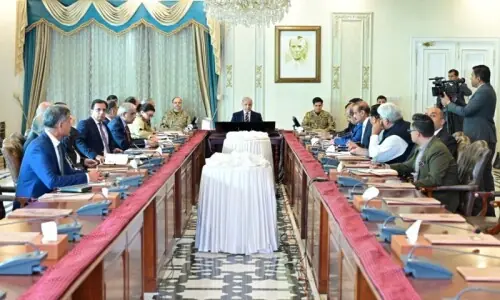
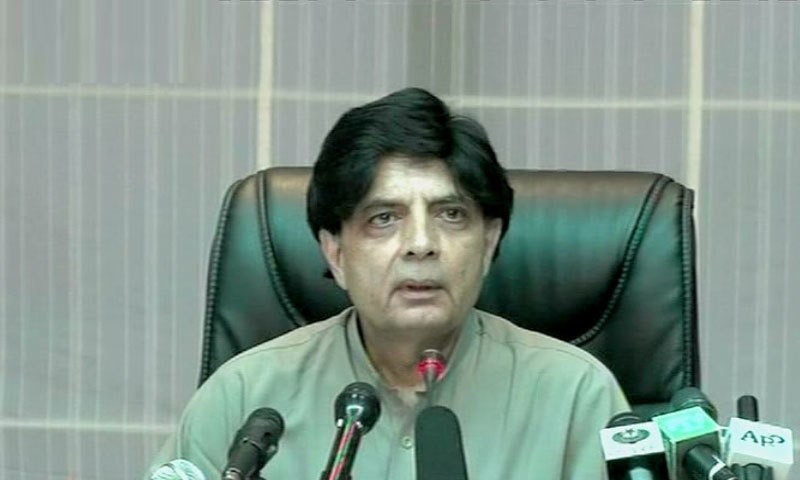
On Monday, Interior Minister Nisar Ali Khan once again claimed that there has been significant progress in several areas of the National Action Plan and appeared to suggest that the clampdown on sectarianism is continuing.
To support his case, the interior minister cited actions against the misuse of loudspeakers and a progressive eradication of hate literature. Yet, there is reason to believe that many, if not most, sectarian elements have remained untouched, continuing to operate with impunity and little fear of the law.
Also read: Banned outfits operating under different names undermine state's credibility: Babar
Consider the case of the banned ASWJ and its leadership. While some of its leaders may be in jail and other affiliated groups’ leaders dead, the fact remains that the ASWJ has an open and vociferous presence inside the country.
When one of the most notorious of banned organisations can have active social media accounts and hold rallies across the country, there is something wrong with the claims of the interior minister.
A key part of the problem is that the state appears not to have given much thought to what constitutes sectarianism and the violence it engenders. If that were to be done and meaningful action taken, sectarian groups like the Sipah-i-Sahaba Pakistan could not simply morph into the ASWJ or another avatar at some later point.
By defining sectarianism clearly and robustly, the focus would be on the leaders spewing hate and the recruits perpetrating the violence — a change from the present nonsensical approach of simply banning organisations and waiting for them to appear in a new form.
Then there is the problem of the mosque-madressah-social welfare nexus along with the proliferation of hate literature that makes sectarianism so hard to root out — even if present-day sectarian militants are captured, the next generation is already being trained and prepared for battle. It is not enough to simply curb the sale and distribution of hate literature outside mosques on Fridays — there has to be an attempt to find and prosecute the creators of the content.
And with the ever-growing use of the internet via smartphones and relatively cheap internet access, there has to be attention paid to online hate literature and the forums in which it is distributed. Anything less and the lull will prove to be only temporary.
Published in Dawn, August 26th, 2015
On a mobile phone? Get the Dawn Mobile App: Apple Store | Google Play