10
10
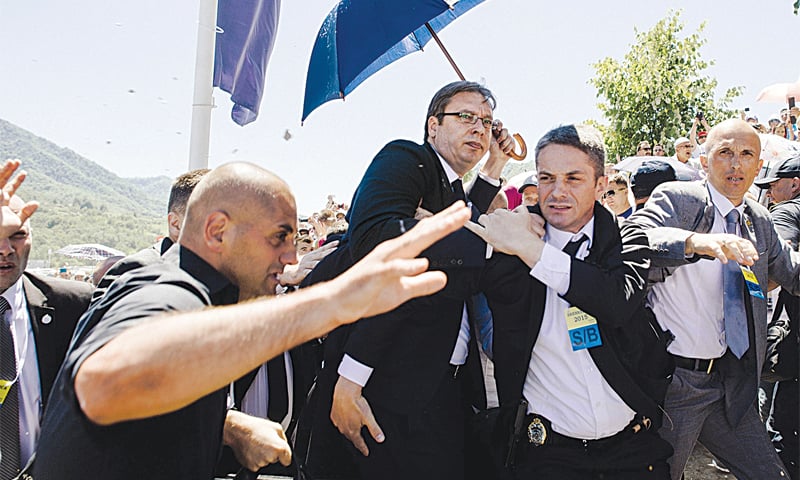
SREBRENICA: An angry crowd hurling stones and plastic bottles forced Serbia’s premier to flee a ceremony on Saturday marking the 20th anniversary of the Srebrenica massacre of some 8,000 Muslims in Bosnia, Europe’s worst atrocity since World War II.
Prime Minister Aleksandar Vucic had just laid flowers at a monument for the Bosnian Muslim men and boys killed and buried there when the crowd began chanting ‘Allahu Akbar’ and throwing stones.
Mr Vucic ran for cover shielded with umbrellas by his bodyguards who were hit by the hail of stones as the crowd also shouted insults at the Serbian leader.
Mr Vucic, whose country backed Bosnian Serbs during and after the 1990s inter-ethnic war in Bosnia, was among numerous dignitaries, including former US president Bill Clinton, and tens of thousands of people attending the commemoration in the eastern Bosnian town.
The prayers of an imam finally calmed the irate people in the crowd of mourners as their attention turned to the burial of newly identified massacre victims.
Mr Vucic had earlier “condemned the monstrous crime” in Srebrenica, where some 8,000 Muslim males were murdered by Bosnian Serb forces who had captured Srebrenica in July 1995, near the end of Bosnia’s war.
Serbia quickly reacted to the incident, calling it an attack against the country.
Srebrenica Mayor Camil Durakovic also condemned the attack, saying: “This is the work of sick minds who abused this solemn event.”
The Serbian premier returned to Belgrade where media had reported he was injured in the incident, but he told reporters that although a stone hit him in the mouth he was not hurt, while his eyeglasses fell and broke.
Serbian and Bosnian Serb politicians have long denied the extent of the killing in Srebrenica, although two international tribunals have described the bloodshed as genocide.
In 1995 Srebrenica was supposedly a UN-protected “safe haven” but the Bosnian Serb forces led by Ratko Mladic, now on trial for war crimes in The Hague, brushed aside the lightly armed Dutch UN peacekeepers.
The slaughter was followed a few months later by the Dayton peace deal, brokered by the Clinton administration, which ended the 1992-95 conflict that claimed some 100,000 lives.
US President Barack Obama spoke on Saturday of the need for “healing the wounds of the past” in a statement on the Srebrenica anniversary, saying that “only by fully acknowledging the past can we achieve a future of true and lasting reconciliation”.
Published in Dawn, July 12th, 2015
On a mobile phone? Get the Dawn Mobile App: Apple Store | Google Play