5
5



NECESSARY and welcome as it is for the state to take its law-and-order and judicial responsibilities more seriously, there is an unmistakable sense that politics is driving the many stunning revelations in Karachi at the moment.
From a bizarre, late-night televised confessional of a death-row convict to the interior minister dilating on the murder of Imran Farooq in London, there are important, disturbing facts coming to light — but few of those seem to be purely about the logic of law and order.
Consider just one fact: the interior minister, Nisar Ali Khan, has spoken about the murder of Imran Farooq, as though there have been sudden revelations.
In fact, for a while now, for years in fact, there has been speculation on the Imran Farooq front. Does the security establishment have in custody two men who may be connected to the murder in London?
If it does, why have they not been brought forward for so long to admit the crimes they may have committed? Surely, it belies the state’s attempt to bring to justice criminals as and when they are discovered, as opposed to prosecuting when it is politically convenient.
Beyond the Karachi episode, beyond the convenient timing of state intervention, there remains a troubling question. When will the powerful recesses of the state ever be brought to a position where they are made to act when evidence is unearthed, as opposed to when it is politically convenient or relevant to do so?
Surely, be it Karachi or Fata or Balochistan or Khyber Pakhtunkhwa, this country needs to evolve in a way where politics is fundamentally separate from institutional interests.
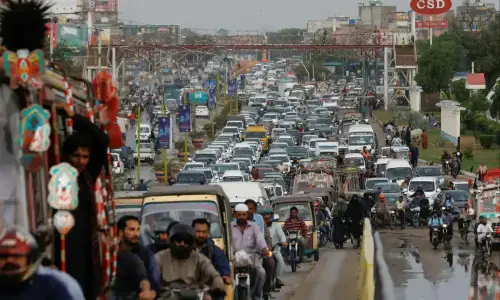
It is quite remarkable that a city of an estimated 20m individuals has been held hostage for so long, in so naked and ugly a fashion, as Karachi has — and to what end?
The myth of the dominance of one or more political parties, and possibly militant elements within, dominating Karachi has been shattered. But the denizens of Karachi — nationally, in fact — ought to ask why it has taken so long for the state to do its job.
In the midst of the overtly politicised actions on Karachi, and, now, possibly including the PPP, owing to sensational headlines created by a known criminal element, there is also a question that needs to be asked of the political parties that dominate urban and rural Sindh.
Why have those parties, be it the PPP, ANP, or sundry regional parties, not sought to rescue the erstwhile city of lights by the Arabian Sea from the ugly, parochial and violent politics that have dominated it for decades?
Surely, for all the misdeeds and unwise ideas that may emanate from certain, non-political quarters, the political leadership of Sindh needs to accept that it has failed the people of Sindh.
Published in Dawn, March 21st, 2015
On a mobile phone? Get the Dawn Mobile App: Apple Store | Google Play