1
1


IT is widely believed that intelligence agencies in Pakistan, both of the civilian and military variety, guard their ‘turf’ jealously. Yet considering the challenges militancy and violent crime pose to the country, such territorial attitudes must be abandoned in favour of greater intelligence convergence.
Fortunately, attitudes do seem to be changing as a few recent incidents have illustrated. As reported, security officials say information from the civilian-led Intelligence Bureau was instrumental in the recent raid on Nine Zero, the MQM’s Karachi headquarters.
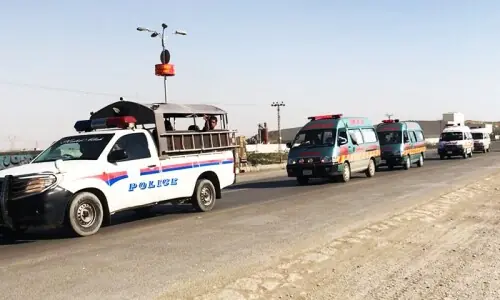
Sophisticated arms and suspects wanted in major crimes were recovered in the Rangers-led action.
Know more: Information collected by IB played vital role in raid on Nine Zero
The IB had been maintaining a database on suspected criminals within religious and political parties in Karachi.
Meanwhile last month, the interior minister told the National Assembly that a network planning to target Balochistan’s Hazara community had been busted thanks to collaboration between the IB and Inter-Services Intelligence.
While these are indeed intelligence successes, gaps still remain, as the bombing of two churches in Lahore on Sunday shows. As per the Punjab home minister, there was no previous information about the possibility of such attacks.
It would be correct to say that the Army Public School tragedy was what motivated the country’s various intelligence agencies to drop their territorial attitudes and combine forces for the sake of national security.
However, this collaboration must be a continuous exercise and not a temporary arrangement. The intelligence landscape in Pakistan has long been dominated by the military’s agencies, with the civilian outfits not given as much attention.
Whenever military regimes were in power the IB was neglected while during democratic set-ups the bureau was politicised.
Now, even though the military’s agencies may be leading the effort, perhaps the IB’s value in intelligence gathering is beginning to dawn on the security establishment. But more work is needed in the area of intelligence sharing; it needs to be a formalised affair instead of working on a case-to-case basis.
Cooperation among agencies must be the norm, not the exception. For this the National Counter-Terrorism Authority can play a major role. Unfortunately, Nacta is still largely inactive, thanks to reported manpower and financial problems, coupled with the state’s apparent lack of interest in making it an active concern.
For effective counterterrorism measures and long-lasting efforts against violent crime, the civilian and military agencies must continue their cooperation under Nacta, which should work as an independent and empowered entity focused on actionable intelligence gathering and sharing.\
Published in Dawn March 17th , 2015
On a mobile phone? Get the Dawn Mobile App: Apple Store | Google Play