6
6

WHEN tradition militates against the well-being of individuals, and runs counter to advances in scientific knowledge, it is time to let it go.
Too often though, tradition has many impassioned, blinkered defenders reluctant to discard time-honoured rituals and that is when the government can play an important role by legislating on the issue.
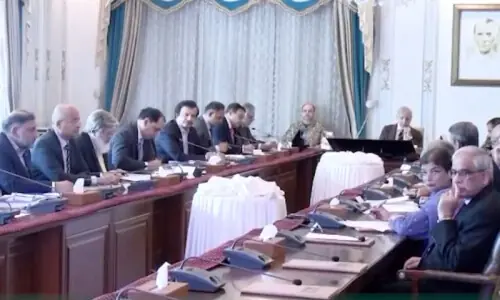
Thus on Wednesday, the Punjab government declared its intention to discuss amendments to the family law and raise the minimum age for girls from 16 to 18 years, as well as penalise the non-registration of marriage with a fine of Rs50,000 and make it mandatory for the bride and groom to produce CNICs to enter into a nuptial contract.
Also read: Punjab plans to raise marriage age for girls to 18
In most of Pakistan, the burden of being born female — with disadvantages of access to healthcare and education — is often compounded by the cross of early marriage.
In a patriarchal and stultifying social sphere that places a high premium on a female’s child-bearing role, millions of girls become wives and mothers before they are mentally or physically capable of the attendant challenges.
There are a number of health risks incurred by females thrust into such early unions, and resulting early motherhood, including obstetric fistula, death in childbirth and cervical cancer.
According to recent studies cited in a report in this paper, the latter is the second most common cancer afflicting Pakistani women, claiming a shocking 20 lives every single day. The country ranks seventh among countries with the highest rates of cervical cancer.
There is, therefore, more than one good reason to welcome the Punjab government’s initiative to review laws that impact girls and women in far-reaching ways.
The precedent was set by the Sindh Assembly in April last year when it passed the Child Marriage Restraint Act 2013, thereby making marriage below the age of 18 a punishable offence. Although changing hidebound attitudes takes time, at least there is now a legal framework to shore up and reinforce the effort. It would behove other provinces to follow suit.
Published in Dawn, January 30th, 2015
On a mobile phone? Get the Dawn Mobile App: Apple Store | Google Play