 KARACHI, April 16: School textbooks, printed by private publishers, are short in supply in the market and are being sold at a price five to 20 per cent higher than last year. A fall of 10 to 15 per cent in prices of a few textbooks of Sindh Textbook Board has brought some consolation this year for the parents.
A simultaneous rise in price of the copy books this year is proving to be the proverbial last straw on the camel’s back for many families with limited income who visit markets to buy a new set of books and copies for their children.
An official in the Oxford University Press told Dawn that the institution had increased the prices of books by only Rs5 per book this year owing to the increase in paper prices.
Other publishers have also increased the prices. For instance, Famous Publisher’s book, Drawing Series-1 for class-I is now sold at Rs25 as compared to Rs20. Social Studies Book-3 for class-III of Top Line Publisher is now available at Rs70 as against its previous price of Rs65. English Writing Series No. 5 of Rehbar Publisher is now sold at Rs22 as compared to Rs20. Understanding English of FEP for class-VI is selling at Rs175 as compared to Rs165. The hike in book prices have definitely made an impact on the bulk buying of course books.
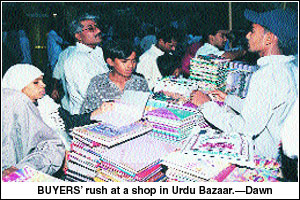
Urdu Bazaar, city’s oldest stationery market, now wears a festive look where people throng from remote areas to fulfil an essential obligation of purchasing books, copies and stationery items at any cost for their children.
Many parents said that they could save a good amount of money if they purchased courses directly from the bazaar instead of school shops.
Despite the fact that this price-hike is a one-time burden in a year, buyers complain that the five to 30 per cent increase in book prices was coupled with copy retailers’ tactics of fleecing them by demanding prices on their own.
Many parents say that majority of the private schools have bound their children to buy full courses from the schools’ shops.
They say that school-owners also obtain discount ranging between 20 and 40 per cent from the publishers on that ground that the ultimate beneficiaries would be the students. However, market sources and some publishers claim that majority of such schools charge the actual prices as printed on the books.
A taxi driver, whose four children study in a private school, said that the a full course of class-IV cost him Rs2,000-2,500 as compared to last year’s Rs1,500 for his other child.
To a query how he managed the home economics being a driver, he said he had to cut food and other expenses. “We have to use pulses instead of meat and also cheaper ghee and cooking oil, cheaper clothing etc.”
Shakil-ur-Rahman, who works in a bank in Dubai, said that his children were studying in reputed private schools. He had purchased books for fifth and sixth class for Rs1,800 as compared to last year’s cost of Rs1,400 while price of copies were Rs600 as against Rs400 last year. “We are buying courses for over Rs3,000 these days for our children and definitely the rates will be much higher in leading private schools,” he said. “I am managing it as I live in Dubai and earn handsome salary, but what about a common and middle-income group people who cannot think of imparting good education to their children in private schools,” he added.
Books are costly. But parents who have several children studying in different classes cannot pass on old books to the children promoted to those classes. The reason: Authors and publishers are in league in making minor changes to old editions and bringing out a new edition of the same book. An additional here and there, a coloured picture instead of black and white is all that is changed.
Children are under pressure from schools to buy the latest versions. Initially only the local small time authors and book publishers were known to fleece the parents this way. But looking at the high profits, even books produced by big names have resorted to this practice. A parent complains that aggregate bill for books for his child in class-VI costs Rs 2,500. He could have saved this money by transferring his older children’s books had the edition not been changed.
Parents say that their monthly budgets are also getting squeezed owing to rising fees in schools coupled with tuition and transportation fee and daily pocket money.
If a person earns Rs6,000 per month and his two children are studying in an average private schools, he has to manage at least Rs1,200 per month for school fees besides meeting other obligations and expenses, thus pushing up the monthly expense on education to Rs2,500. One can guess how much amount these essential expenses eat up a person’s monthly salary of Rs6,000 and only a handful of families are managing to provide education to their young ones by curtailing other daily expenses.
The fee structure of a good private school ranges between 1,000 and 1,500 per month and only those people can think of taking the costly ride who earn 10,000-12,000 per month and have two children. If they have three to four children, then their education expenses will rise to Rs7,000-8,000 per month.
The Chairman of Pakistan Publishers and Book Sellers Association (Sindh and Balochistan Zone), Nadeem Mazhar, and Convener of Book Publishers Standing Committee of the Association, Aziz Khalid, claim that the prices of books (class-I to X) of Sindh Textbook Board had declined by 10-20 per cent this year and quality of books had also improved. For the first time, the Board has distributed books free of cost for class-I to V under free education policy.
Mr Aziz was of the view that the price of private publishers’ books had gone up by 15-20 per cent as a result of 60 per cent increase in prices of paper produced by local mills. To a query as to why the books are costlier despite being exempted from sales tax, he said all the basic raw materials had 15 per cent sales tax. Besides, he added, utility charges had also gone up in recent years. He was of the view that more than 60 per cent schools were selling full course/books at their schools which was a wrong practice. He said that school owners were selling books because they thought that book sellers did not provide books on time.
An old and a leading copy producer in Urdu Bazaar said that the prices of copies had not witnessed any upward change. An average wholesale price of a copy ranges between Rs3 and 4 but retailers are fully exploiting the situation by charging Rs8-20 per copy on their own. Retailers are earning over 100 per cent profit and consumers are plainly paying higher prices.
Copy makers are divided in organized and unorganized sector. In organized sector, there are hardly five leading copy makers paying sales tax while there is a mushroom growth in informal sector which also evades sales tax. There is no difference of prices offered by both the sectors. But consumers are being cheated by informal sector copy makers who provide mediocre quality copies and lesser number of pages in them.
He said private schools were selling copies at Rs20 as compared to their actual market price of Rs 10.
In the last few years, opening of private schools has emerged as a lucrative business and an estimated 100-150 schools are opened every year in Karachi.
Currently there are 2,500-3,000 private schools in the city with more than 400,000 students having been enrolled.