0
0

 BAGHDAD, April 13: US troops battled the Iraqi army in Saddam Hussein’s home town of Tikrit on Sunday, sending attack helicopters and F-18 aircraft into the last significant town outside their control.
In Baghdad and Basra, life started returning to normal as Iraqis volunteered to help restore law and order, and rebuild the war-scarred cities. And in the northern oil hub of Kirkuk, US troops eased tensions after days of street violence.
But in the holy city of Najaf, friction between Muslim Shia factions flared. An aide to a top Shia scholar said an armed group surrounded his house and gave him 48 hours to leave.
Military planners had expected remnants of the Iraqi army and Baath party might mount a last stand in Tikrit, dominated by the clan of Saddam, who was born in a nearby village.
“This morning, Iraqi infantry came out of their holes to fight the Marines in their light armoured vehicles.
About 15 Iraqis died in that exchange, no Americans,” Matthew Fisher of Canada’s National Post newspaper told CNN from Tikrit.
After nightfall, US Marines battled Iraqi troops, including tanks, on the southern outskirts of the town.
“It’s a very, very significant attack. They’ve brought forward a great number of Cobra assault helicopters and there are Marine F-18s (aircraft) overhead,” Fisher said.
He said troops had been told there was a core of about 2,500 Republican Guard and Saddam Fedayeen in the town.
However, armed men in Tikrit told al-Jazeera television that tribal leaders were negotiating a ceasefire with US forces and that Iraqi troops and paramilitaries had left.
Gen Tommy Franks said that although the core Iraqi army had been destroyed, militia, death squads and foreign fighters were battling on.
“Until we have a sense that we have all of that under control, then we will probably not characterize the initial military phase as having been completed and the regime totally gone,” he told CNN.
US TROOP RESCUE: During their push to Saddam’s northern powerbase, the Marines rescued seven US soldiers missing since the third day of the 25-day war.
“The guards evidently were deserted by their officers, and the guards themselves brought the prisoners of war to the Marines,” said Lt Col Nick Morano at Marine headquarters southeast of Baghdad.
Four men and one woman were members of a maintenance company captured on March 23 when their convoy was ambushed. The other two were pilots whose Apache helicopter went down the same day.
Chief Warrant Officer Ronald Young Junior, 26, of Georgia, was among those rescued. His father told CNN: “It’s almost like Christmas, New Year’s and everything rolled into one.”
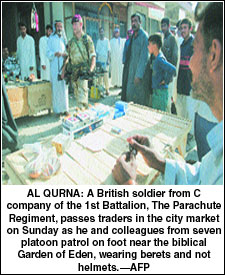
Normality slowly returned to Baghdad on Sunday, with street-traders and kiosks selling food and cigarettes for the first time since US troops seized the Iraqi capital.
Thousands of Iraqis who had fled the fighting drove back into the city with furniture and clothes strapped to their cars.
It was an emotional homecoming for 42-year-old Daoud Kashash Hussein. “I am so happy,” he said as he hugged his tearful 70-year-old father, who had remained in Baghdad.
Wasn’t his father, Kashash, afraid during the bombing? “War is war. At least now we don’t have a tyrant over us,” he said.
Anxious to restore calm to Baghdad, hundreds of Iraqi police and civil servants responded to US calls to meet in the city centre and discuss returning to service.
Iraqi officials said local police should gather on Monday at the police training college, health workers at a hospital and electricity workers at one of Baghdad’s power stations. There they would be assigned duties.
ORDER REPLACES CHAOS: In the southern city of Basra, streets that had seen widespread looting were visibly less tense after Iraqi policemen joined British military police trying to restore calm.
US Secretary of State Donald Rumsfeld told NBC’s “Meet the Press”: “Every hour that goes by it’s getting better and more peaceful and more orderly in that country.”
Saddam himself has gone to ground. Some people believe he may be in Tikrit or has fled abroad, others that he might be dead. Franks said the United States had Saddam’s DNA and would use it to check whether attempts to kill him had succeeded.
President George Bush warned Syria against offering Saddam safe haven. “Syria just needs to cooperate with the United States and our coalition partners, not harbour any Baathists, any military officials, any people who need to be held to account.”
As a degree of order returned to a number of areas, religious tensions flared in Najaf between Shia factions.
“Armed thugs and hooligans have had the house of (Grand) Ayatollah (Ali) Sistani under siege since yesterday,” said Ayatollah Abulqasim Dibaji. “Total terror reigns in Najaf.”
A mob hacked to death two Shia scholars in the city last week. Aware of sensitivities in the holy centre, US troops have kept their distance, but they will want to prevent any major infighting between Shia groups.
“This is the biggest catastrophe,” Dibaji said. “Najaf is a main centre of learning, like Oxford in England. It has more than 1,000 years of history.”
TENSIONS IN NORTH: Tensions also persisted in northern Iraq, where at least eight people were killed in running battles between US-allied Iraqi Kurds and Arab tribes still loyal to Saddam.
Kurdish fighters and tribal leaders said most of the fighting had been around the town of Huwaija, on the road between the oil centre of Kirkuk and Tikrit.
In Kirkuk itself, US tanks and armoured personnel carriers helped restore calm after a spasm of anarchy and vandalism.
The number of Kurdish “peshmerga” fighters also appeared to drop, fulfilling a pledge by Kurdish leaders to hand control of the city to the Americans and ease concern in Turkey.—Reuters