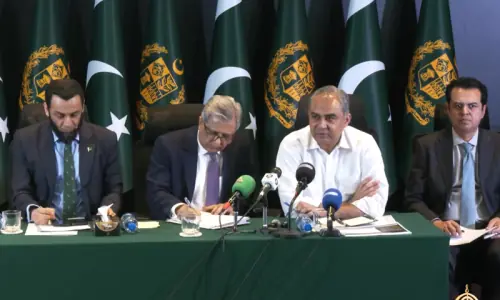
“What's in the nomenclature, it is not important; what are important are the issues. All eight segments being discussed in the composite dialogue will be part of the talks,” he said at a media briefing on the Saarc summit and a meeting between the prime ministers of Pakistan and India on its sidelines.
Mr Qureshi's claims that the change was limited only to the nomenclature contradicted reports in the Indian media that a new format for talks would be negotiated by foreign ministers and foreign secretaries in their meetings to be held in near future.
The foreign minister said “It exceeded our expectations. It is a concrete development and we'll build on it.”
During their 90-minute meeting in the Bhutanese capital of Thimphu on Thursday, Prime Minister Yousuf Raza Gilani and his Indian counterpart Dr Manmohan Singh agreed to resume peace dialogue and mandated their foreign secretaries and foreign ministers to draw up a roadmap for future talks.
Although Mr Qureshi stayed short of saying that Pakistan had agreed to drop the 'composite dialogue' title in return for India changing its hard-line position on normalisation of ties with Pakistan, he alluded to it, saying “The change in Indian thinking has to be appreciated.”
He emphasised that the change in title was in national interest. “What I'm advocating is in national interest; otherwise I wouldn't have done so.”
It may be mentioned that before the Feb 25 meeting of foreign secretaries, foreign policy managers had strongly advised against tinkering with the composite dialogue. They said that any change in the composite dialogue would be counter-productive because of the current political mood in India. Besides, such a change would not be in Pakistan's interest.
The foreign minister evaded a question about the 'thinking afresh' remark made by Indian External Affairs Secretary Nirupama Rao.
Foreign ministry sources told Dawn that the decision of accommodating India had been taken after the failed Feb 25 talks.
A cursory glance at Foreign Office documents shows that the expression of composite dialogue was phased out of Pakistani diplomatic vocabulary some time close to the Pak-US strategic dialogue, indicating that this could have been a result of American prodding.
After giving up the revival of 'composite dialogue' mantra, the Foreign Office started stressing the “need for meaningful engagement”.