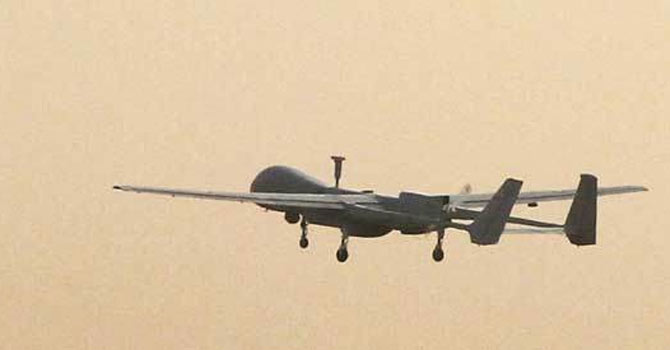
WASHINGTON: “As the frequency of drone strikes spikes again, some questions must be asked: How many of those targeted were terrorists?
Were any children harmed? And what is the standard of evidence to carry out these attacks?” says US Congressman Keith Ellison.
“The United States has to provide answers and Congress has a critical role to play,” he argues.
Mr Ellison, the only Muslim member of the US Congress, is a Democrat from Minnesota and has been a member of the House of Representatives since January 2007.
In a piece he wrote in Monday’s Washington Post, Mr Ellison notes that unmanned US aerial vehicles — or drones — reportedly killed eight people in rural Pakistan last week, bringing the estimated death toll from drone strikes in Pakistan this year to 35.
Highlighting his main differences with the drone programme, the Congressman says: “The heart of the problem is that our technological capability has far surpassed our policy.”
He points out that the US administration exercises unilateral authority over drone strikes against terrorists abroad. In some cases, President Obama approves each strike himself through “kill lists.”
While the president should be commended for creating explicit rules for the use of drones, “unilateral kill lists are unseemly and fraught with hazards,” he warns.
The congressman acknowledges that the drones have produced results -- eliminating 22 of Al Qaeda’s top 30 leaders and just last week took out a Taliban leader. The drones have also lessened the need to send American troops to a war zone, reducing the number of US casualties.
But he urges US policy--makers not to ignore the costs of these strikes.
Mr Ellison notes that a recent study by human rights experts at Stanford Law School and the New York University School of Law found that the number of innocent civilians killed by US drone strikes is much higher than what the US government has reported: approximately 700 since 2004, including almost 200 children. “This is unacceptable,” he warns.