1
1

ISLAMABAD: Pakistan hockey team’s manager Khwaja Junaid believes the upcoming Azlan Shah Cup could play a vital role in assessing the opposition for the London Olympic Games.
The seven-team event in Malaysia will bring Pakistan face-to-face with gold-medal contenders for the Olympics in July.
Apart from hosts Malaysia, Pakistan will face India, New Zealand, South Korea, as well as their Olympic group opponents Britain and Argentina.
“The event will provide an opportunity to our boys to watch the other teams closely,” Junaid said on Wednesday.
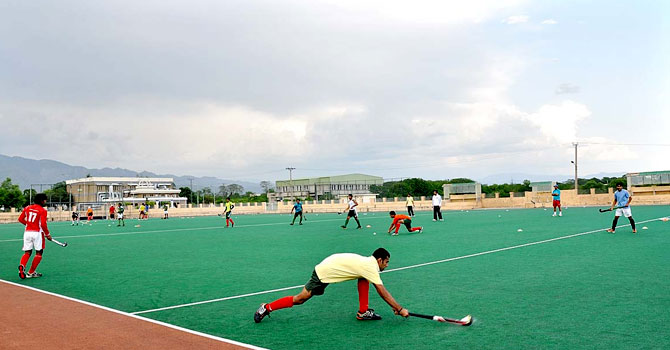
Members of the hockey squad are currently undergoing preparation for the Azlan Shah Cup at the National Hockey Stadium in Lahore, under head coach Akhtar Rasool. The team management is looking to help the players overcome technical flaws and improve on their performance in Ipoh.
“We are aiming to prepare a strong team for the London Olympics, for which we have adopted a step by step approach to strengthen the side,” Junaid said.
Pakistan, however, could face problems adjusting to the blue astroturf at the Games since the team has yet to practice on the new surface.
“The boys could have some problems adjusting and co-coordinating on the blue turf and with the yellow ball,” Junaid admitted.
Following the Malaysian event, Pakistan are expected to practice on the blue turf, which is being laid in Lahore and Junaid was confident his players will be able to familiarise themselves in time for the Olympics.
“I hope our players will adapt to the change in time before departing for the Olympics. We have to make sure we cover off all bases by the time we get there (London).”
The Punjab Sports Board has vowed to install a blue turf by May 20.
Olympic organisers believe the innovative decision to move away from the standard green-coloured turf will provide high levels of contrast for players, officials and spectators.
The pitches at the Hockey Centre in the Olympic Park will also feature pink run-off areas.
Historically played on natural grass, hockey made the move to synthetic pitches in the 1970s. The colour green was originally adopted to replicate the traditional playing environment, but now a wider range of colours are being used.