0
0


NEW DELHI: India hopes this week to join a select group of countries with intercontinental missiles by holding the first test flight of a new long-range nuclear-capable rocket, officials said Monday.
The Defence Research and Development Organisation (DRDO) said it plans the maiden launch of the Agni-V missile, which has a range of more than 5,000 kilometres, between Wednesday and Friday.
The exact launch date has not yet been set “because this is our longest-range missile and there are many logistics issues and hence we don’t plan for one (particular) day,” DRDO spokesman Ravi Gupta told AFP.
In the latest display of India’s growing military might, the test of the indigenously developed Agni-V will be carried out from a coastal range in the eastern state of Orissa.
“Agni-V is a 5,000-plus kilometre range missile and it is to meet our present-day threat perceptions, which are determined by our defence forces and other agencies,” Gupta said from the test site.
The Agni-V would in theory be able to strike targets across Asia and some parts of Europe. Only China, Russia, France, the United States, Great Britain and Israel are thought to have such long-distance missiles.
The weapons system was not developed to threaten any particular country, said DRDO spokesman Gupta.
“This is a deterrent to avoid wars and it is not country-specific,” he said. “Besides, India has a no-first-use policy,” he said, calling the country’s missile development programme “purely defensive.”The planned test flight comes after India launched last November the Agni-IV missile that can travel 3,500 kilometres and is capable of carrying a one-tonne nuclear warhead deep inside China.
India is among the world’s top 10 military spenders, with Jane’s Defence Weekly forecasting its total purchases between 2011 and 2015 will top $100 billion.
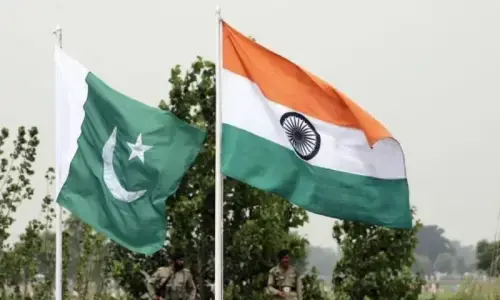
India has fought three wars with Pakistan since independence in 1947, but China is now viewed as the main focus of India’s military concerns.
The border between India and China has been the subject of inconclusive diplomatic talks since the 1980s after the two nations fought a brief, bloody war in 1962.
Indian military analyst Afsir Karim said since the country already has potential to strike China with the Agni-IV, the utility of the latest missile was unclear.
“I do not see any strategic value in developing this system except for upgrading India’s military prestige,” Karim, a retired army lieutenant-general, told AFP.
India staged a string of atomic detonations in 1998 and declared itself a nuclear-weapons state but it refuses to sign the Nuclear Non-Proliferation Treaty.
The country’s test plan has not attracted the international criticism aimed at reclusive North Korea, which last week carried out a rocket test that ended in failure.