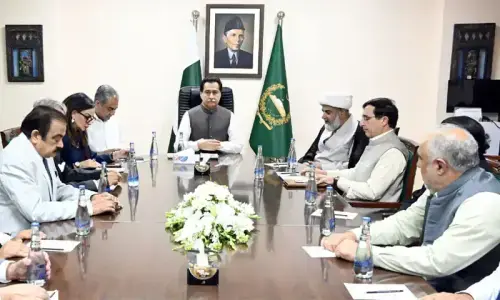
WASHINGTON: The delay in finalising parliamentary recommendations for US-Pakistan relations is causing confusion in Washington where the Obama administration seems unable to decide how to proceed with rebuilding this key relationship.
While the White House and the State Department say that they will wait patiently for Pakistan to complete the review, a senior US general told a congressional panel on Thursday that the United States would have to rely on India and the northern distribution network if Pakistan did not reopen Nato supply lines to Afghanistan.
“If we can’t negotiate or successfully negotiate the reopening of ground lines of communication with Pakistan, we have to default and rely on India and the northern distribution network,” said Lt-Gen Frank Panter, the Deputy Commandant for Installations and Logistics.
“Both are expensive propositions and it increases the deployment or redeployment,” the general told the Readiness Subcommittee of the House Armed Services Committee.
In earlier testimonies, other US generals have warned that the failure to reopen Pakistan routes could delay the schedule for withdrawing US combat troops from Afghanistan by 2014.
American political analysts, however, say that the Obama administration, which is seeking re-election later this year, will not want any delay as the war has already become very unpopular in America.
A CBS News/New York Times survey, released on Thursday, showed that the support for the Afghan war in America reached an all-time low in March with only 23 per cent backing continued US engagement while 69 per cent saying that now was the time to pullout troops.
Within the ruling Democratic Party, only 24 per cent said the war had been mostly a success and 18 per cent said the US was doing the right thing.
Increased pressure at home is obviously forcing the Obama administration to ensure that the troops are withdrawn as scheduled, if not before as 47 per cent Americans want.
“This has also increased their frustration with the delay in the Pakistani parliamentary process, even if they do not say so publicly,” said a diplomatic observer.
Meanwhile, CNN reported on Friday that the Obama administration was also talking to Pakistanis about possible changes in the way the US was conducting drone strikes in Fata.
They have offered to provide Pakistan advance notice of attacks, modify the targets and change how targets were determined.
CNN noted that the drone strikes had already reduced, although a fresh strike killed four militants in Fata on Friday.
Senate Intelligence Committee Chairman Dianne Feinstein told CNN she had no confidence that the relationship with Pakistan would smooth out any time soon.
Senator Feinstein is going to Pakistan early next month with a delegation from both Senate and House intelligence committees “to demonstrate the importance of the nations’ relationship and to re-enforce their shared national security objectives,” CNN reported.