0
0

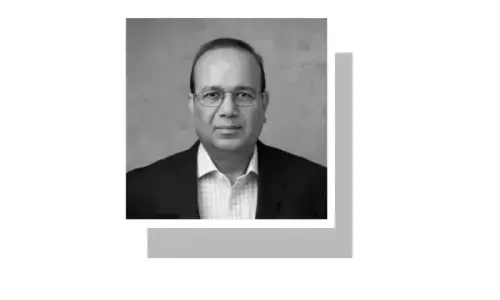
His gentle smile and unassuming demeanor doesn’t reveal the long list of awards and honours, he has accumulated over a forty-four year long career.
Fateh Muhammad Malik’s first was a gold medal in MA in Urdu from the Punjab University. Since then he has added a Sitara-e-Imtiaz (Literature, 2001), Iqbal Presidential Award (2003), Pakistan Writers Guild Award on Literary Criticism, Gold Medal in field of ‘Writers on Kashmir’, and Nazaria-e-Pakistan Council Gold Medal to his honours as well as having taught at places such as Quaid-e-Azam University, Islamabad, Columbia University, New York; University of Heidelberg, Germany and Saint Petersberg University, Russia.
At present he is the Rector of the International Islamic University, Islamabad and has also served as Chairman, National Language Authority, Cabinet Division, Islamabad.
The son of a school teacher, Fateh Muhammad grew up in a household that was passionate about learning. Thus it is no surprise that he ended up with an equally strong devotion to education and research.
He was born on June 18, 1936 in a small village Tehi, near Talagang where he spent his childhood playing in the streets and running around mustard fields. The educationist claimed that it was in this small village as a child that he learnt to look beyond the horizon, a habit that helped him acquire a broad vision.
No wonder then that by the time he turned ten, he had decided to support the Muslim League; he was chanting slogans in favour of this party at a time when most people around him supported and voted for the Congress party.
It was his interest in politics and the League that also led to Malik’s interest in Iqbal and his poetry at an early age; in fact his area of expertise is Iqbaliat.
A great fan of Quaid-i-Azam as well, Malik said he had written nearly a dozen books inspired by the ideas of these two thinkers.
His belief is that the secret to Pakistan’s progress lies in the ideas and thoughts of Iqbal, Jinnah and Sir Syed Ahmed Khan, who initiated the struggle to revive the Muslims of the Subcontinent.
Pointing out that these three men lived when the Muslims faced times that were harsher for the Muslims than the present; he added that they found ways to face the challenges confronting the community.
Sir Syed established the educational institution of Aligarh to get the Muslims back on the track of learning, science and education. Iqbal awakened them and gave them emotional and spiritual confidence by reminding Muslims of their glorious past. He fought the Muslims’ tendency to have blind faith in the clerics and advocated Ijtehad.
This is why Malik pushes for the youth to be taught the ideas of Iqbal and Jinnah.
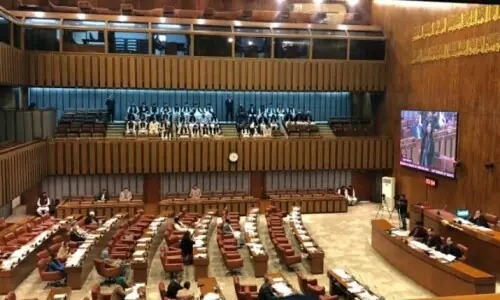
But as the interview ended, he added that the best thing that had happened in Pakistan was the democratic process that was on track. It must be allowed to strengthen with time, he added. “The assemblies will improve, once people realise how their votes decide who sits there.”
Only Iqbal’s concept of ‘khudi’ can save Pakistanis – once they realise that they can make their own destiny, he concluded.