ISLAMABAD, April 22: The capital's population has more than doubled since the last census in 1998.
The housing survey, conducted by the census department in collaboration with the Federal Directorate of Education and the local administration, estimates the capital's current population at 1.7 million. According to the 1998 census, population of Islamabad was 800,000.
“The survey is an initial work before the comprehensive national census by the end of current year,” said a senior official of the local administration.
The household survey is being conducted throughout the country.
Every city's administration has been tasked to collaborate with the census department for the houses' count.
The official said the survey's final report would be made public on April 25. “The survey was to be completed on April 19 but Prime Minister Yousuf Raza Gilani extended it by one week,” the official said.
At least 400 enumerators from the education department counted the number of houses in Islamabad, which has been divided into 14 sectors for the purpose.
The number of houses, according to the survey, has also increased sharply in the city. In some places 100 per cent rise has been registered.
“There is insignificant increase in the number of houses in developed resident sectors like F-6, F-7, F-8, G-6, G-7, G-8, and G-9,” the official said. “But 100 per cent increase has been seen in localities on the outskirts of the capital like Bhara Kahu, Banigala, Tarnol, Golra, and sectors I-11, G-11, G-12, F-12 and H-13.”
In the last decade, the city has been divided into rural and urban areas, leading to increasing its representation in the National Assembly from one to two seats. The neighboring Rawalpindi city, having a population of five million, has only two NA constituencies.
Replacing Karachi as the country's capital in 1967 and designed by Constantinos Doxiadis, Islamabad has an area of 907 sq km.
The government also plans to divide the capital into two districts apparently to meet a constitutional requirement amid fears that it would increase fiscal budget of local administration and police and put additional burden on the national exchequer.
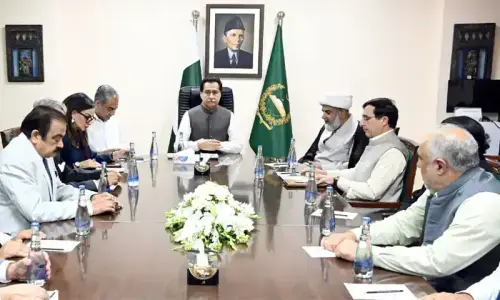
“We have finalised the plan to make two districts, District-East and District-West, and sent it to the interior ministry for approval,” said Chief Commissioner Islamabad Tariq Pirzada.
The bifurcation plan has been made in the light of Islamabad High Court (IHC) Act, which requires two district and sessions judges in the capital, instead of one in the existing local judiciary.
But under the Criminal Procedure Code (CrPC), two district and sessions judges cannot work in one district. That is why it has been suggested that without turning Islamabad into two separate districts, the constitutional requirement could not be fulfilled.
Under the plan sent to the interior ministry, all rural areas of the capital – its 11 union councils – would become District-East. Only the union council Shah Allah Ditta and the entire urban area will be District-West.
The present annual budget of both the local administration and police is more than Rs4.5 billion.