0
0

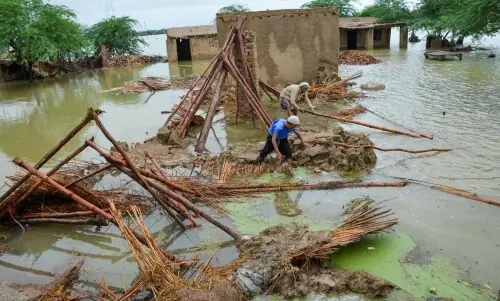
KOT ALMO (Thatta), March 7: An eerie silence still prevails in the village of Kot Almo located almost at the toe of Moolchand-Surjani Bund which had developed a massive breach in the last summer's great deluge and caused massive displacement, particularly in the area of Sujawal.
Inmates of 150 households of the village still reel from the shocks of that fateful night of Aug 26, 2010, which forced them to migrate to save their lives, shattering them economically and physically.
Kot Alam or Kot Almo was the first casualty besides other settlements in Thatta on the left bank the Indus where such a major breach occurred after Torhi breach.
Although the government has started repairing the dyke, villagers have doubts about quality of work. “Given experiment of Raj Wah which again developed breaches after repairs, we don't know what future holds for us when flooding season begins this year again,” argues Noor Ahmed, a small grower.
Villagers had to flee towards to Darro, a town located around seven kilo meters from Kot Almo, with their livestock, family members including elderly and women on the day the dyke breached.
Majority of them landed in Makli which then became the largest settlement of displaced population in Thatta. They even stayed in Makli necropolis, a historic graveyard which covers a diameter of eight to 10 kilo meters.
Noor Ahmed lost crop of paddy and cotton on 12 acres of land. After first landing in a camp, he decided to seek shelter in some relative's home.
“Kot Almo is a historic village because two villages of the same namesake were washed away in katcha area on the other side of dyke on the left bank in the past,” he says.
The village, inhibited by Memons and Syeds, has around 1,000 to 1,500 people who still feel harassed when they recall that terrible night.
Syed Abdul Razaque, who serves in Pakistan Army, still feels the pain to recall how Purdah observing women of his family had to pass sleepless nights under the open sky without proper privacy. “We moved to some acquaintance's house because the authorities were incapable to respond to needs of entire displaced population,” he said.
On their return after several days of the floods, the traumatized villagers found most of the houses and other infrastructure damaged or destroyed.
The government has promised to rebuild their houses, but the work has not begun yet. The villagers also await the second instalment of money under the Watan Card scheme committed by Prime Minister Yusuf Raza Gilani in Dadu during his visit to flood-hit areas. Noor Ahmed said that some families had not received the first instalment of Rs20,000 yet. “No one knows when the second instalment is going to land here,” he says.
He said that villagers told Sindh Minister Nadir Magsi, who is entrusted with supervision of dykes' repair work by the government, on Monday that they were not satisfied with quality of work that was seen in the repair of Raj Wah.
They are also faced with issues of healthcare. They have not got subsoil water of village tested but still they consume it because they have not other options.
A basic health unit (BHU) which villagers say is managed by the People's Primary Healthcare Initiative only offers normal medication. It has one male doctor who arrives there only thrice a week. Facilities of midwifery remain non-existent, although post of a female doctor is vacant.
Around 60 to 70 per cent of the households have returned but there are villagers who still live in other parts of the district in rents or with their relatives.