0
0

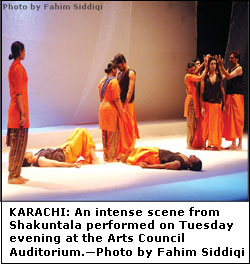 KARACHI, Dec 18: Adapting a 2,000-year-old play to modern times is no easy task even for seasoned actors. So when the students of the graduating class of the National Academy of Performing Arts were tasked with performing Kalidas’s Shakuntala, one was sure that they must have pushed themselves to the limit to live up to the high expectations of performing a classic.
Yet Zain Ahmed, the director of the play and Napa faculty member, decided to make the equation even more complex as the presentation of the play departed from the ‘usual’ manner in which theatre is generally performed in Pakistan: he worked music and dance into the script in a way that was quite unique and ditched conventional dialogue in favour of “the group acting as one to convey each scene”.
And perhaps because average Joes, such as this writer, are more accustomed to seeing plays performed in the ‘usual’ manner (good theatre in Karachi being a rare treat, anyway), this adaptation of Shakuntala was a tad difficult to follow at times.
Kalidas himself adapted the play from the epic Mahabharata. The plot follows Shakuntala, the title character, from her home in a forest ashram where she is spotted by the king Dushyant, courted and married. The king has to leave her to attend to affairs of the state and when Shakuntala fails to attend to a hermit visiting the ashram, he curses her so that Dushyant will forget her unless she shows him a ring he had gifted her upon their wedding.
The players spoke as one, as the group channelled their energies towards representing each of the characters. The enunciation of the dialogue, translated by Ahmed Himesh, was good, although at times there was a little overlap when several actors were speaking as one.
The lighting was very effective in illustrating the changes in mood as well as the transitions between scenes, while sound effects were used to perfection as the players made their way through the play without props.
But what set the performance apart was the intricate use of music and dance: elements of both these arts were fused to carry the experimental narrative forward. Three musicians – Alan Simon, Ahsan Bari and Joshua Fernandez of Taal Karisma and students of Napa’s music department – played live and were incredibly effective in supporting the actors. The actors themselves put up a commendable display of dance and movement techniques, along with the dialogue delivery, and also sang along to the musical pieces as a chorus. The songs were composed by two of the actors, Paras Mansoor and Aymen Ali.
As stated earlier, the play was certainly unconventional and at times tough to follow if one was not familiar with the original story. But in the words of the director, “some plays give up their secrets easily but others can take a more complicated route”.
The play, held at the Arts Council Auditorium here, will continue till Dec 20.—QAM