0
0

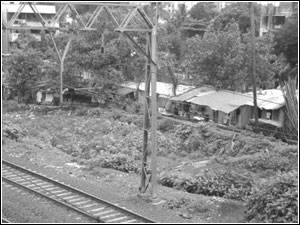 INDIAN Railways is the biggest landowner as its track network is spread across 63,000 km across the nation. But it also happens to be one of the most inefficient landlords, and has a terrible track-record of managing the vast tracts of land.
Even in cities like Mumbai, Delhi and Bangalore, where land is at a premium, the railways have mismanaged their estates, resulting in hundreds of acres being occupied illegally by the land mafia. After the land sharks ‘acquire’ the properties – obviously in league with some officials – they put up slum colonies and rent out the shelters to the poor and needy.
Once an illegal shanty comes up on public property, it is a time-consuming and near-impossible task to get them relocated. It is not just the courts and local politicians who are opposed to the forceful eviction of the occupants, but even international organisations like the World Bank do not extend funding in the absence of a resettlement of persons likely to be displaced by a project.
It is only recently that Indian Railways has realised the worth of the land owned by it. In places like Navi Mumbai, a satellite town on the outskirts of India’s financial and commercial capital, the railways have capitalised on their land holdings, putting up sprawling IT parks and office complexes on top of railway stations.
Of course, these developments occurred because of a smart joint venture partner, the Maharashtra government-owned City and Industrial Development Corporation (Cidco), which has been ensuring commercial exploitation of the land. Recently, Cidco and the railways auctioned off tens of acres of land outside new stations in Navi Mumbai, fetching them billions of rupees.
Similarly, in the national capital, the Delhi Metro Corporation – which has built an impressive mass rapid transit network – has been auctioning off land outside the new stations profitably, and top developers have built shopping malls and commercial office blocks.
Railway stations are prime commercial properties because of the fact that thousands of passengers traverse through them. Mumbai’s suburban railway network carries over six million passengers daily, many of who would prefer to do their daily shopping – for vegetables, fruits, groceries, and essential items – near the stations.
While Indian Railways failed to capitalise on this aspect, enterprising traders, hawkers and vendors have exploited it to the hilt. But hawkers and vendors occupy narrow corridors leading from the stations to bus stands, resulting in further congestion. In Mumbai, many of the railway over-bridges are also occupied by hawkers, who block the smooth flow of passenger traffic.
But the suburban railway management has now realised the potential in exploiting the little land that is still left with it, and is planning to auction off space above and below railway stations, and also in the neighbourhood.
Indian Railways, under the stewardship of Lalu Prasad Yadav – who has turned out to be a surprisingly shrewd and pragmatic minister – is now launching an ambitious expansion project. It plans to promote two major dedicated freight corridors – linking Delhi to Mumbai and Kolkata.
These access-controlled corridors would see high-speed freight trains lug cargo in modern containers, from and to the two major ports (Mumbai on the west coast, and Kollkata on the east) to the country’s heartland. Indian Railways has a pathetic track-record in cargo movement, and many private companies prefer sending their goods (including automobiles, consumer durables, industrial products, etc) by road – though the costs are higher – because of factors like safety and timely delivery.
Unfortunately, though Yadav announced the ambitious Delhi-Mumbai dedicated freight corridor ( the nearly 1,500-km-long corridor would cost about $7 billion) nearly two years ago, there has been little movement on the ground. A special purpose vehicle (SPV), the Dedicated Freight Corridor Corporation, was set up last year, but the project has been moving at a painstakingly slow pace.
The Indian Railways, managed by a board, is a top heavy and centralised organised, with little autonomy for divisional railways and other units. Even today, the Indian Parliament has to pass the railway budget, and even senior officers in other parts of the country have little freedom and have to approach the board for clearances.
Allegedly autonomous corporations set up by the railways have failed miserably, as bureaucrats in Delhi are loathe to the idea of allowing managers take decisions on their own. Organisations like the Delhi Metro Corporation, or the Konkan Railway – which built a new railway line along the western coast of the country – have survived and thrived thanks to the presence of strong chief executives who have refused to kowtow to the ‘babus’ in Delhi.
The managing director of Delhi Metro, E. Sreedharan, is a much-respected professional, who brooks no interference from any quarters. He built the metro in a record time, and has ensured its autonomy. Stung by an independent Delhi Metro boss, the railways were reluctant to allow autonomy for metros in other cities.
But state governments, who are joint venture partners in metro corporations, have managed to win independence for new corporations in cities like Mumbai and Bangalore. These mass rapid transit networks are being promoted under public-private partnerships, with private (including international) partners managing the show.
The delay in building the Delhi-Mumbai corridor will prove to be prohibitively expensive for one of the biggest projects being taken up in India. The Delhi-Mumbai Industrial Corridor (DMIC), which will come up along the freight corridor, envisages an investment of a whopping $90 billion over the next few years.
The corridor will see hundreds of industrial clusters, mega power plants, ports and airports come up along side. It is expected to generate three million jobs in the manufacturing and processing sectors, lead to the rapid industrialisation of at least half a dozen states, triple industrial output in the region and quadruple exports from the hinterland.
The corridor is being partly-financed by the Japanese government, and dozens of Japanese corporations are eager to invest in units and in the infrastructure. Last week, Akira Amari, Japan’s minister for economy, trade and industry, visited Delhi and Mumbai, and worked out the modalities of the mega project with Kamal Nath, India’s commerce and industries minister. He also met top industrial barons in Mumbai.
The project, which was conceptualised last December, when Indian Prime Minister Manmohan Singh visited Japan, is likely to kick off formally next month, during the official tour of Japanese Premier Shinzo Abe to India. Work on the project is expected to begin in January, and is likely to be completed within seven years.
According to Amari, the corridor will trigger off an “industrial revolution” in India. The Japanese delegation included top executives from leading companies including Suzuki Motor Corp, Honda Motor Company, Mitsui & Co, Sony Corporation and Hitachi Ltd. All of these corporations are eager to set up units, and hope to establish a regional base along the corridor, to service the European and African markets.
Of course, Indian government leaders, stung by the controversies relating to land acquisition for special economic zones (SEZs), have made it clear that the government would not be involved in acquiring land for the project. Investors will have to negotiate with farmers and landowners, to prevent the kind of violence that broke out in West Bengal recently.
Politicians and state governments are also lobbying for a piece. Nath, the federal minister – who is from Madhya Pradesh – was annoyed that the corridor would not cover his state. He warned that the project would not be a success if Madhya Pradesh – India’s largest state – was not included.
But analysts feel that the project – initially expected to cost around $50 billion – would become prohibitive if the government now decides to divert the corridor to other near-by states and cities. A direct route between the north Indian markets and the western coast ports would cut down travel time and also result in significant savings.
It remains to be seen whether the ambitious project will take off smoothly, and attract huge investments, or whether it will fall victim to petty politicking.