0
0

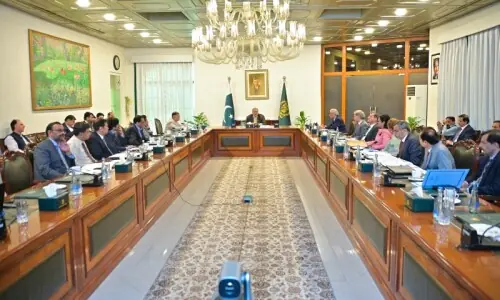
THAT government is finding it hard to face questions from business executives on uncontrollable high inflation and rising external sector deficit was more than evident on Thursday when two top functionaries—Dr Salman Shah, Advisor to Prime Minister on Finance, and Dr Shamshad Akhtar, Governor State Bank—failed to turn up at a seminar to share their perception on mid-term review of the economy.
Instead, Dr Ashfaq Ahmad Khan, the government advisor in the finance ministry made an unscheduled presentation on economic performance in last seven years which, he said, had won international recognition as “one of the fastest growing economies of Asia’’. He asserted that Pakistan is now on a higher growth trajectory. with: an average annual growth rate of seven per cent.
Its distinctive features as spelt out by him are (i) growth in exports and imports and a qualitative change in trade structure from consumption to production, (ii) phenomenal rise in revenue collection (ii) and an excellent debt management policy that has brought down debt- to- GDP ratio to 56 per cent in 2005-06 and is likely to be 52 per cent by end June next.
The seminar ended with questions about how the economic growth alone is justified when it promotes income inequalities, regional imbalances and back breaking inflation. ``Pakistan was declared a model economy for the world in the decade of sixties but hungry and impoverished people overthrew Ayub Khan’’ reminded Aftab Ahmad Khan, now a retired civil servant. He challenged government advisor’s assertions by declaring that any growth that promotes income inequalities, heats up economy to push up inflation and bring miseries to the people is worthless.
``In Pakistan, bureaucrats become conscious of peoples’ plight only after their retirement from service’’ quipped a business executive present in the seminar who appreciated this role because the politicians and political parties are not doing their job of educating public on economic issues.
``Food inflation in most of the countries carries hardly five or six per cent weight in the consumer price index’’ replied Dr. Ashfaq in a brief ten-minute question and answer session allowed by the organisers.. In Pakistan he said food inflation carries 40 per cent weight in Pakistan’s CPI. ``You cannot address this issue with monetary and fiscal tools’’ he said.
He endorsed a journalist’s view that food inflation in Pakistan is more a governance problem rather than economic as it demands improvement in supply chain system. Obviously, only a politician (minister or advisor) could have offered appropriate reply who was then missing from the scene. `Why in Pakistan, the food inflation constitutes 40 per cent of the CPI?’’ is a question that remained unanswered because it has lot to do with government claim of reducing poverty ratio by 10 per cent in last three years to 24 per cent. ``The World Bank says poverty ratio is Pakistan is 29 per cent’, Aftab Ahmad Khan said.
Food prices have a lot to do with governance has been repeatedly stated by State Bank of Pakistan in its annual and quarterly reports in last few years. In its latest report—annual report for 2005-06 released on December 2, 2006—the State Bank foresees harvesting of a bumper wheat crop but warns of ``speculators’’ who can play havoc and expects appropriate administrative measures to ensure a steady supply of grain to the market. In many of its previous reports, the State Bank has noted with concern the abuse of low interest loans in 2002 and 2003 by the speculators and suggested framing of anti-competitive laws to curb the trend..
How would one explain the lingering sugar crisis now in the fourth year. The milling capacity is more than four times of Pakistan’s demand and the sugarcane crop is giving good results. ``What’s the problem then’’? asks a harassed citizen. Then there is unending shortages of vegetables and pulses for last four years. The easy way to handle these shortages is to improve supply by allowing duty free imports. This leads to bulging food import bill and serves those traders who make quick buck from distress imports. Why has not agricultural reforms addressed this problem?
Dr Ashfaq’s assertion was that core inflation--that is non- food and non- energy inflation--was under control and is on decline, manifests the success of Pakistan’s monetary and fiscal policies. While energy cost remains beyond control of the government, Pakistan’s 2006-07 budget was drawn up on assumption of 68 dollars a barrel of crude and the prices have now come down to around $52 a barrel. By maintaining the previous inflated prices on oil products, the government is retaining savings at the cost of general public.
House rent is linked with construction and has to do a lot with cement prices and real estate business. With cement price spiral and speculators taking over real estate, the rent of low income localities are touching the sky.
The main budget expenditure components of a low income group are mainly food, house rent and transport. Since long, education and health care have become prohibitive for low income family and entertainment is no more a part of his life.
The government’s claim of reducing debt-GDP ratio is being questioned for last three years since the time national accounts were rebased in 2000-01. The size of the economy went up from about Rs3 trillion to about Rs6 trillion. Independent economists, reputed research organisations and a consultancy like Social Policy and Development Centre (SPDC) asked for sharing the modalities for rebasing national accounts which was refused. They say that the ratio of debt to GDP is down because of a rebased national economy.
But this has brought problems for the government too. The tax to GDP ratio is down to about 10-11 per cent. The ratios of saving and investment to the GDP are too dismal. So far as tax is concerned, reports suggest that the CBR is on a programme to explore new areas like agriculture, stock exchange and real estate.
Total collection of tax on agricultural income is hardly Rs1.5 billion. In the year 2,000 the IMF on the basis that agriculture is about 23 to 24 per cent of the economy has estimated tax potential at Rs8 to Rs9 billion a year. Punjab collects a little over Rs1 billion, Sindh about Rs220-250 million and NWFP about Rs120 million. There is no collection of agricultural income tax from Balochistan. It remains a burning a political issue for which obviously Dr Ashfaq had no answer.
Media reports suggest the transfer of CVT on real estate transactions to the provincial governments. Sindh started collection of a very small CVT on shares transaction through depository which evoked a lot of anger. The rich continue to defy taxation. Stock brokers have managed to get one more year of exemption from capital gain tax, as announced by Prime Minister recently. Who is then paying bulk of Rs835 billion taxes this year? The fixed wage earners and small businessmen and industrialists are paying taxes while the agriculturists, the speculators in stock exchanges and real estate dealers enjoy immunity.
In second generation reforms, the government intends to make judiciary, police and civil service more proactive and effective. The reforms also aims at improving competitiveness of the industry, promote transparency in economic decision making and further strengthening of tax administration.
``The economic landscape in Pakistan today is very different from yesteryears’’ declared Dr Ashfaq in his concluding remarks to which no one seemed to disagree. That Pakistan economy has resilience with prospects of a sustained growth is also now accepted by critics of the government. Equity and justice are missing from Pakistan’s taxation system and economic policies. It is for both the ruling coalition and opposition parties to draw up a road map to ensure that fruits of economic developments are shared by all.