0
0

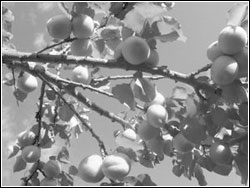 The Northern Areas (NAs) are blessed with ideal climatic conditions for cultivation of fruits like apricot. The availability of snow-melt fresh water, light textured soil, full-day sunshine, cool nights, and pest and disease-free conditions make this region ideal for fruit growing.
More than 2.72 million apricot trees on 6,370 hectares yield annual production of 1,07,737 tons. Apricot is the most popular and common fruit of the NAs.
The plant is deciduous, medium or large-sized tree, with spreading branches and dense canopy. The tree is stout and winter hardy; even flower buds can withstand temperature as low as -24C.
During the cool days, plants shed their leaves (the most sensitive parts which receive signals from surrounding environment and transfer them to plant) and remain dormant; 700-1000 chilling hours (below 7c) is crucial for breaking bud dormancy.
In Pakistan, apricot plant is grown from 200-3,000 meter elevation; but the quality of fruit is produced at higher elevation only. The NAs are home to millions of apricot trees but there are very few regular orchards. Mostly trees are planted on farm ridges, home yards, spring and water channels’ banks, roadside, foothills and uneven steep marginalised land.
Apricot trees bloom early after almond (February-April) depending on altitude and temperature of different valleys right from Chilas to Skardu. Flowers are pinkish white in colour, borne solitary on twigs (one year old branch) or short spur.
Fruit is small to medium size somewhat round in shape, creamy white to orange in colour, nearly glaborous (rough). Some varieties develop red cheeks that attract consumers. Apricots of the NAs are very sweet in taste; full-day sunshine which encourages more food (photosynthates) production, cool nights, high elevation and well drained soil, all contribute to its prized taste and quality.
Apricot can be grown on all types of soils but deep, fertile and well-drained sandy loam soil is the best. The tree can withstand moderately basic and saline soil but is prone to the presence of more water in root zone.
Soil of the NAs is generally deficient in major nutrients (NPK) required to plant in more amount and organic matter (less than one per cent). Light texture, shallowness and steepness of soil make it more vulnerable to water, wind erosion, which depletes the natural fertility.
Nutrients especially nitrogen, phosphorus and potassium are widespread deficient owing to basic parent materials, erosion and leaching with irrigation. In this area, fruit plants are scarcely fertilised. Production can be very easily boosted provided nutrients (organic and inorganic) are added on time and in balance proportion.
At planting time, only well decomposed compost at 40kg per plant is needed. Plant at the age of 1-2 years need to be fertilised with one kg urea, half kg DAP and one kg MOP with addition of 20-25kg compost. Up to five years, double of the above doze is recommended.
Afterwards, for best commercial production, fertiliser (urea, DAP, MOP) should be added at six, four and two kg per plant respectively, coupled with 20-25 kg compost.
Due to cool temperature, decomposition of FYM/compost remains slow, it can be expedited with the application of urea and covering the compost with polythene sheet for more heat trap.
Well-decomposed compost should be given to plant during December-January and thoroughly mixed with soil. It is not only a source of organic minerals but also works as soil conditioners by increasing water holding capacity and soil aeration. Inorganic fertilisers should be applied in split after leaf buds sprout and when fruit attains berry size.
After fruit harvest, plant photosynthates reserves are depleted so to invigorate the plant to withstand chilly temperature, slight dose of NPK is essential in commercial plants for fresh growth and more carbohydrates assimilation.
This area has more than 100 apricot varieties but the general trend is growing plant from seeds that do not retain its parental qualities and resultantly quality of fruit declines. Like other fruit trees, true to type quality apricot plants can only be raised through clonal propagation techniques.
Best quality scion varieties can be easily budded on different rootstocks e.g., apricot, peach and plum but in the NAs best results are achieved when plants are budded on wild apricot locally known as “Hari”. This rootstock provides good anchorage, produce medium-large size tree with good canopy and is resistant to several root diseases.
Apricot nursery should be raised in November and on germination in February-March, the plant should be kept weeds free. At pencil thickness selected scion varieties should be budded through T-budding technique, which is usually practiced in apricot with up to 95-100 per cent success. It should be carried out from May-August in this very area. Later on temperature drops restricting active growth, diminishing cell sap success chances.
For commercial plantation spacing of about 20x20 feet in square system is ideal which can be intercropped for initial years easily. Training and pruning is of utmost importance for this tree.
Due to lack of awareness there is no trend of training-pruning of trees in the NAs. Trees grow tall and shady; after several years of production declines. There is a misconception among growers that apricot ceases bearing after 10-12 years of fruiting. If the tree is regularly fertilised, pruned and properly managed, it keeps bearing for more than 30 years. The tree should be trained according to vase system, centre open and branches spreading outsides.
Apricot needs severe pruning every year and nearly 1/3 of fresh wood be removed in dormant stage. Apricot retains 40 per cent of the bloom; later on due to tense competition for food or embryo abortion, fruit drops, which need not be worried.
For good quality crop fruit should be thinned at berry size at 2-3 inches. Both these practices overcome the problems of alternate bearing. Alternate bearing is one of the major problems faced by growers in the Northern Areas. One-year tree remains fruit ridden while the other year production remains negligible. This problem can be easily overcome with best management practices.
Thinning fruit on twigs not only overcomes problem of biennial bearing but also improves quality and size. Tree should be trained for initial 4-5 years for open centre system where plant receives uniform sunlight and air circulation. This results in uniform fruit bearing on upper and lower branches and in uniform maturity.
Flat-head borers, bacterial and fungal diseases are biotic factors affecting the yield. The best way to control these menace with other practices is to avoid pesticides hazard. If necessary, suitable insecticide-fungicides should be sprayed judiciously at dormant stage and later at the appearance of symptoms. Diseased and infected twigs should be pruned and burnt.
Besides optimising production proper marketing is the key tool for harvesting maximum benefits. Apricot fruit is soft and perishable when ripe; so it needs more attention while picking for local and distant market. The fruit attains its best quality when fully ripened on tree but at this stage it needs more care for picking, packing and transportation.
To avoid post-harvest losses and market heaviness it is best to dry apricot. Dry apricot is sought after and remains in the market round the year. Recent estimates reveal that only in Gilgit market dry apricot trade exceeds Rs160 million. The fruit can be easily sun dried, addition of S2O adds more shelf-life and helps control disease/pest.
The consumer demand is more for non-sulphur treated apricot for their taste and quality. Solar dryer system developed by the Pakistan Agricultural Research Council scientists is the cheapest method which is simple and needs no energy to operate. Apricot dried through this system is dust-free and good looking, retains its taste and fetches good price. One kilogram dry apricot costs Rs80-100 in local market, depending on the quality.
Dried, cleaned and hygienically packed apricot can fetch growers additional income through minimizing post-harvest losses which are nearly 50 per cent (48,626 tons) in this area owing to unawareness and lack of handling facilities.