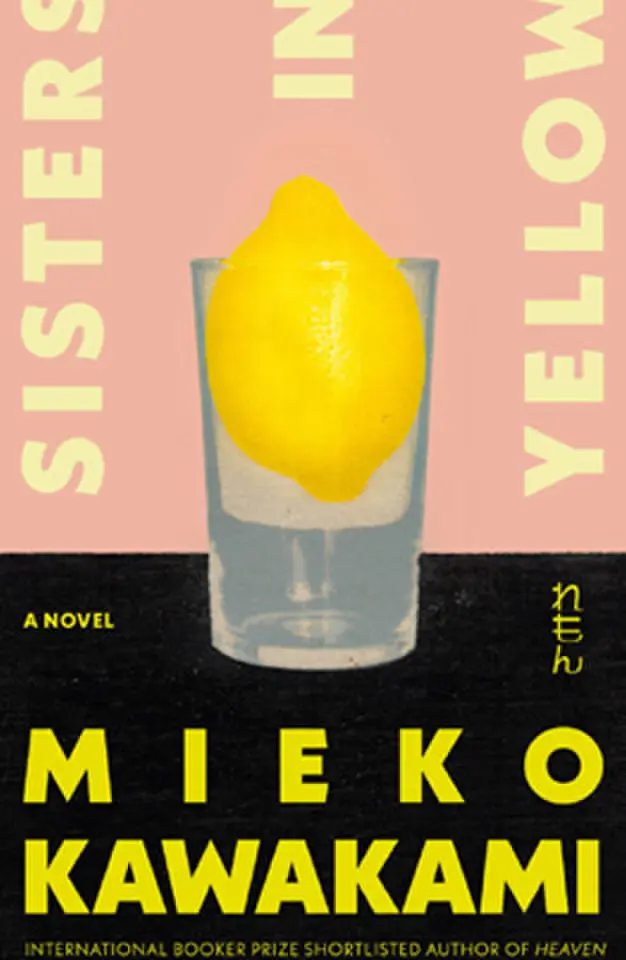
Sisters in Yellow
By Mieko Kawakami
Translated by Laurel Taylor and Hitomi Yoshio
Alfred A. Knopf
ISBN: 9780593537732
430pp.
The experience of reading Mieko Kawakami’s Breasts and Eggs (2019) has stayed with me. It was as if I had been slapped awake by a tender tale about two sisters — one a mother of a teenage daughter considering breast implants, and the other contemplating parenthood without a partner — that dismantled all my intimately held beliefs about women’s bodies, desire, motherhood and existence.
I immediately followed it up by reading Heaven (2009), to be moved by its raw and dark portrayal of adolescent relationships and trauma bonding. So, even before the algorithm littered my feed with news of the release of Kawakami’s latest work, I rushed to pick up Sisters in Yellow.
Originally published in Japanese in 2023, its English translation came out this year. Set in the throbbing urban landscape of Tokyo in the 1990s, the story follows the young narrator Hana Ito as she hustles and comes of age in this city, cycling through different money-making gigs with a tragic desperation, from waiting tables to running a dive bar to committing credit card fraud, thrown into one Kafkaesque situation after another.
Hana is appalled when she stumbles upon a news article about a friend she last saw two decades ago. Kimiko Yoshikawa is being tried for murder, kidnapping and assault, triggering Hana’s recollection of a lifetime that powers the rest of the novel.
A young girl living at the edge of Japanese society, craving emotional connection, financial security and a familial environment… Mieko Kawakami’s latest novel, now available in English, teases themes of class inequality, racism and poverty
Hana has grown up in an obscure Tokyo suburb, in a run-down apartment under a social, “upbeat” but aloof mother who works as a bar hostess and uses a tin box in the way of a bank account. Naturally, she grows up craving emotional connection, financial security and a familial environment. When one of her mom’s boyfriends vanishes with Hana’s savings, she leaves home in a fit of rage.
In a serendipitous turn of events, she is taken in by the peculiar and mesmerising Kimiko, her mother’s friend and nightlife colleague, whose arrival in Hana’s life feels like “someone had taken a piece of pencil-smudged notebook paper and carefully erased one white spot.” Together, the two of them set up a bar and name it Lemon because of its links with the colour yellow — a harbinger of luck and prosperity in Chinese feng shui.
Soon things start looking up for Hana and Kimiko as they gather a close-knit tribe of underdogs — the naïve and bumbling adolescents Ran and Momoko and the charming Kotomi — around themselves. Hana spends her days catering to sleazy customers, managing the bar’s accounts and riding the high of success.
She stows away her earnings in a navy shoebox, attending to the money with an alarming financial prudence and, later, a kind of neurotic obsession. In addition to cash and friends, she also collects various yellow trinkets for her “Yellow Corner”, a little shrine of luck. However, life as a runaway is riddled with caveats, as Hana learns of the fleeting nature of friendship and riches generated through shortcuts.
If one of fiction’s functions is to make philosophical conversations accessible to the reader, then Kawakami knows how to command her work in its service. Through sharp, discursive prose, rendered in Laurel Taylor and Hitomi Yoshio’s plain and alive English translation, she teases themes of class inequality, racism and poverty. There are also reflections on the fragility of the capitalist system and the concept of money as a social construct.
“Maybe the true form of money is movement. And when you needed money, it was only ever moving through you,” wonders Hana while sweating her way through the city to commit ATM fraud. “Money is power, and poverty is violence,” remarks Viv, the “unremarkable” gangster boss, over an expensive yakiniku dinner with Hana.
Here, Kawakami refrains from the extensive feminist philosophising that characterised much of Breasts and Eggs, and turns her attention to the underclass and the institutional neglect that creates it. Through Kimiko’s friend and confidante, Yeongsu, Hana not only learns of Kimiko’s own troubled past but also rubs shoulders with various players from Tokyo’s underworld, who prey on the city’s soft underbelly.
Through the narrator’s breathless encounters, Kawakami sketches for the reader the interconnected fiefdoms associated with the city’s organised crime scene. There are the yakuza, the tekiya cartel, bookkeepers and countless other conmen operating in plain sight, in addition to the undocumented, isolated segment of society, living “half-alive”. Through Lemon and Hana’s mother, the reader is offered a look at the precarious lives led by women in the perverted and cruel world of nightlife and male desire.
The strength of Kawakami’s writing is in the way she captures the complex, inner emotional worlds of her characters. I read on, regarding Hana’s saviour complex with a mix of disdain, concern and satisfaction. There are oppressively beautiful descriptions of youth in scenes depicting Hana’s bonding with other female characters and her yearning for emotional connection and acceptance.
However, there is also slight frustration. As Hana succumbs to fate, hopping jobs and running errands for the Japanese mafia, the novel often strays into crime noir territory while trying to keep a footing in the literary fiction ground, with the result that Kawakami’s endgame becomes unclear. There is no explicit plot and many mysteries surrounding characters are left unanswered. Strange, dramatic occurrences are presented throughout without any closure. Characters arrive in the story with so much potential, but leave with nothing to offer beyond back stories, memorable moments or networking opportunities.
The book mostly revolves around Hana’s twisted relationship with money and Kimiko, whose memory opens the book but soon becomes just one of the many trinkets in Hana’s Yellow Corner — symbolic but inconsequential. The desire to hold on to these two things blinds her, confounds her moral expectations, and eventually leads to her undoing, setting up the reader to expect some epiphanies on the part of the main character — none of which arrive.
Sisters in Yellow is an aching coming-of-age tale full of reflections on the fragmented nature of a materialistic society, but with many contradictions at its centre that it struggles to resolve. Perhaps it is trying less to be a story and more to mimic the “randomness and strangeness” of life that Kawakami is so keen on exploring in her works.
The reviewer is currently doing her masters in development economics in Germany, with a focus on gender and economic history. X: @maneehaa
Published in Dawn, Books & Authors, November 8th, 2026