Continuity in development policies vital amid global uncertainty: minister
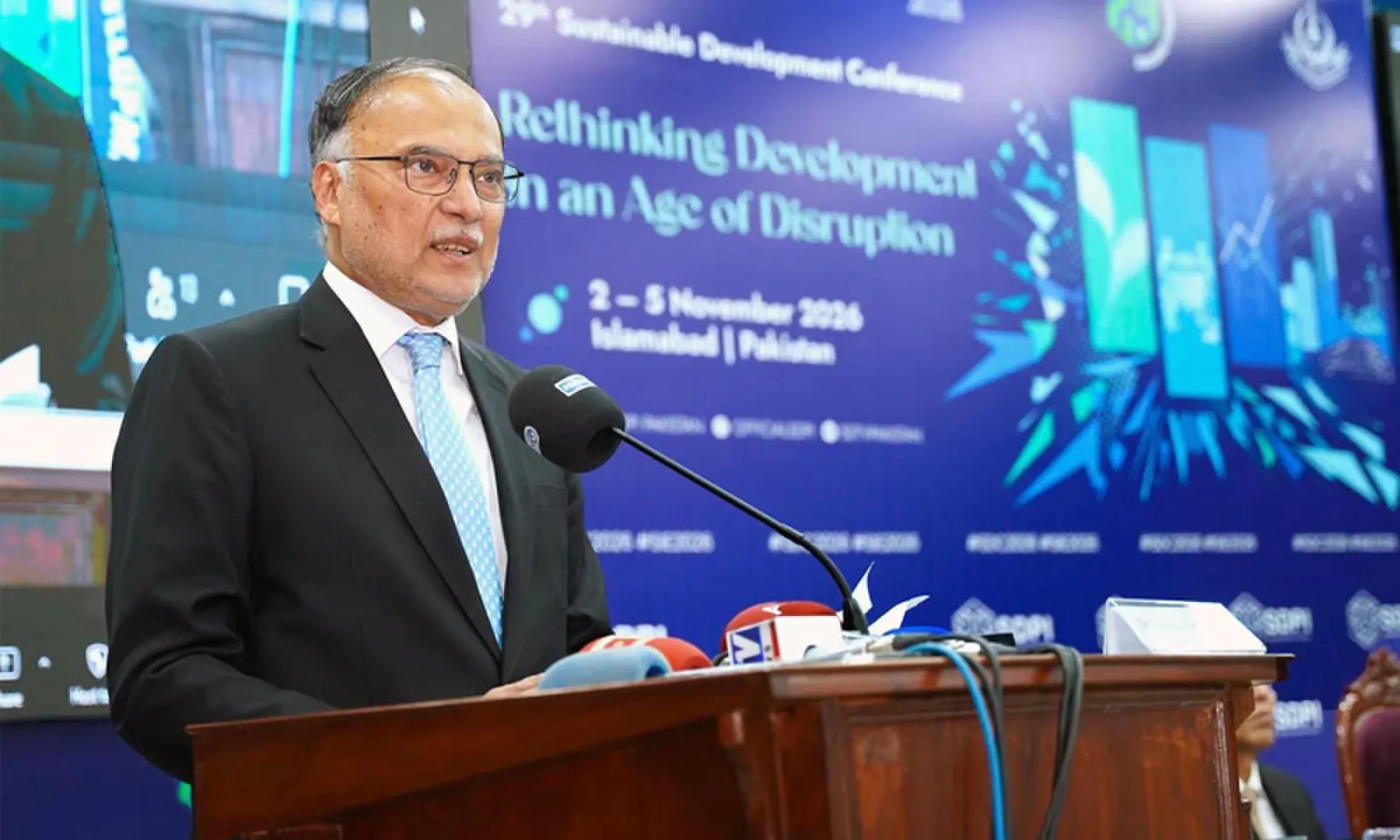
ISLAMABAD: Federal Minister for Planning, Development and Special Initiatives Professor Ahsan Iqbal on Monday said continuity in sustainable development policies, institutional preparedness and long-term strategic planning were essential for countries to navigate global uncertainty arising from emerging technologies, climate change, geopolitical tensions and economic challenges.
Addressing the 29th Sustainable Development Conference and 4th Sustainability Investment Expo, organised by the Sustainable Development Policy Institute (SDPI) at Allama Iqbal Open University, the minister said rapidly evolving technologies and growing climate challenges were fundamentally transforming economies and societies, requiring countries to adopt proactive and forward-looking strategies.
He said nations had two choices in the face of inevitable change: either remain apprehensive and suffer its consequences or develop proactive strategies to turn emerging challenges into opportunities.
Highlighting Pakistan’s commitment to technological advancement, he said the government had established national centres of excellence in artificial intelligence, cybersecurity, big data and cloud computing to equip the country’s youth with the skills required to compete in the rapidly evolving global economy.
Emphasising the growing link between geopolitics and economic stability, Mr Iqbal said conflicts and geopolitical rivalries, including the Russia-Ukraine war, were having far-reaching consequences for the global economy, affecting energy markets, food security, international trade and global supply chains.
Stronger Pakistan-China institutional cooperation
Federal Minister for Planning, Development and Special Initiatives Ahsan Iqbal has called for stronger institutional cooperation between Pakistan and China, saying political continuity, effective governance and people-centred development are essential for sustainable national progress.
“Pakistan’s political parties could draw valuable lessons from the Communist Party of China’s (CPC) emphasis on public service, self-reform, organisational discipline and long-term national planning,” he said while speaking at a symposium on Xi Jinping Thought on Party Building here on Monday.
Highlighting the importance of continuity in development, Mr Iqbal said Pakistan had paid a heavy price for abandoning sound policies whenever governments changed. He stressed that national development plans must rise above electoral cycles.
He said the first phase of the China-Pakistan Economic Corridor (CPEC) had translated a memorandum into approximately $25 billion in investment, delivering over 8,000 megawatts of electricity, 888 kilometres of highways and motorways, and around 236,000 direct and indirect jobs.
Referring to Uraan Pakistan and CPEC 2.0, he proposed five political corridors between the CPC and Pakistani political parties to complement the five economic corridors. These include strategic dialogue, governance and development learning, youth and leadership development, cultural connectivity, and regional peace and cooperation.
He also proposed reciprocal exchanges between young leaders of the CPC and Pakistani political parties, beginning with an initial cohort in 2027, including structured learning opportunities at China’s Central Party School.
Congratulating President Xi Jinping and the CPC on the successful conclusion of the Fifth Plenary Session of the 20th Central Committee, he said the 75th anniversary of Pakistan-China diplomatic relations provided an opportunity to open a new chapter of political and institutional cooperation.
Published in Dawn, November 3rd, 2026