Agriculture: The growing threat of double-rice cropping

Rice is Pakistan’s second-largest crop after wheat and the country’s largest agricultural export commodity. For decades, the Punjab government consistently enforced a ban on raising rice nurseries before May 20 under the Punjab Agricultural Pests Ordinance, 1959, and its 1960 Rules. Its violation was treated as a cognizable offence.
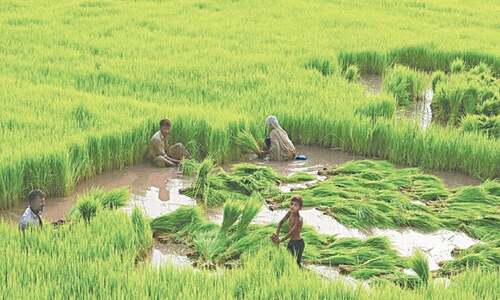
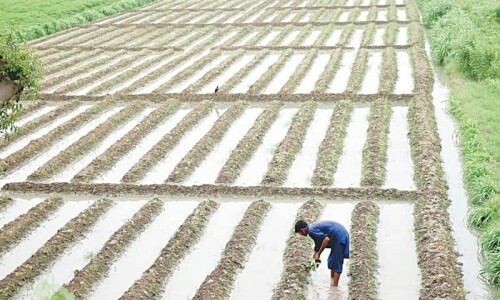
In recent years, however, the emergence of short-duration basmati and hybrid rice varieties in Pakistan, coupled with a lax enforcement regime, has encouraged farmers across several districts to grow two sequential rice crops — the first (early) from March-April to June-July, followed by the main (Kharif) crop from July to October. This double-rice cropping amplifies pest populations and enhances groundwater pumping to irrigate the water-intensive crop during the hot months.
Early rice cultivation has exposed a growing disconnect between the government’s regulatory framework and evolving cropping patterns. This trend suffered a temporary setback in 2024 when hybrid rice varieties – mostly imported – failed to withstand the high temperatures of May and June. The resulting yield losses, caused by widespread pollination failure and kernel abortion, inflicted heavy financial losses on farmers. In response, the federal government constituted a technical committee to investigate the failure of hybrid varieties. The committee recommended a complete ban on raising rice nurseries before May 20.
In the first week of March 2025, the Punjab government formally notified the ban on early rice cultivation, and district administrations actively ploughed rice nurseries in several districts. In response, many farmers rushed to plant maize as an alternative. They bought seed at sky-high prices from the black market. Yet, incomprehensibly, the provincial government lifted the ban on April 8, 2025, just as maize seed companies had sold off their stocks.
Confused govt policies and quick bucks are pushing farmers for two rice crops a year
Having learnt a lesson from the previous year’s crop failure, farmers who did not switch to spring maize shifted from temperature-sensitive hybrids to Kissan Basmati (1509) — an open-pollinated, short-duration variety that matures in 90 days -- to grow two successive rice crops.
Despite the committee’s findings and recommendations, the decision to permit early rice cultivation reflected a serious failure of policy continuity and regulatory oversight. It reversed a long-standing pest-management policy and encouraged double-rice cropping which is undermining the sector in several ways.
In 2026, the government neither articulated a clear stance on early rice cultivation nor deployed field staff from the agriculture department or district administration to enforce regulatory limits. Operating in a regulatory vacuum, growers pursued double rice-cropping unhindered.
Limited crop choices, potentially higher financial returns relative to competing crops, and, above all, the pursuit of a cropping intensity of three crops a year are among the major factors why farmers persist with this trend. Farmers are effectively gambling on early rice cultivation, despite knowing that yields remain highly vulnerable to weather conditions in May and June – at pollination and grain-filling stages.Farmers’ decisions cannot be viewed in isolation from the wider economic pressures confronting Pakistan’s agricultural sector. Rapid population growth, shrinking landholdings, and mounting financial constraints are compelling growers to extract maximum output from their acreage. In several districts of Punjab, cropping intensity has reached three crops a year, with the Sahiwal division being a prominent example. For many farmers, growing two successive rice crops alongside a third crop of wheat, canola, mustard, peas or any other Rabi crop – preferably short duration -- offers a way to intensify land use and boost annual earnings.
Given these economic imperatives, farmers are unwilling to abandon this cropping pattern voluntarily. Meanwhile, some experts and government officials argue that the state lacks the administrative capacity to regulate early rice cultivation at the grassroots level. Rather than introducing robust policy measures and strengthening enforcement, regulatory authorities appear content to wait until climate-induced heatwaves and recurring financial losses force farmers to abandon it on their own.
However, field reports of 2026 indicated that farmers who transplanted early rice in February-March following potatoes, peas or mustard obtained better yields and fetched good prices for their produce. This has further strengthened farmers’ confidence, which may lead to its widespread adoption in the coming year. Conversely early rice transplanted in April after wheat or canola performed poorly.
Harvesting of the main (Kharif) rice crop is currently underway in Punjab, and field reports from the districts of Pakpattan, Okara and Sahiwal –areas known for double-rice cropping –indicate severe pest infestations, particularly by stem borers and top borers. Consequently, their symptoms “whiteheads” and “dead hearts” are visible in almost every field. Despite repeated applications of potent pesticides, the majority of farmers have failed to control the pests and are reporting yields of just 20–35 maunds per acre. However, pesticide dealers are reporting significantly higher sales volumes this year.
If the area under the early rice crop expands further next year, it could pose a serious threat to the main rice crop, which covers a much larger acreage. The early crop acts as a bridge host, allowing stem borers and other pests to survive and multiply before the main crop is planted. Consequently, main-crop growers are confronted with a dual challenge: rising pesticide costs to control increased pest pressure, combined with declining overall yields. Such conditions threaten to render rice cultivation economically unviable.
Environmentalists warn that double-rice cropping is environmentally unsustainable. They are particularly concerned about rising pesticide use and mounting pressure on groundwater resources, accelerated by solar-powered tube wells.
In conclusion, the government must look beyond the narrow commercial interests of rice seed and agrochemical suppliers. It must adopt a clear, consistent policy and strictly enforce the ban on raising rice nurseries before May 20. If the trend continues amid the current regulatory vacuum, Pakistan risks diminishing returns—using far more agricultural inputs while producing less rice overall – alongside severe financial losses for all rice farmers, whether or not they have adopted double-rice cropping.
Khalid Wattoo is a development professional and Dr Waqar Ahmad is a former associate professor at the University of Agriculture, Faisalabad
Published in Dawn, The Business and Finance Weekly, October 19th, 2026