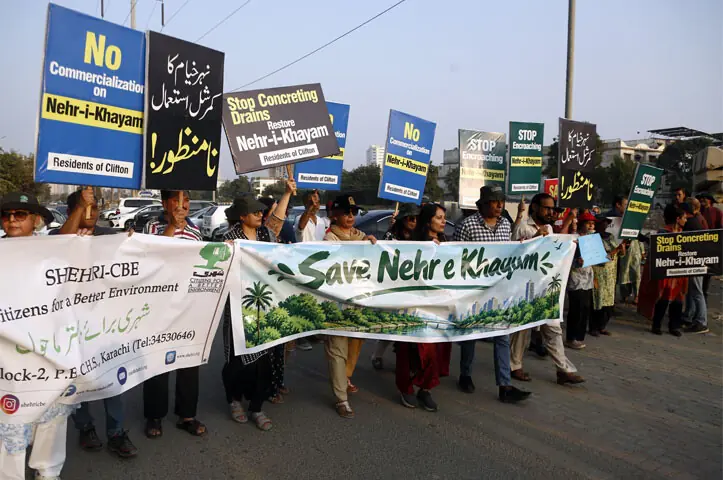
• Clifton residents, environmentalists stage rally to protest construction at key waterway
• Demand suspension of work until EIA is conducted and project details are made public
KARACHI: Expressing concern over construction at Nehr-i-Khayyam, an open drain in Clifton’s Block 5, residents and environmentalists from across the city held an awareness walk on Sunday, fearing that covering the drain would reduce its width and pave the way for “commercial activity”.
Holding placards with messages such as “Commercial use of Nehr-i-Khayyam not accepted” and “Stop concreting drains, restore Nehr-i-Khayyam”,“Save Nehr-i-Khayyam and stop urban flooding”, the participants gathered near the construction site and said trees had previously been present on both sides of the drain, but now remained on only one side, with just a few left along the stretch where construction was under way.
Dawn visited the site and observed that construction was underway on one side of the drain, where two columns had been built. Half of the columns had been plastered with cement, while T-shaped concrete blocks lay nearby.
Standing behind a banner bearing the words “Save Nehr-i-Khayyam”, Rasha Tarek, a protester and member of the Karachi Residents’ Community (District South), questioned the practice of discharging sewage into the waterway and then using its pollution to justify covering more than half of it.
“Where in the world do people discharge sewage into a waterway, then claim that its water is polluted and proceed to cover over half of it?” she asked.
She added that they had stood up for the city and urged everyone to unite to save the waterway. She also demanded an environmental impact assessment (EIA) and said residents should be informed about the project.
Masood Lohar, founder and CEO of the Clifton Urban Forest and an environmentalist, claimed that the project had been approved by the Sindh cabinet in 2019 for “recreational purposes”. He alleged that the construction was intended for commercial activity.
He said that if an EIA hearing had been held, its details should be made public and the authorities should disclose which civil society representatives or residents had been invited to attend.
Expressing concern, he said the authorities were blocking a major intertidal channel between two creeks, adding that the city had already been choked. He termed the matter a “national security issue”.
He warned that if Karachi received 250mm of rainfall, the port and important security installations could become dysfunctional.
Another environmentalist, Yasir Husain, said he had joined the protest to show solidarity with the community. He added that under the law, every government project should undergo an environmental assessment.
He said the purpose of the project remained unclear, as its details had not yet been shared.
Mr Husain said that a one-kilometre stretch of the drain, from Ocean Mall to Boat Basin, had suddenly been taken up for construction and a platform had now been built over it. He added he would file a right-to-information request to obtain details of the project. Meanwhile, he added, the protest would continue every weekend.
He said he had only been able to obtain information that the project fell under the local government department and was titled “Rehabilitation of Nehr-i-Khayyam, including diversion of sewerage water, district South”.
“This project is not about cleaning sewage,” he said, adding that “it is a commercial project, and the sewage will end up in the sea”.
Actor Tipu Sharif, who stood alongside other protesters, said he had been a resident of the area for the past 25 years. He claimed that over the past four years, he had witnessed rapid commercialisation in the area.
He questioned why the waterway could not be allowed to remain in its original form, asking, “If it was built as a waterway, why not let it remain one? Why is it necessary to cover everything with cement?”
He warned that the waterway had helped prevent rainwater from accumulating during heavy rainfall in the area. However, if it was covered, blocked or narrowed, garbage could obstruct the flow of rainwater and create problems during the rainy season.
In a press statement, residents of the area demanded the suspension of construction until the required environmental assessment had been conducted and approval obtained from the Sindh Environmental Protection Agency.
They also demanded the disclosure of project documents, including the design, and the preservation of the channel’s full original width and banks as open public land.
The statement further called for an end to the discharge of untreated sewage into the channel and demanded that wastewater be treated before reaching Boat Basin and the sea.
Published in Dawn, October 19th, 2026