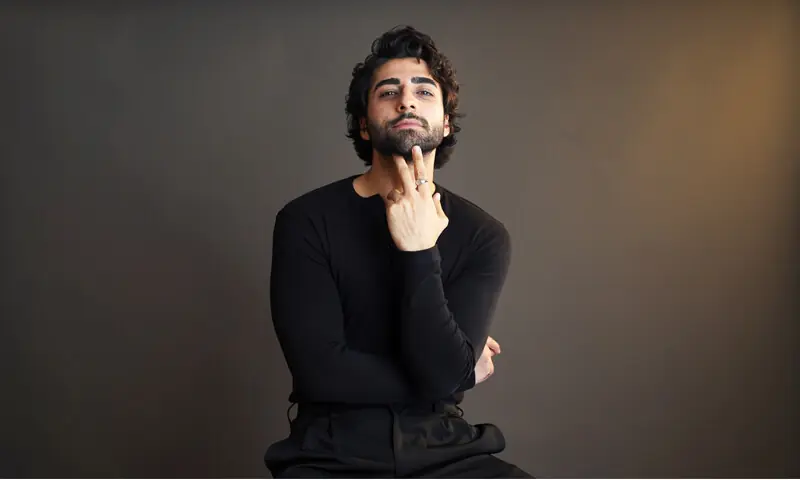
My meeting with Nameer Khan has a slightly unusual quality. We meet in his hotel room in Karachi, away from the noise and interruptions of public spaces. This is partly because stepping out in the current climate — given his toxic role of Zamil in the ongoing drama serial Dar-i-Nijaat — would probably have drawn the kind of attention neither of us wanted.
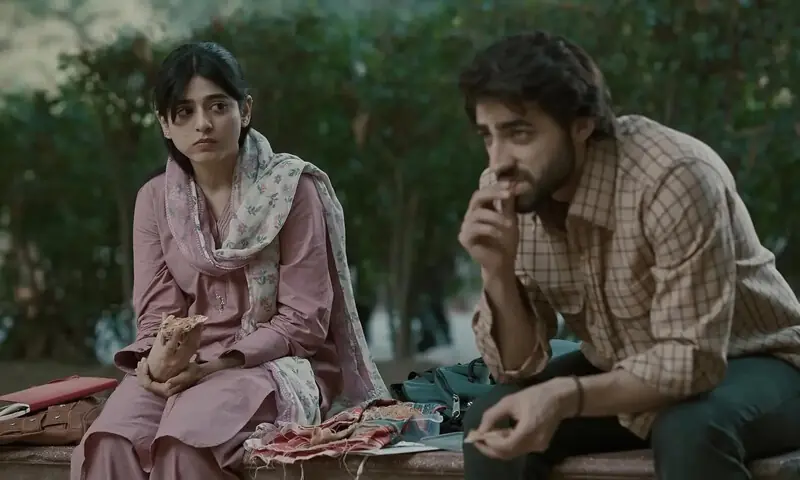
In Dar-i-Nijaat, Zamil has a physical relationship with his girlfriend, Zaryab (Durefishan Saleem), but becomes jealous when she introduces him to the pious Abu Bakar (Sheheryar Munawar). When Zaryab decides to marry Abu Bakar, Zamil tries to turn him against her in retaliation, but fails. That’s classic villainy, if you ask me. However, the person I am meeting seems more aligned with Abu Bakar than with Zamil.
This isn’t our first meeting. We also sat down for an interview a few months ago, just before Aik Aur Pakeezah ended, in which he played the role of Faraz. Back then, Nameer was clean-shaven, looked like a young Robert Downey Jr, and talked about his success in the industry.
Today, he sits in front of me as Zamil, bearded and the ultimate red flag in our society. As always, he speaks in measured tones, articulates intelligent answers and is extremely charming.
The characters he has played so far may be toxic, jealous and impossible to root for, but the young actor himself seems anything but. Does he yearn for roles closer to his own personality? As Zamil in Dar-i-Nijaat becomes his most talked-about role yet, Nameer Khan looks back at his unlikely journey from software engineering to TV…
INHABITING THE GREY
After his television debut in Main in 2023, Nameer moved on to Qarz-i-Jaan, Main Manto Nahin Hoon and Aik Aur Pakeezah, building a track record of playing characters that were rarely straightforward.
Although his negative role in Main was a supporting one, he shared the screen with Wahaj Ali and Ayeza Khan, while in Qarz-i-Jaan he was on equal footing with co-stars such as Yumna Zaidi and Usama Khan. His character in Qarz-i-Jaan, Ammar Bakhtiyar, was a spoilt brat who ended up in jail, but not before delivering a powerful monologue that touched both parents and children.
Main Manto Nahin Hoon followed, where he was again relegated to a supporting role alongside Humayun Saeed, Sajal Aly, Asif Raza Mir, Babar Ali, Saba Hameed, Azaan Sami Khan and Saima Noor. His growing fan base wasn’t happy with him playing Sajal Aly’s elder brother, but that experience “helped [him] understand the game.”
Now, with Zamil, he finds himself playing yet another morally complicated man — although, as he points out, that is hardly accidental.
“I connect with characters facing internal conflict because, in reality, none of us is entirely black or white — we’re all grey,” Nameer tells me. “Such roles feel relatable, give me more room to perform and challenge me as an actor. I’ve always wanted the industry to recognise me as a strong performer, and I believe I’m gradually getting there.”
That makes sense. If a thread runs through Nameer’s major roles, it is complexity and, although they inhabit different worlds, they are men with plenty going on beneath the surface.
“I’ve mostly played conflicted characters and haven’t yet explored a straightforward role,” he adds.
Which of the characters that he has played is the closest to him?
“Faraz in Aik Aur Pakeezah,” he shoots back immediately. “It was also the most challenging role I have played.”
That could well be because Faraz had multiple shades and there were too many similarities to Nameer’s own personality. Both grew up in Lahore, and both had to go against the tide to make their presence felt. Nameer’s eyes betrayed the conflicts that Faraz faced time and again and earned him sympathy from viewers.
With Zamil, the reaction has been different. The character has become one that audiences love to hate. Nameer himself has addressed Zamil’s behaviour publicly, urging men to be respectful, honest and accountable in relationships. However, today Nameer doesn’t seem particularly interested in shielding himself from criticism.
“Honestly, neither popularity nor criticism affects me much because I’m secure in my identity,” he explains. “I know both my strengths and my shortcomings. My life’s mantra is simple: if something costs you your peace, let it go.”
That attitude may explain why the current discussions about Zamil don’t seem to have rattled him. The actor understands that the audience’s anger, in a way, is evidence that the character has registered.
THE ACCIDENTAL ACTOR
Interestingly enough, Nameer didn’t always want to be an actor. He studied software engineering and had no ties to showbiz.
“I realised I wanted to become an actor during the first semester of studying for my master’s in engineering in Canada,” he reminisces. “I had no friends or family there, so, apart from studying and driving an Uber, I spent most of my time alone.
“That period of self-reflection made me realise I wasn’t cut out for a conventional nine-to-five job. I’m a free-spirited person. I value freedom and diverse experiences — I don’t enjoy a monotonous life. Acting gave me the chance to explore all of that.”
That self-realisation set in motion a momentous change in Nameer’s life. He returned to Pakistan and began the process of entering the media industry.
“I started my journey in 2020 with no connections and no idea how to enter the industry,” he recalls. “For the first three years, I was barely on the radar — I wasn’t getting auditions and would occasionally take on fashion shoots and runway modelling [between 2020 and 2022], which brought me some visibility. The Hum TV Awards, which I hosted in 2022, gave me further exposure, and eventually projects started coming my way.”
His first drama, Main, came in 2023. “For that reason people think I’ve been around for three years, but my journey so far has actually taken six,” he points out.
“Software engineering itself may not have helped me directly with acting, but moving to Canada, living alone and studying alongside people from diverse cultures certainly did,” he says. “It exposed me to a wide range of personalities and sharpened my observation — something every actor needs when preparing a character. Living alone also gave me the space to reflect on and observe people and life without distractions.”
There was also a practical advantage.
“Financially, software engineering helped me stay independent enough to say no to projects that didn’t feel right, even early in my career,” he says. “So, education gave me exposure, awareness and the ability to understand what to say, when to say it, and when not to.”
His family, he says, never stood in the way of his decision to leave a conventional career path. “My father would always say, ‘I know Nameer would never make a foolish decision.’ That trust meant a great deal to me. Knowing that my family believed in my judgement gave me the confidence to believe in myself and take the leap into acting.”
GETTING INTO THE CHARACTER’S SKIN
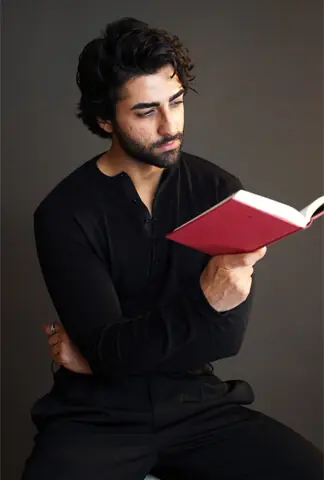
Nameer describes himself as an actor without formal training but says his work with established directors has served as his education.
“I’ve learned through experience, and it’s a process that continues with each project,” he says with humility.
Among the directors who have already shaped him, one stands out: Kashif Nisar, who directed Aik Aur Pakeezah. “I learned a lot of things from him that helped me become a stronger performer.”
We talk about how he prepares for his roles and it turns out that it isn’t based on a rigid acting method. “In addition to reading the entire script, I take notes about [the character’s] personality and listen to playlists of songs I have created that I think the character would listen to. The same goes for the perfume. If I am playing a poor character, I choose to wear a cheap perfume and an expensive cologne for a rich character to help me enter their world.”
Clearly, for Nameer, understanding the character’s mind matters more than memorising lines.
“During a scene, dialogue is secondary to me — the character’s thought process matters most. Once I understand what they’re thinking, it naturally shows in my eyes and reactions. That’s why there is often a contrast between what my characters say and what their eyes reveal, which I believe is very true to human nature.”
THE BUSINESS OF BECOMING AN ACTOR
Nameer’s rise has placed him alongside some of Pakistan’s leading actresses, including Ayeza Khan, Yumna Zaidi, Sajal Aly, Sehar Khan and Durefishan Saleem. He insists that this was never part of a deliberate strategy.
“I don’t think I consciously look for that when choosing a project — it’s something that has simply happened along the way,” he says.
“I’ve been fortunate to work with some incredibly talented female leads, but I’ve never really planned it that way. Sometimes, opportunities and people just come into your path at the right time, and you only understand their significance later. I’d rather let things unfold naturally and let time reveal the rest.”
However, he believes actors can no longer afford to ignore one thing: their online presence.
“A social media following can influence casting, but it depends on the project. For premium or passion projects, established directors and production houses rarely compromise on talent. That is why I continue to focus on improving my craft — talent consistently opens doors to strong opportunities.”
At the same time, he acknowledges that the business has changed.
“Commercials and brand endorsements are increasingly data-driven, so metrics and online reach matter greatly. Today, talent alone isn’t enough — a strong social media presence is essential as well. Your social media audience is a valuable asset that can create opportunities and support your career in the long term.”
That awareness hasn’t made him overly strategic about his image. If anything, he seems more interested in his work.
“When a script comes to me, I first consider the director, then the writer, my co-actors and then, finally, the DoP [Director of Photography].”
BEYOND ZAMIL
Away from television, Nameer’s ambitions are considerably less dramatic.
He still keeps one foot in the technology world, staying in touch with former colleagues and following developments in the field. He also plans to explore business, possibly trading, and continues to shuttle between Pakistan and Canada.
“Life can be unpredictable,” he says matter-of-factly.
For now, however, he devotes most of his time to his acting career. “Since I’m still early in my career, most of my time goes to work. There was a time when I had no opportunities, so now that I do, I want to make the most of them.”
When he gets a break, he spends it with his family. “Ultimately, my purpose is to become strong enough to support them and to always be there for my family.”
Nameer is a self-confessed foodie, partial to Italian food, burgers, and, naturally, pizza and pasta. He enjoys travelling, particularly for the exposure it offers, and is equally comfortable travelling solo or with his mother and siblings.
Fitness, meanwhile, is less of an obligation than a personal philosophy. “It’s something I genuinely enjoy,” he asserts. “Even if I weren’t acting, I would still prioritise it, as it strengthens the mind — the physical transformation is merely a by-product. My goals are to stay healthy, achieve financial security, enjoy life and support my family.”
His idea of leisure is also refreshingly simple: long solo drives, cricket, snooker and slow mornings. Regarding the latter, he says, “That is [one of the few times in the day] when I know the time is entirely mine.”
Does he spend his free time watching the dramas he works on? “Not at all. I prefer to travel.” Although he doesn’t read regularly, he is drawn to self-help books, usually in their summarised YouTube form.
His artistic influences are more specific. Ranbir Kapoor remains the actor he admires most, particularly for the expressiveness of his eyes, while Imtiaz Ali is among the directors he most hopes to collaborate with.
WHAT COMES NEXT?
His next role may, finally, take Nameer away from the grey, conflicted men who have defined his early career.
“You’ll get to see me in a very different setting next,” he says about his forthcoming project with Hania Aamir, directed by Badar Mehmood. “It’s a character I haven’t explored before, so I’m really looking forward to seeing how the audience responds to him.”
That change may be necessary. Actors who establish themselves through a particular type of character can quickly find themselves trapped with the same kinds of offers. Nameer, however, believes he has already demonstrated range.
“Each character I’ve played has offered something different.”
His solution to avoiding typecasting is simple: “Simply choosing scripts that offer a variety of characters.”
Perhaps that is the most appropriate way to understand Nameer’s career so far. The man sitting across from me is considerably less troubled than the men he portrays on television. Zamil may prompt viewers to question his choices, but Nameer himself appears remarkably comfortable with his own.
After all, he says, audiences still haven’t seen anything yet. And as the conversation ends, he adds: “I have an empathetic soul. I tend to feel things deeply and understand people’s perspective, even when I don’t agree with them. Perhaps that’s something that doesn’t always come through in the characters I play.”
For an actor whose career has so far been built on roles that are difficult to understand, that may be the most revealing thing he says.
The writer is a broadcast journalist who writes on sports, film, television and popular culture. X: @omair78
Published in Dawn, ICON, October 11th, 2026