Sindh Cabinet allows flour mills to hold wheat stocks for three months

• Millers are required to maintain flour price at Rs112 per kg, says Sharjeel
• Body formed to recommend DAP subsidy rates for growers during Rabi season
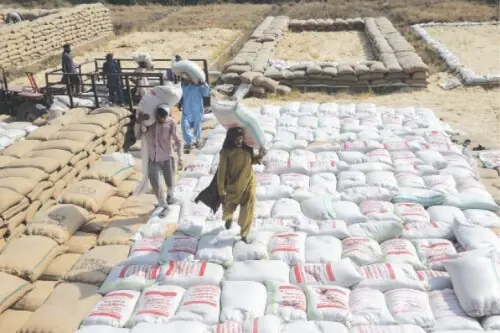
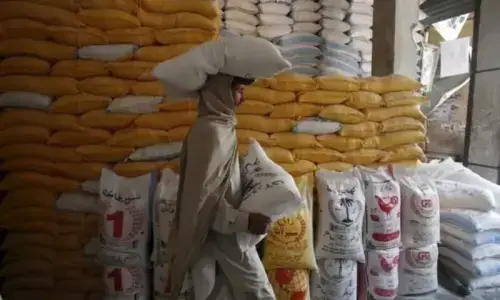
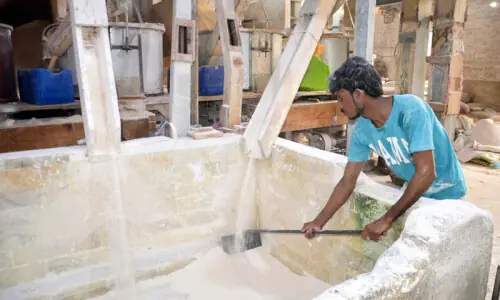
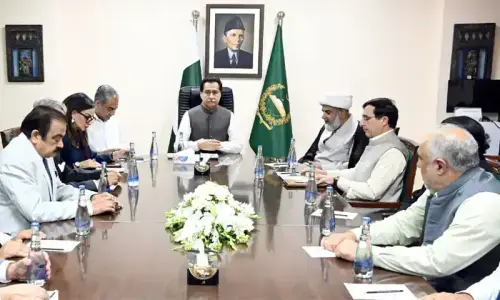
KARACHI: In an attempt to stabilise flour prices and shield farmers from rising input costs, the Sindh cabinet on Tuesday increased the wheat storage holding period for flour mills from one month to three months.
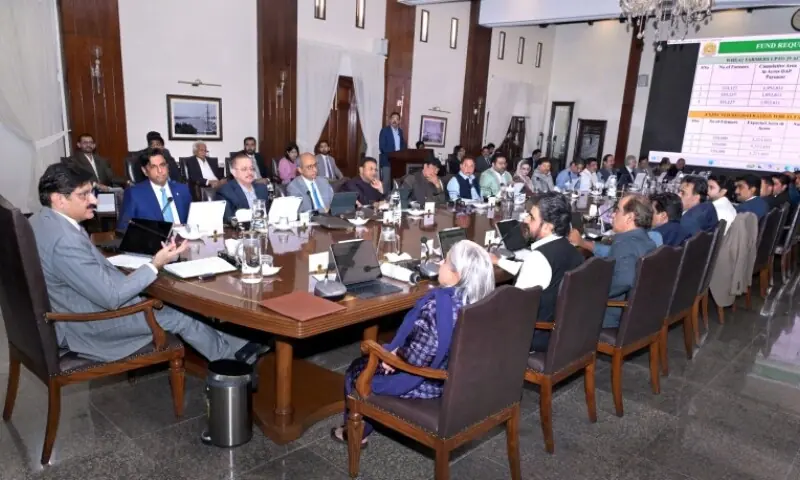
The cabinet meeting, chaired by Sindh Chief Minister Murad Ali Shah, also approved a Rs20 billion subsidy package for small growers with landholdings of up to 25 acres.
The decisions taken by the cabinet were announced by Sindh Senior Minister Sharjeel Inam Memon at a press conference here.
He told reporters that the decisions were taken to ensure food security and support growers. He said that the cabinet decided that it was mandatory to maintain the price of flour produced by the flour mills at Rs112 per kg.
The senior minister said that the burden of fluctuations in the global market would not be allowed to fall on the farmers. “The Sindh government will continue to support small and medium growers to safeguard food security and sustain agricultural productivity,” he added.
He said that in the previous phase, a subsidy of Rs45 billion had been provided for farmers, while a further subsidy of Rs20bn was now being provided.
DAP subsidy
A statement issued by the CM House said that the cabinet reviewed the anticipated increase in DAP fertiliser prices for the Rabi 2026-27 season due to international supply-chain disruptions. It approved a subsidy package for wheat growers owning up to 25 acres, along with fresh registrations and revalidation of existing farmers through land revenue authorities.
The chief minister said that a committee comprising Food Minister Mohammad Bux Khan Mahar, Irrigation Minister Jam Khan Shoro, Special Assistant Rahjvir Singh and Culture Minister Zulfiqar Shah was constituted to recommend DAP subsidy rates and the wheat support price, and to formulate a mechanism for the next procurement cycle.
The meeting was informed that the province’s total wheat availability for 2026 stood at 4.84 million metric tons (MMT), including 4.70 MMT of the current crop and 0.14 MMT of carry-forward stock.
The cabinet was informed that administrative action against hoarding had improved wheat visibility, with unaccounted stocks declining from an estimated 1.18 MMT in July to around 0.70 MMT by mid-August.
Inspection teams visited more than 800 locations and seized 257,738 tonnes of undeclared wheat, while approximately 0.19 MMT was confiscated during enforcement operations.
It also approved the utilisation of 56,729 tonnes of wheat seized from mills in Sukkur and Larkana divisions for local atta production.
Rs441.9m okayed for intelligence fusion centre
The cabinet sanctioned an additional Rs441.9 million to meet the funding shortfall for the Provincial Intelligence Fusion and Threat Assessment Centre (PIFTAC).
The amount would be spent on a state-of-the-art data centre, nerve centre, AI hub and upgraded field coordination rooms.
The cabinet also approved an exemption from procurement rules to engage the National Radio and Telecommunication Corporation (NRTC) on a government-to-government basis.
It also approved the terms and conditions for the chairman and members of the Sindh Electric Power Regulatory Authority (Sepra) for a four-year tenure.
The cabinet also approved the draft Service Level Agreement for the World Bank-supported Sindh Transformational Accelerated Rural Services – Water, Sanitation and Hygiene (STARS-WASH) programme to be implemented by the Sindh Peoples Housing for Flood Affectees (SPHF).
Under the agreement, SPHF will plan, construct, operate and maintain WASH infrastructure for six years. Phase-I will cover Khairpur, Jamshoro, Badin and Naushahro Feroze, benefiting an estimated 1.2 to 1.5 million people.
The cabinet further approved the takeover of the operation and maintenance of the 193-km Naukot-Mithi-Islamkot-Nangarparkar-Chelhar water supply system by the public health engineering department. A committee under Local Government Minister Nasir Shah was formed to assess the water requirement of the area.
Sharjeel prays for Imran’s health
Responding to questions at the presser, the senior minister said he was praying for PTI founder Imran Khan’s health. “Political differences have their place, but decency and humanity should not be abandoned because of someone’s illness.”
To a question, he said that the province was currently facing shortages of water, gas and electricity. “Sindh produces gas but is itself facing gas load shedding,” he said, adding that the water shortage in the province was not a minor issue but a matter concerning the basic needs of the people.
Published in Dawn, August 19th, 2026