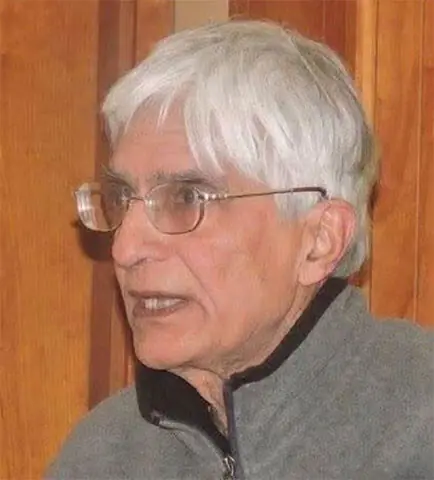
It is just a coincidence, but not without a symbolic significance. Progressive intellectual, journalist and teacher Prof Amin Mughal slipped away into the great beyond on a day when people in Europe, including Britain, were witnessing a solar eclipse. Like the eclipse that remained invisible in our part of the world, the passing away of the 91-year-old activist living in exile in London for over 40 years went almost unnoticed on our public media. Ironically, few of his compatriots even know that from the start of his exile in 1983, he had clung to his Pakistani passport throughout, refusing to apply for grant of British nationality.
Born in the Sialkot suburb of Kotli Loharan Mashriqi in 1935, a young Mohammad Amin, known as Amin Mughal in later life, got his early education in Jabalpur in Madhya Pradesh where his father was posted as a VCO (present day JCO) in the army. This was followed by matriculation from a public school in his native town and higher education in Murray College, Sialkot and Government College, Lahore (now GCU), leading to a master’s degree in English. It was in Murray College, however, that he forged some of his life-long friendships. One such friend was Zamurrad Malik, a teacher of English and a formidable poet of Punjabi who, on his untimely death, was showered with glowing praise by Amrita Pritam, the creator of immortal lines ‘Aj Aakhan Waris Shah Nu’.
How Zamurrad Malik played a seminal role in giving shape to my own worldview as a student in Jinnah Islamia College, Sialkot, is a story for another day. What is relevant is that it was from him that I would hear Amin Moghul’s name off and on in our ‘daily conferences’. That Amin Sahib wore many feathers in his hat, one of them as a trade unionist, became vividly clear to me on a cold January morning in 1971. By my reckoning, what happened was in the run-up to our military action in former East Pakistan, unleashed some 73 days and a few hours later.
Our BA Final class was in progress in a Jinnah Islamia College lecture theatre, only yards away from the principal’s office, when a police contingent forced entry into the classroom and resorted to, what looked like, a full dress rehearsal of a large-scale baton charge. An official handout, later on, implied that the action had been provoked by a clash outside another local college. Luckily, our lecturer was in his usual academic gown, which became his instrument of personal safety. But not so in case of some other senior staff members, including Zamurrad Malik, who had vehemently protested against the police excesses.
“A baton charge is meant for dispersing a violent crowd, so what is the point in hand picking the boys for individual thrashing?” he asked. Needless to say, he was taken into custody along with two of his colleagues who supported him. In the wake of the police action, more than 80 students were also arrested on the spot. And that is what triggered Amin Mughal’s proxy but instant role as a trade unionist.
Along with half a dozen other students, I had gone to the city police headquarters on the top of Sialkot Fort to see my teachers and co-collegians when Zamurrad Sahib slipped a piece of paper to me.
“It’s an Express telegram to be sent to Prof Amin Mughal, the secretary-general of the West Pakistan College Teachers’ Association.” He must have swished some magic wand as all the three teachers were set free before the nightfall, followed by the students’ release within two days. But how was Amin Mughal able to retain simultaneously the leadership of the teachers’ body and his office as the National Awami Party’s provincial secretary?
For a response, one has to leave aside fifty plus years of camaraderie with Amin Mughal in Pakistan and the UK and fast-forward the narrative to our last years’ mirthful conversation which went on for several hours at ‘Five Bells’ - a public house situated close to his flat in Finchley, and to which he was said have a 24/7 secret key.
“When the government nationalised our Shah Hussain College, founded by Pof Manzoor Ahmed, Eric Cyprian and me, I suggested to my lawyer Mian Mahmood Ali Kasuri to file a petition asking for my permission to take part in politics despite being a newly-engaged government servant, resulting from nationalisation.”
“Sir, what was your line argument?”
“A university teacher in Britain is at liberty to be politically active. So, why not in Pakistan?” Kasuri Sahib was amused but he didn’t buy my argument and said, “We don’t have a local precedent to support your stance.”
“Then what did you do?”
“I decided to resign as an assistant professor of the newly nationalised Shah Hussain College while continuing my job at Viewpoint under Mazhar Ali Khan’s editorship. I didn’t hear back from the government for months together. One day, Mazhar Ali Khan went to see the education secretary who was somehow personally known to him … Mazhar Sahib came back with the horrifying update that a decision was still pending because your name had found mention in a list to mischief mongers, out to wage sectarian riots.”
“What next, sir?”
“The rest is history. Good night.”
(The author is a senior journalist.)
Published in Dawn, August 17th, 2026