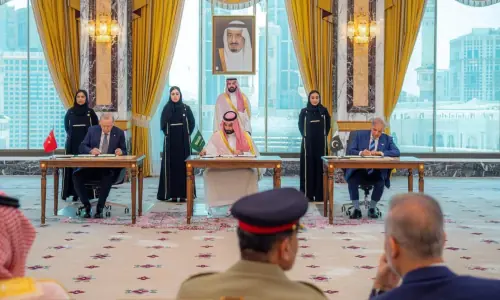


THE Makkah Joint Defence Agreement, signed by Pakistan, Saudi Arabia and Turkiye on Aug 7, stands out for one clause: an attack on any of the three countries is an attack on all. Coming in the wake of the recent tensions in the Middle East, this agreement has the potential to reshape the strategic layout of the region. Pakistan’s foreign ministry has described the agreement as a reflection of a “shared commitment” to further strengthen the “collective security” of the region.
Understandably, the Makkah Agreement does not give the specifics of the commitments that each side has made. Such matters lie in the realm of operational details that are generally kept confidential. What is, however, clear is that it is not a military bloc. Nor is it aimed at any specific country. Since these three countries have different threat perceptions, the agreement seems to be an attempt to enhance their collective deterrence and defence capabilities to deal with any aggression.
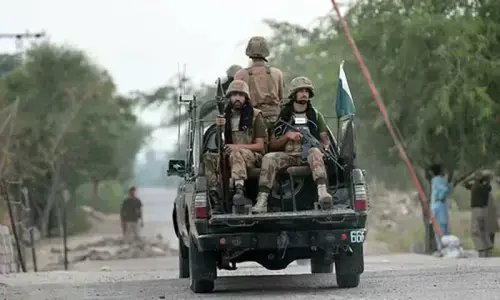
In the midst of the US-Iran tensions, Saudi Arabia came to the conclusion that the American security umbrella was not working. It started exploring multilayered security arrangements, including a strategic mutual defence agreement with Pakistan and a civil nuclear agreement with the US. In some ways, the Makkah Agreement is an upgrade on the existing Pak-Saudi defence agreement. Anchored in Turkiye’s defence manufacturing capabilities, Saudi Arabia’s financial heft and Pakistan’s trained forces and capabilities, as demonstrated in the war with India in May 2025, the agreement marks an important strategic landmark in the evolution of a new security architecture of West Asia.
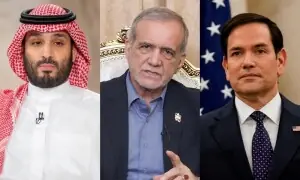
Beyond the three countries’ deterrence and defence needs, there are regional and global aspects to discuss. Detractors are projecting it as an anti-Iran, Sunni group. The Turkish foreign minister has stated clearly that neither Iran nor anyone else was the target of this agreement. Iran’s spokesperson also indicated that Iran has no reason to fear the agreement, as regional countries, rather than outside powers, were working on regional security. Importantly, the Makkah Agreement ensures that there would be no single regional hegemon should America decide to retreat from the area. Given that the agreement is predicated on the idea of collective security, Iran and other countries in the neighbourhood could possibly join the agreement in due course so that a durable regional security architecture is established.
The accord shouldn’t be seen as a military bloc.
The Makkah Agreement is also a strong signal to Israel that its ambition of establishing Greater Israel and dominating the region is over. The US strategy to use the Abraham Accords to integrate Israel into Gulf security is also no longer plausible. The three signatories have consistently called upon Israel to stop its genocide of Palestinians in Gaza and respect international law and UN resolutions calling for an independent state of Palestine based on the pre-1967 borders, with East Jerusalem as its capital.
The accord reduces the US burden of protecting the Gulf states and places the region on the path of self-reliance through collective security. America has two vested interests in the region. One is Israel’s security. The second is the continuity of petro-dollars. The US-Iran war has shown the limits of Israeli regional dominance, while America will do its utmost to ensure that the pricing of oil remains in US dollars. The petro-dollar is increasingly likely to be challenged by several countries desiring to buy Iranian and other oil in non-dollar currencies. Yet, it is important for the three signatories to take the US on board on the scope of this agreement. As for China, it will be pleased with the agreement as it helps expand its concept of collective security encapsulated in the Global Security Initiative. As it is, any step that seems to weaken America’s footprint in the region is a welcome development in Chinese and Russian eyes.
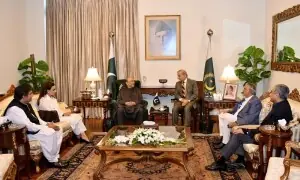
Pakistan’s leadership has done well by consistently using its peace diplomacy to not only bring stability to the region but also shape an entirely new image of the country.
At the same time, Pakistan must continue its constructive engagement with Iran and major powers. While these strategic alignments serve the interests of the three signatories and the region, it would be useful to explore a corresponding initiative of concluding a trilateral economic agreement to pool together resources for the shared interests of the three states.
The ultimate message of the Makkah Agreement is that the region is secure only when every country located in it is safe and when a culture of cooperation replaces one of confrontation. It is also clear that diplomacy backed by credible defence capabilities is the best guard against kinetic misadventures.
The writer is former foreign secretary and chairman of Sanober Institute.
Published in Dawn, August 16th, 2026