PM Shehbaz briefs President Zardari on Pak-Saudi-Turkiye defence pact
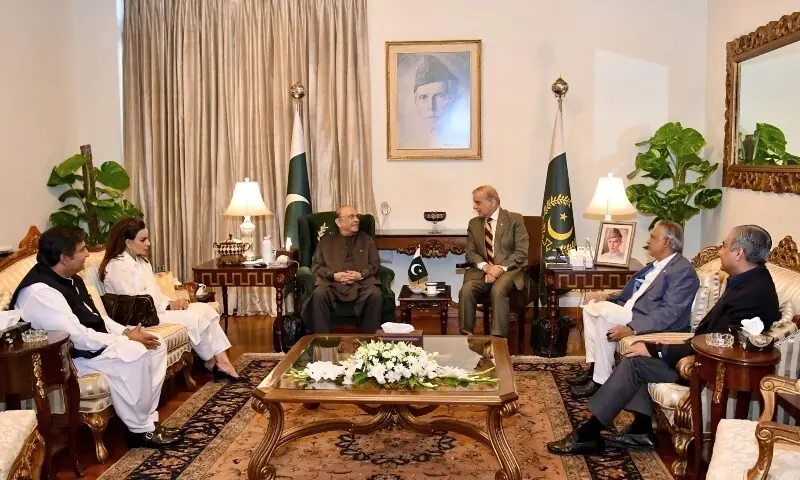


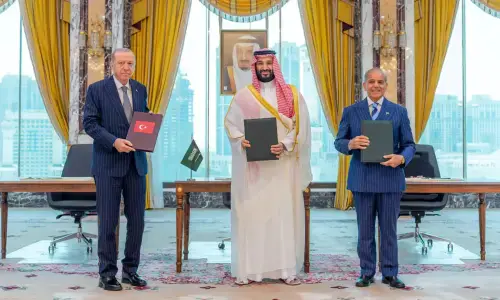
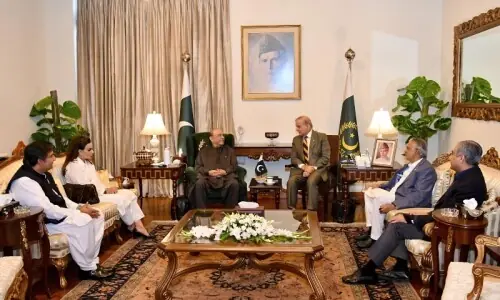
Prime Minister Shehbaz Sharif called on President Asif Ali Zardari in Islamabad on Friday and briefed him on a recently signed defence pact between Pakistan, Saudi Arabia and Turkiye, according to a statement issued by the Presidency.
For his part, President Zardari “expressed his best wishes for the effective implementation of the tripartite agreement with regard to defence cooperation, regional peace and stability and promotion of the security of the Muslim ummah”, the Presidency’s statement on its X account said.
He also appreciated PM Shehbaz’s and Chief of Defence Forces and Chief of Army Staff Field Marshal Asim Munir’s efforts for “further strengthening the longstanding fraternal relations between Saudi Arabia, Turkiye, and Pakistan into a robust strategic partnership”, the statement added.
The joint defence agreement, signed on August 7 in Makkah, aims to strengthen collective deterrence and empowers its signatory states to treat an attack against one of them as an attack against all of them.
Pakistan, Turkiye and Saudi Arabia will form political and military mechanisms under the defence pact, Turkiye’s defence ministry said on Thursday, adding the alliance would also deepen defence industry cooperation.
Both Prime Minister Shehbaz Sharif and Dar have said the pact is defensive in nature, with the latter saying that it is also “open to any country in the region” willing to uphold its fundamental principles.
Turkish Foreign Minister Hakan Fidan on Saturday said Turkiye expected Egypt to join the pact “in the next stage”, telling the Anadolu state news agency only “a few technical issues” stood in the way.
Egypt has not commented on the agreement nor on the remarks by Fidan.
Meanwhile, Kuwait, Bahrain and Somalia are among the countries that have welcomed it. Iran’s comments also took a rather positive tone, stressing its stance of pursuing “security mechanisms based on cooperation between regional countries”.
Counter-terrorism also discussed
Apart from discussions on the Makkah pact, “the professional capabilities of the security forces and law enforcement agencies in operations against Fitna-al-Hindustan and Fitna al-Khawarij were appreciated” during Friday’s meeting, the statement by the Presidency said.
The state has designated Balochistan-based terrorist groups as Fitna-al-Hindustan to highlight India’s alleged role in terrorism and destabilisation across Pakistan, and Fitna al Khawarij is a term the state uses for terrorists belonging to the banned Tehreek-i-Taliban Pakistan.
The meeting’s participants reiterated the “resolve to eradicate the scourge of terrorism” from the country, the statement said, adding that foreign and interior affairs were also discussed.
President Zardari also emphasised “the need for effective measures to provide relief to the people” in light of the current regional situation. He also stressed the need for “uninterrupted supply of essential commodities and their availability at reasonable prices”.
He “expressed the hope that Pakistan’s effective diplomatic efforts for the promotion of regional and global peace would further strengthen the country’s international standing, and that its positive impacts would be reflected in the national economy and the lives of the people”, the Presidency’s statement said.
The meeting was also attended by Deputy Prime Minister and Foreign Minister Ishaq Dar, Interior and Narcotics Control Minister Mohsin Naqvi, Punjab Assembly Speaker Malik Muhammad Ahmad Khan and Senator Sherry Rehman.