The 2025 Pakistan-India conflict — as it happened
A year ago, Pakistan was engaged in a military conflict with India, dealing the boastful neighbour an internationally recognised “clear setback”.
The conflict with India, starting from the April 22 Pahalgam attack to the end of Operation Bunyanum Marsoos, with a ceasefire ending a military escalation between the two countries on May 10, has been called “Marka-i-Haq” (Battle of Truth) by the state.
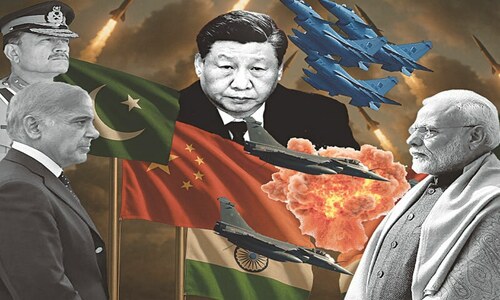
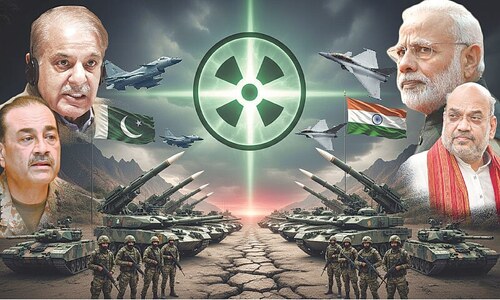
But from the night of May 6 to May 10, the drums of war were echoing loudly across South Asia as the nuclear-armed arch-rivals exchanged missiles, raising global alarm over the risk of unpredictable escalation.
Dawn retraces the period of military hostilities, recounting not just the decisive moments etched in history, but the less-noticed developments that shaped the news cycle at the time.
May 6
With exchange of fire on the Line of Control (LoC) beginning on April 26 — bringing tensions between India and Pakistan to an alarming level — the armed forces were prepared with their full might for what was to come.
This was reflected in Prime Minister Shehbaz Sharif’s visit to the Inter-Services Intelligence (ISI) headquarters on May 6.
“We are ready for them everywhere at all times,” said Defence Minister Khawaja Asif hours later, cautioning that a clash with India “can happen anytime”.

May 7
Shortly after midnight, the military’s spokesman, Inter-Services Public Relations (ISPR) Director General Lt Gen Ahmed Sharif Chaudhry, confirmed that India carried out missile strikes at Bahawalpur, Muridke, Narowal and Sialkot in Punjab, and Muzaffarabad and Kotli in AJK.
Those attacks, which killed at least 31 Pakistani civilians and left many others injured, did not go unanswered.
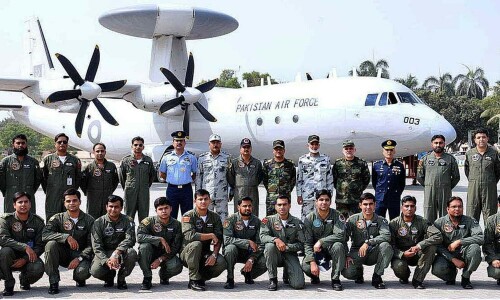
What unfolded next did not merely showcase the Pakistan Air Force’s (PAF) battle capabilities but also became a potential case study for militaries worldwide.
By dawn, Pakistan had shot down at least five Indian jets — a figure later raised to seven. These included at least three Rafale fighter jets — the pride of the Indian Air Force (IAF).
The US, which ended up brokering peace between the nuclear-armed neighbours, immediately activated its diplomatic channels. President Donald Trump hoped the fighting would end “very quickly”.
Then came a press briefing by the DG ISPR, detailing the extent of the Indian strikes’ damage and Pakistan’s response in self-defence to the “uncalled-for aggression”.
Top-level huddles were underway in Islamabad, where the prime minister, the three services chiefs and the newly appointed national security adviser (NSA) were attending a meeting of the National Security Committee (NSC).
The NSC authorised the military to “undertake corresponding actions”.
Across the border, New Delhi was busy broadcasting its narrative, with its military officials briefing the media on the strikes carried out as part of “Operation Sindoor”.
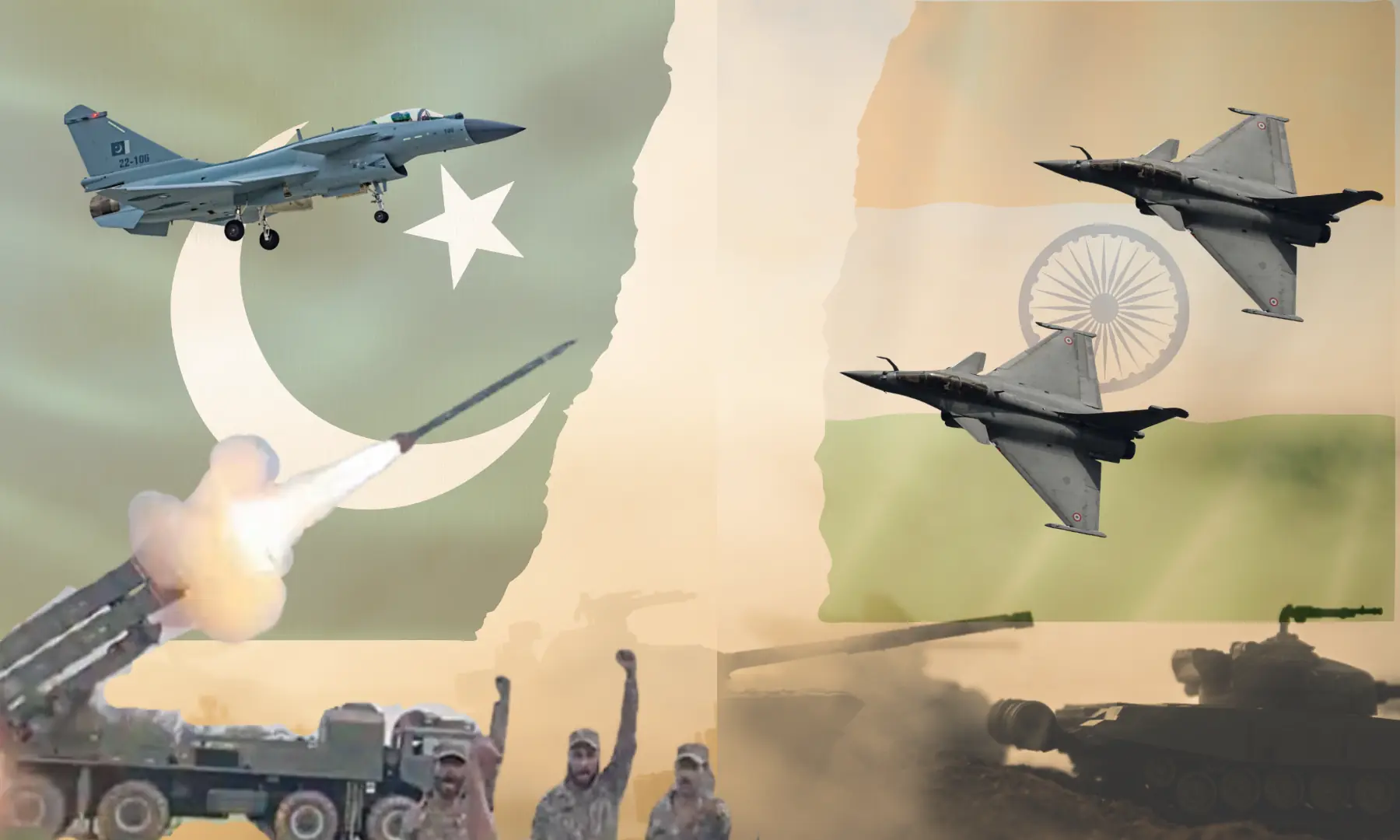
In China, defence-manufacturing companies enjoyed rallying stocks amid widely believed reports — later confirmed — that the PAF shot down India’s prized Rafales using Chinese J-10C jets.
In the skies, pilots had to divert their planes onto alternative routes as airlines scrambled to avoid flying over the conflict zone.
This was also the day when X perhaps no longer posed enough of a threat to national security, as the ban imposed on the social media platform since Feb 17, 2024, was finally lifted.
Pakistan and India also engaged in cyber warfare. Besides foiling cyber attacks, Islamabad responded to New Delhi’s social media blockade by restricting access to Indian videos and websites.
Rare political unity was seen in Sindh as workers from various political parties took part in a solidarity rally organised by the PPP.
In the evening, PM Shehbaz and Deputy PM Ishaq Dar delivered firm speeches before the National Assembly (NA), with the prime minister also appearing on television later that night to address the nation.
Punjab invoked ‘War Book’ protocols for maximum preparedness and took measures to ensure public safety.
By then, New Delhi had started its preparations for Pakistan’s expected retaliation. The Indian capital went dark when power was cut off for an emergency drill.
At 10pm, about 12 hours after his earlier press briefing, the DG ISPR provided an updated toll of casualties from the Indian strikes. Meanwhile, Trump offered his help in calming down tensions.
May 8
The second day of active conflict, in the words of the DG ISPR, marked a “serious provocation” as India sent 25 Israeli-made Harop drones into Pakistan — all of which the military said it intercepted.
While Dar said at this point that the Pakistani and Indian NSAs had spoken to each other, a day later the DG ISPR said no direct communication had taken place. Regardless, firing across the LoC had continued overnight, while Indian cities witnessed blackouts as part of a nationwide civil defence drill.
The conflict’s impact extended to the country’s south, with an Indian drone falling on the outskirts of Karachi and in villages in Sindh near the border.
One drone crashed near the Rawalpindi Cricket Stadium, the venue of the then-underway Pakistan Super League’s 10th edition, resulting in the death of a vendor.
An Indian drone “managed to engage in a military target near Lahore”, injuring four army personnel, DG ISPR Chaudhry said.
With drones hovering in the skies, flights from major airports largely remained suspended. In India, around 27 airports were closed, with the Delhi airport alone seeing as many as 90 flight cancellations.
After India’s strikes the previous day accompanied by a barrage of drones, Indian Foreign Minister S. Jaishankar claimed it was not their “intention to escalate the situation”, and warned Pakistan against retaliating. Defence Minister Rajnath Singh claimed that New Delhi was willing to engage in dialogue.
In Islamabad, PM Shehbaz endorsed the NSC’s decisions made a day earlier.
Meanwhile, the NA witnessed a rare moment of the treasury and opposition benches being on the same page, as the PTI expressed its clear support for the armed forces.
Speaking on the NA floor, Information Minister Attaullah Tarar said Pakistani forces killed “40 to 50 Indian soldiers” across the LoC.
At this point, the US’ mediation efforts were publicly acknowledged by the defence minister, who said Washington was leading efforts to reduce tensions between Pakistan and India.
This was followed by US Secretary of State Marco Rubio’s separate phone calls to PM Shehbaz and Jaishankar, wherein he urged both sides to de-escalate. This was reiterated by the US State Department hours later, which said the US was “engaged with both governments at multiple levels”.
Interestingly, US Vice President JD Vance called for “de-escalation” but also said that the conflict between neighbours was “fundamentally none of our business”.
After a long day, Dar and the DG ISPR held a joint press conference, with the former accusing India of “deliberate” attacks in its Punjab province to “falsely implicate Pakistan”. The number of drones neutralised by Pakistan was now 29.
Pakistani state media said the armed forces also dealt heavy damage to an Indian battalion headquarters in occupied Kashmir.
Alongside the on-ground skirmishes, the misinformation and disinformation warfare was already underway. Information Minister Tarar promptly refuted “fake and concocted stories” about India downing PAF F-16 and JF-17 jets, as well as claims of a Pakistani pilot being in their custody.
“Get out of [your] B-tier Bollywood mindset,” he quipped.
May 9
The drone incursions continued on Friday. By 1pm, Pakistan’s defence systems had shot down another 49 drones sent by its eastern neighbour, taking the total tally to 77.
The LoC remained very active, with Indian shelling killing at least five civilians and Pakistan destroying three Indian posts in response. Amid a war-like situation, civil defence drills were conducted in Punjab.
In the afternoon, leaders across the political spectrum slammed India’s actions as they spoke on the NA floor. The defence minister contended that New Delhi planned to detect the locations of sensitive sites inside Pakistan through its drone flights.
The ongoing drone attacks prompted the Pakistan Cricket Board (PCB) to postpone the remaining eight PSL matches. New Delhi also suspended the Indian Premier League (IPL) for one week.
Meanwhile, DPM Dar was busy communicating Pakistan’s stance to other countries as he spoke on the phone with various counterparts, including the United Kingdom’s foreign secretary.
The Foreign Office, in its weekly press briefing, called out India’s “irresponsible, unlawful and belligerent conduct” that “brought the two nuclear-armed states closer to a major conflict”.
In the evening, the now-familiar trio of DG ISPR, Air Vice Marshal Aurangzeb Ahmed and Vice Admiral Raja Rab Nawaz held a joint press briefing. The number of civilian casualties from Indian attacks had now risen to 33, with 76 injured.
Lt Gen Chaudhry highlighted that India had still not given any evidence regarding its allegations against Pakistan on the Pahalgam attack, while AVM Aurangzeb provided a reconstruction of how the PAF shot down Indian jets on May 7.
Despite the ongoing escalation, backchannel diplomacy continued. Later that night, the White House confirmed that Rubio was in constant contact with leaders in Islamabad and New Delhi.
May 10
Saturday was busy for everyone — from the personnel on the defence frontlines to journalists sifting through the barrage of reports, and from top global leaders to those involved in relaying diplomatic messages.
Things escalated pretty early on. Shortly after 3am, the DG ISPR confirmed that India targeted three PAF bases, located in Rawalpindi, Chakwal and Shorkot.
The majority of the missiles were intercepted and all PAF assets remained safe. But this did not mean that India’s “madness”, as per the military spokesperson, would go unanswered.

What followed was a thundering response from Pakistan, dubbed Operation Bunyanum Marsoos (concrete structure).
Over a span of about 12 hours, the armed forces targeted multiple strategic and military sites in India and occupied Kashmir, destroying the S-400 missile system in Adampur and a storage site of the Brahmos missiles in Beas, among other targets.
The retaliatory attacks targeted at least 26 locations, India acknowledged, adding that at least five airbases suffered damage to “equipment and personnel”.
In the morning, state media reported that PM Shehbaz had called a meeting of the National Command Authority (NCA), which is responsible for making operational decisions on Pakistan’s nuclear weapons. However, hours later, the defence minister said the nuclear option was “not on the cards” at the moment.
In between these developments, Rubio spoke separately with Chief of the Army Staff Gen Asim Munir and Dar, offering US assistance in talks for de-escalation.
Rubio also spoke with Jaishankar, emphasising the need to identify methods to de-escalate.
Pakistan’s airspace remained off-limits for all types of flights. There were also reports of cyber attacks continuing, with Indian websites being hacked.
Following active US diplomatic efforts, at around 5pm, Trump announced that both India and Pakistan had agreed to a full and immediate ceasefire.

The cessation of hostilities, effective 4:30pm PKT, was confirmed by both countries. Subsequently, air traffic across Pakistan resumed later that night.
A day of intense military activity finished off with statements from across the globe hailing peace as the brief conflict finally came to an end.

Header image: Illustration made on Canva using file photos of Rafale and J-10C fighter jets sourced via Reuters.
Muskaan Mujahid is a senior sub-editor on Dawn’s online news desk with over three years of experience in journalism. A communication and design graduate, her reporting focuses on arts, social issues, and maps. She can be found on X at @MuskaanMujahid.