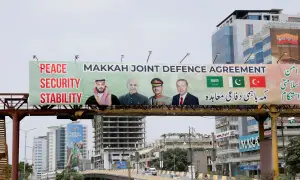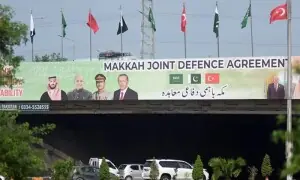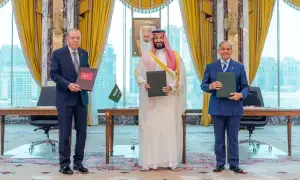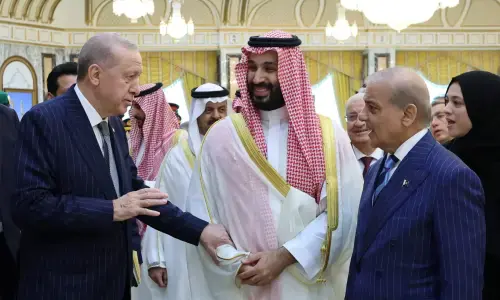


THE triangular defence pact signed last week by Turkiye, Saudi Arabia and Pakistan is the most consequential geopolitical development reshaping the strategic landscape of the region and beyond. It has been concluded in the midst of a war that not only affects the region but also has far-reaching implications for the wider world. The three countries span the Middle East, South Asia and Europe.
Despite facing diverse security challenges, they are bound together by a common defence pact. While Saudi Arabia and Pakistan were already bound by a bilateral agreement signed last year, Turkiye’s entry has broadened the scope of the pact. The collective strength of these three countries has made the grouping a formidable force in the region.
Although the full text of the Makkah Joint Defence Agreement has not been made public, it does declare that “any armed attack against any one of the three states shall be regarded as an attack against them all”. It also states that the pact is not directed against any country but serves as a deterrent against external aggression. It is, however, silent on the question of where the common threat lies.
This question becomes all the more pertinent as the triangular agreement has taken shape while America’s war on Iran drags on and Israel continues its expansionist war, threatening regional security. While Saudi Arabia has been directly affected by the war, Pakistan and Turkiye have remained on the fringes. The Makkah Agreement is being viewed as similar to Nato’s Article 5, but any military response would still require political decision-making. The immediate practical emphasis may be on intelligence-sharing and deterrence.
It is wrong to brand the newly formed defence bloc a Muslim alliance or, more narrowly, a Sunni one. It represents an emerging regional security architecture that reduces dependence on the US and pushes back against Israel’s expansionist agenda. Other Gulf countries — which have borne the brunt of Iran’s retaliation targeting US military bases on their soil — could also join the grouping.
The Makkah Agreement has fundamentally altered the strategic landscape of the region.
Questions have been raised about the reliability of the US as a defence guarantor for its Middle Eastern partners. Instead of ensuring security, the presence of US military bases has made these countries — many of which also have security pacts with Washington — more vulnerable. Lessening this dependence, however, does not mean severing ties with America.
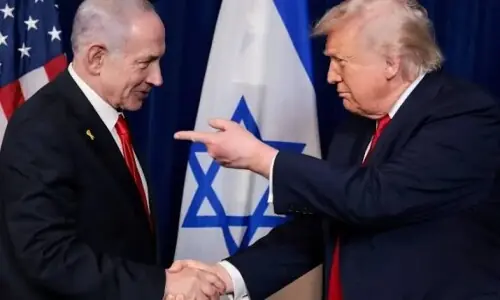
All three countries maintain good relations with Washington, despite President Donald Trump having destabilised the region through his unprovoked war on Iran and his continued support for Israel’s expansionist agenda. There has been a curious silence in Washington over the alliance.
Egypt was another country expected to join the grouping. The North African country has been part of a quad alongside these three allied nations, helping to find a negotiated resolution to the conflict. Cairo is believed to have reservations, however, about joining a regional security architecture that could affect its peace treaty with Israel. According to some analysts, Cairo appears to view the pact as much a political instrument as a military one. The group remains hopeful that Egypt will join the defence pact at some stage.
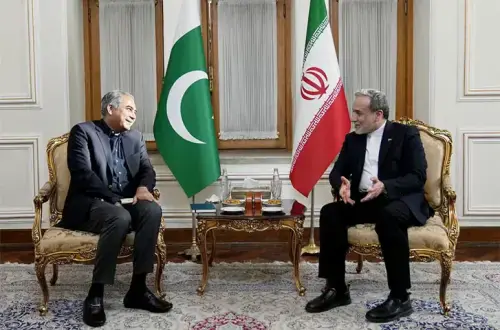
Further complicating matters is Iran’s mixed reaction to the agreement. Foreign Minister Abbas Araghchi posted a message calling on Muslim states to stand together, describing the moment as one in which they should rely only on themselves and embrace true brotherhood. The post left it unclear whether he was referring to the trilateral agreement.
Earlier, Araghchi is also reported to have said that Tehran was ready to partner with Persian Gulf states to build a new regional security architecture, arguing that recent events had demonstrated the need for regional countries to take responsibility for their own security. He said any security framework should include economic cooperation and stressed that military powers from outside the region should be excluded.
Meanwhile, Ebrahim Rezaei, a member of parliament’s national security committee, said that the “Saudis should understand that a paper agreement with Turkiye and Pakistan will not bring them security, just as decades of one-sided dependence on the Americans failed to do so”, thus reflecting the scepticism over the agreement among certain sections of the Iranian leadership. However, as reported, Iran’s foreign ministry spokesman said that “the pact reflected a changing regional perception of US and argued that countries in the region could no longer rely on Washington”.
Predictably, the Makkah Agreement has provoked a strong reaction from Israel’s right-wing government, which views the development as a serious threat to its security. India has concerns over the triangular agreement, of which Pakistan is a key partner. According to some reports, the pact has accelerated the India-Israel security partnership.
On Aug 7, the day the trilateral agreement was signed, Indian Prime Minister Narendra Modi and his Israeli counterpart Benjamin Netanyahu discussed the Special Strategic Partnership between their two countries in a telephone call. The two countries had formally elevated ties to a Special Strategic Partnership for Peace, Innovation & Prosperity during Modi’s state visit to Israel this year. That visit produced concrete defence and technology agreements. According to the Israeli media, both leaders recognised that they now face a shared strategic challenge: a bloc combining Saudi money, Turkish drones and a nuclear-armed Pakistan.
The Makkah Agreement has fundamentally altered the strategic landscape of the region. But there are also questions about how the partnership will actually work, given the varied security concerns of its members. While agreeing to a joint defence strategy, each country also brings its own conflicts and security problems.
That raises the question of whether the partners would be drawn into one another’s conflicts. While Pakistan’s principal security threat comes from India, Turkiye, a Nato member, has long-running territorial disputes with Greece in the Aegean Sea. There is also a view that, in practice, the pact is more about Saudi Arabia’s immediate security concerns stemming from regional non-state groups than Turkiye’s or Pakistan’s. These are issues that will require a more coherent collective response. For all the questions it raises, the Makkah Agreement marks a decisive shift in how the region’s major powers conceive their own security.
The writer is an author and journalist.
X: @hidhussain
Published in Dawn, August 12th, 2026