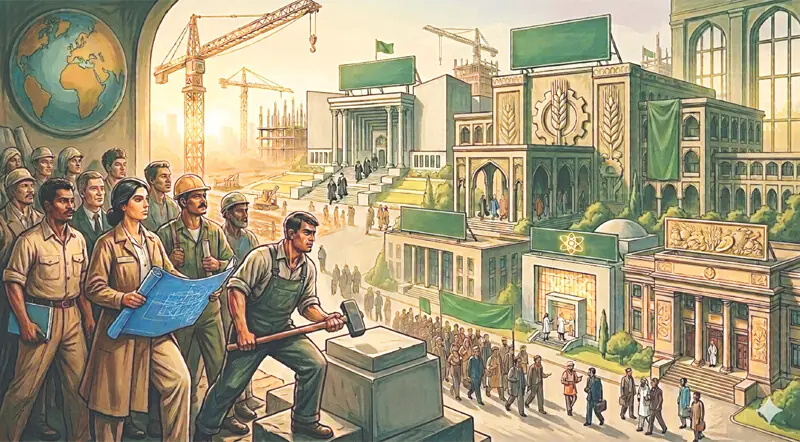

EVERY nation reaches moments when the most important questions are no longer about politics, personalities or policies. They are about the state itself. Such moments invite a country to pause, not to retreat from its challenges, but to examine whether the institutions that once served it remain equal to the demands of a changing world. They compel a nation to return to first principles and ask a question from which every other question flows: what is the purpose of the state?
Pakistan finds itself at such a moment.
The country’s recent national debate on governance has generated sharply differing opinions, competing diagnoses and familiar political narratives. Yet its greatest value lies not in the arguments it has produced, but in the question it has revived. Beyond the headlines and the politics lies a more enduring challenge: are we shaping a state whose purpose is to expand opportunity for every citizen, or have we become too occupied with managing the pressures of the present?
The distinction is more profound than it first appears. Throughout history, nations have seldom struggled because they failed to recognise their problems. More often, they have struggled because they became increasingly proficient at managing those problems while postponing the institutional reforms required to solve them. Crisis management gradually acquires the appearance of governance. Short-term stability begins to replace long-term strategy. Resilience becomes a substitute for renewal. Yet the purpose of the state is not simply to preserve stability; it is to create conditions in which society can continually advance.
Are we shaping a state whose purpose is to expand opportunity for every citizen?
Pakistan has never suffered from a shortage of ideas. Across successive governments, universities, think tanks, public institutions and the private sector, thoughtful proposals for reform have accumulated for decades. The country’s recurring challenge has not been understanding what must change. It has been building institutions capable of sustaining change once it begins. Ideas illuminate the path forward, but institutions determine whether a nation is able to walk it.
That reality should fundamentally reshape the current national conversation. The defining question before Pakistan is no longer whether reform is necessary. That proposition commands broad agreement across political, institutional and professional circles. The more consequential question is whether we possess the institutional capability, policy continuity and collective discipline to translate reform into enduring public value. States ultimately justify their existence not by the policies they announce, but by the opportunities they create.
This is why the present debate deserves to be viewed as an opportunity rather than merely a controversy. Governments are temporary, institutions endure, policies evolve. National purpose must provide continuity. Countries that succeed over generations do so because their institutions preserve strategic direction even as governments, leaders and political priorities change. The true strength of the state lies not in its ability to manage today’s challenges, but in its capacity to expand opportunity for tomorrow.
History offers few lessons more consistent than this one. Nations blessed with abundant resources have often underperformed, while others with far fewer advantages have transformed themselves through capable institutions, disciplined governance and clarity of purpose. Leadership may inspire a generation, but institutions shape the destiny of nations. The enduring purpose of the state is fulfilled not through moments of exceptional leadership alone, but through institutions that continue serving long after leaders have departed. That is the lesson Pakistan now has an opportunity to embrace.
What, then, is the purpose of the state?
The state exists because no society can secure justice, opportunity and shared progress through individual effort alone. Its highest responsibility is not simply to maintain order or administer public affairs, important as those responsibilities are; its fundamental purpose is to create conditions in which every citizen can live with dignity, realise his or her potential and contribute meaningfully to the nation’s future. Every institution, every public policy and every national priority ultimately derives its legitimacy from that larger purpose.
Viewed through this lens, development acquires a deeper meaning. It is not merely an economic objective, nor can it be measured solely through fiscal indicators or annual statistics. Development is the visible expression of a state fulfilling its purpose. It reflects institutions that educate rather than merely instruct, courts that inspire confidence rather than merely dispense judgments, public administration that delivers rather than merely regulates, and economic policies that reward enterprise, innovation and productivity. Prosperity is rarely an accident of history. More often, it is the natural consequence of institutions that consistently expand opportunity.
This is why state capacity matters. It should never be confused with the expansion of governmental power. The purpose of the state is not to control more; it is to serve better. State capacity is the ability of public institutions to formulate sound policy, implement it effectively, adapt intelligently to changing circumstances and earn public confidence through consistent performance. Strong states are distinguished not by the extent of their authority, but by the quality of the opportunities they create for their people.
History repeatedly confirms this principle. The decisive advantage enjoyed by the world’s most successful nations has seldom been geography, natural resources or even political systems. It has been their ability to build institutions that outlast governments, preserve national direction across political transitions and steadily improve the lives of successive generations. Leadership may initiate transformation, but only institutions can sustain it. The true inheritance of every successful generation is therefore not a collection of policies, but a stronger state capable of serving the next generation even better than it did the existing or the previous ones.
Pakistan’s own experience points to the same conclusion. The country has never lacked talent, resilience or ambition. Time and again, it has demonstrated the ability to overcome adversity. Yet resilience alone cannot fulfil the purpose of the state. Nations ultimately progress not because they repeatedly recover from crises, but because they patiently build institutions that reduce the need for crisis management altogether. The transition from resilience to institutional excellence is therefore more than an administrative reform. It is the means through which the state fulfils its highest purpose: expanding opportunity, strengthening justice and enabling every generation to inherit a stronger republic than the one before it.
What, then, should this mean for Pakistan?
It should mean that every significant national decision is judged not only by its immediate political or economic consequences, but by a more enduring test: does it enable the state to fulfil its purpose? Does it strengthen institutions, widen opportunity, reinforce the rule of law, reward enterprise, and prepare future generations for a more competitive world? If the answer is no, even the most well-intentioned initiatives are unlikely to produce lasting national progress. The legitimacy of the state is measured not by the promises it makes, but by the opportunities it consistently creates.
This understanding also reshapes how we define national strength. Defence remains indispensable, diplomacy remains essential, yet neither can fully achieve its purpose without development. A nation’s enduring influence rests upon the quality of its institutions, the education of its people, the competitiveness of its economy, the credibility of its justice system and the confidence inspired by its governance. Development is therefore not merely another public policy objective. It is the means through which the state fulfils its fundamental purpose and transforms national potential into national power.
The same principle applies to democratic governance. Elections confer legitimacy upon governments; institutions sustain legitimacy for the state. Governments formulate policies, but institutions preserve continuity, protect public confidence and carry the national mission beyond electoral cycles. Empowered local governments, a professional civil service, an independent judiciary, effective regulators, a dynamic private sector and an engaged civil society are not competing centres of influence. Together, they form the institutional foundation through which the state fulfils its purpose across generations.
This is why the significance of the present national debate extends far beyond the statements that initiated it. Its lasting value lies in reminding us that Pakistan’s future will be determined less by the arguments we win than by the institutions we build. Every generation inherits a state shaped by those who came before it. Every generation also bears the responsibility to strengthen that inheritance so that those who follow inherit greater opportunity, stronger institutions and deeper public confidence.
History seldom remembers nations for the crises they endured; it remembers them for the institutions they built, the opportunities they created and the confidence with which they prepared for the future. Pakistan possesses the human talent, entrepreneurial spirit, strategic __cpLocation and resilience to become one of those nations. The defining question before us is therefore no longer whether change is necessary. It is whether we possess the wisdom, discipline and collective resolve to build a state that remains faithful to its highest purpose. Governments will come and go. Policies will evolve. Political debates will fade. Institutions alone endure. The ultimate purpose of the state is not simply to govern society, but to expand opportunity, protect justice and enable every generation to build a better future than the one it inherited.
The writer is a public policy advocate, business strategist, and former minister for investment.