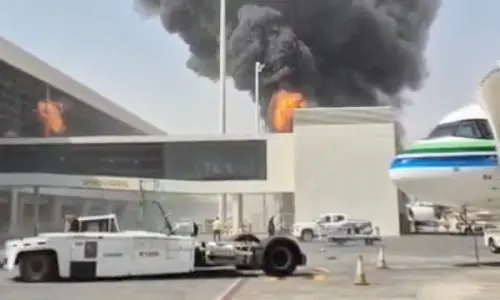
THE storm that struck Lahore recently was nothing exceptional. Just wind, dust and some rain. The kind of weather that arrives every year at this time, and surprises nobody. Within a few hours, 72 feeders had tripped across Lahore, and there was no power in most parts of the city. Where I was, it stayed out for three to four hours. From the fans to the internet, nothing was functional.
I assumed this was a local problem, but it was not. In Peshawar, over 200 feeders tripped across 12 grids the same evening. Poles were uprooted in Charsadda, where an internet worker died from electric shock while repairing damaged cables. Feeders failed across Multan, Bahawalpur and Dera Ghazi Khan, while dust storms disrupted supply in Sukkur, Larkana and Hyderabad. The same weather event led to the same outcome city after city.
What is difficult to get past is something in the data of the Lahore Electric Supply Company (Lesco) itself. Electricity demand that day was 3,700MW, exactly matching the allocated supply. There was no shortage. The outage had nothing to do with how much power was available, and everything to do with transmission lines that fail to handle wind, electric poles that give way in rain, and a grid that trips the moment conditions vary. Sometimes it does not even take a storm. A light drizzle is enough.
The same thing had happened in August last year when heavy rains had triggered nationwide outages. It happened the year before that, too. It happens with a regularity that the electricity supply itself rarely achieves. We are heading into the monsoon season. The storms coming over the next few months will be heavier than the recent dust-and-wind event. The question that has been waiting for an answer for several years now is straightforward: at what point does a grid that cannot survive ordinary weather stop being considered acceptable?
Maheen Zahra
Lahore
Published in Dawn, July 28th, 2026