KARACHI: There’s a particular kind of scoreboard cruelty reserved for sprinters, and Faiqa Riaz found it waiting for her at Scotstoun Stadium on Monday, in the exact shape she’d spent two years being told to expect. Twelve one-hundredths of a second.
That’s the distance between qualifying for a Commonwealth Games semi-final and not — the width of a fingernail, translated into the only currency that matters in a hundred metres — and it’s the distance that separated Faiqa from the next round of her first Commonwealth Games.
She isn’t going to Tuesday’s semi-final. She is, as of Monday afternoon, the fastest woman in Pakistan’s history, and it says something about how she’s built that both of those facts sat comfortably in the same sentence in her head by the time she’d finished talking to Dawn on Monday.
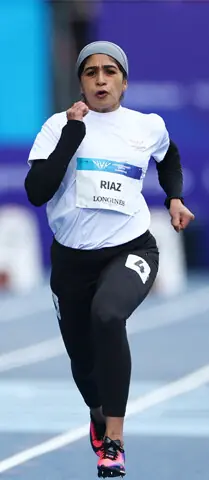
The number was 11.64. It replaced 11.81, a time that had belonged to Naseem Hameed since the 2010 South Asian Games — since before Faiqa, born in 1999, had properly finished being a teenager herself, let alone a sprinter.
“I am really glad to achieve the goal that I set up for myself despite many obstacles,” Faiqa told Dawn in an over-the-call interview from Glasgow on Monday.
As soon as she crossed the finish line, her eyes darted to the digital screen. When the numbers appeared, it finally dawned on her — she had realised her dream.
“I thought I finished in 11.65, which would’ve also been a record, and I was extremely delighted to see that,” Pakistan’s fastest woman said. “When I later settled down and saw my official results, it was a microsecond less, which was my personal best and also the national record.”
Sixteen years is a long time for a national record to survive in a sport where hundredths of a second are treated like border disputes; long enough that an entire generation of Pakistani schoolgirls grew up being told that particular number was simply what fast looked like, here. On Monday, in lane four of heat three, it stopped being true.
She finished third. Australia’s Torrie Lewis, who’d broken her own national record in Slovakia less than a week earlier and arrived in Glasgow as one of the form sprinters in the field, won the heat in 11.15.
Antigua’s Geolyna Dowdye (11.28) was second. Barbados’ Kishawna Niles, twenty years old and already a world Under-20 medallist, took the final qualifying spot with 11.52.
Faiqa’s 11.64 — clean, wind-legal, beyond dispute — left her twelfth-hundredth of a second short of following any of them through. It is the sort of margin that invites a particular kind of grief, the if-only variety, and for a moment, by her own account, it did.
“I felt a little bit sad on missing out but then I said to myself, why should I focus on the negative,” the 26-year-old said.
It’s worth sitting with how quickly that sentence turns the corner — sadness acknowledged, then set down, in the same breath.
“What I am able to achieve is still a significant achievement for myself. I am really happy with my performance, and thanks to Allah. Unhon nay mujhay itna bhi nawaza (He has given me even this much)”.
It isn’t the language of someone performing gratitude for a reporter’s benefit. It’s closer to the vocabulary an athlete reaches for when there’s genuinely nobody else in the room to perform it for.
She’d told Dawn before the Games that this was, in fact, the entire plan — that a medal was, in her own word, “very difficult” against a field that included an Olympic champion and a three-time Olympic medallist, and that the number she was actually chasing lived somewhere else.
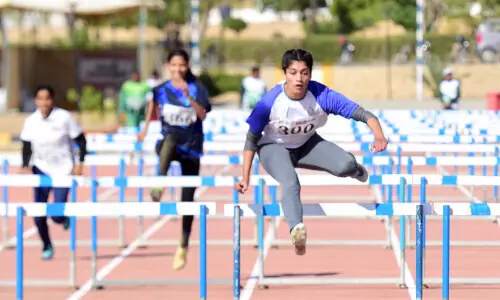
Paris had taught her that lesson the hard way. She ran her personal best of 12.49 at the 2024 Olympics, finished sixth in her heat, and came home having let the occasion get inside her head before the gun had even gone.
“I had some doubts and I lost some of my confidence and got nervous,” the Olympian admitted of that day, with the specific honesty of someone who’s already made the mistake once and isn’t interested in making it twice. This time, she said, she’d kept telling herself she could do it, right up until the blocks.
Her coach, Fayyaz Ahmed, called her before the race — not with tactics, not with splits, just the one instruction that matters most to an athlete who has already done the physical work and has nothing left to manage but her own head.
“He told me to remain positive and believe in your skill and training,” she revealed. “I believe that if you feel even one per cent negative, the negative vibes follow you.”
It’s a small, almost throwaway detail in the transcript of the interview, and it’s also the difference, in her telling, between Paris and Glasgow — between a race she let get away from her and one she didn’t.
What she takes home from Scotstoun isn’t a medal, and Pakistani athletics doesn’t yet have the depth of competition, the sponsorship, or the year-round exposure to pretend otherwise.
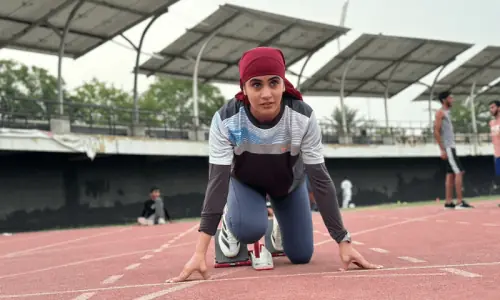
It’s three to four hours a day, five until eight in the evening, at Punjab Stadium in Lahore, repeated for long enough that a number that had outlasted sixteen years of Pakistani sprinters finally moved.
It’s Fayyaz Ahmed and Gohar Shahbaz, the two coaches she credited afterwards, and the Pakistan Olympic Association, whose officials Anna Ibtisam and Irfan Younis were there at trackside to greet her when she walked off it.
Faiqa, who emphatically mentioned divine help in enabling her to reach the level many dream in a country like Pakistan, didn’t make the semi-finals of the Commonwealth Games. She ran the fastest hundred metres by a Pakistani woman in the history of the country trying to produce one, on a track in Scotland, in front of a field that included the athletes she’d spent the buildup warning everyone she couldn’t beat.
“I am really happy with my performance,” she said, once the numbers had settled and the disappointment had been filed where she’d decided to put it.
“I am past the qualification miss. I am happy.” She said it like someone stating a fact rather than making a case for one — which, by Monday evening, is exactly what it was.
Published in Dawn, July 28th, 2026