Faiqa focused on clock, not CWG podium
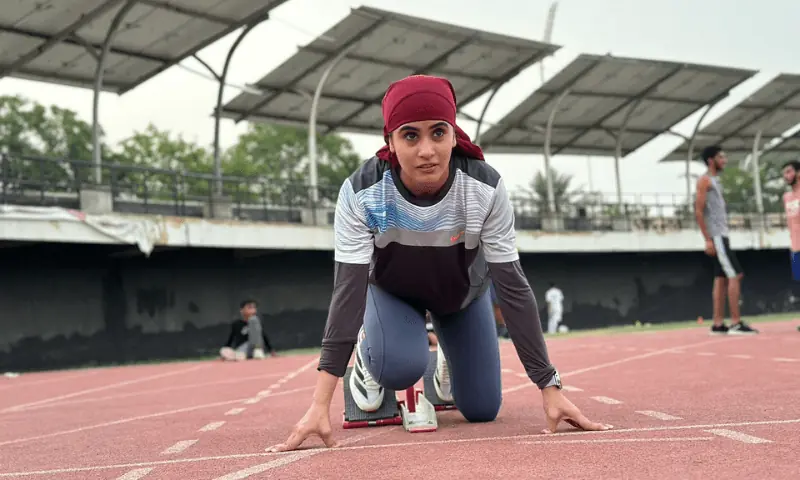

KARACHI: There is a version of this story that ends with a medal, and Faiqa Riaz has already told you it isn’t this one.
She has seen the start list. She knows who is in lane four, and lane six, and she has done the arithmetic that every sprinter outside the handful of nations that treat 100 metres as a matter of national prestige eventually learns to do: run your race, know your rivals, and don’t confuse ambition with delusion.
“The line-up is stacked,” Faiqa told Dawn on Tuesday, and there is no self-pity in it, just the flat, practised honesty of someone who has been reading entry lists long enough to know what they mean.
Saint Lucia’s Julien Alfred, Olympic champion in Paris two years ago. Dina Asher-Smith, three Olympic medals deep into a career most Pakistani sprinters can only watch on a phone screen.
Nigeria’s Blessing Ogundiran, freshly crowned at her own trials in 11.12 seconds. Australia and Jamaica, because it would hardly be a major championship without them.
“There are athletes from Saint Lucia and Jamaica,” the 26-year-old said. “Who are comparable to some of our male athletes here.”
It is meant as a measure of the gap, not a complaint about it.
So when the Commonwealth Games open in Glasgow on Thursday, and Scotstoun Stadium hosts the women’s 100m heats on July 27 — one of those brutal, one-and-done formats where the semi-finals and final arrive a day later regardless of whether your legs are ready for them — her target will not be a place on the podium.
It will be a number: 12.49 seconds, the personal best she ran at the Paris Olympics on a universality wildcard, finishing sixth in her heat but quietly setting the fastest legal time by a Pakistani woman over the distance.
Beyond that sits another number, older and more stubborn — 11.81 seconds, Naseem Hameed’s national record, standing since the 2010 South Asian Games like a door nobody has managed to push open in sixteen years.
Faiqa was recorded to have run faster than that in the last year’s National Games in Karachi, only for it to be not counted because it was gauged manually and not according to international standards.
“In the National Games, there was no electronic timer,” the Olympian said.
It is a strange kind of ghost to chase — a time that may or may not exist, remembered rather than recorded — but it is the ghost she has decided to chase anyway. None of this happens by accident.
Three to four hours a day, five until eight in the evening, at Punjab Stadium in Lahore: weights, drills, the unglamorous repetition that never quite makes it into a magazine profile.
Her coach, Fayyaz Ahmed, runs the sessions; Gohar Shahbaz assists. And because there is no depth of competition to sharpen her against at home, she has gone looking for it — travelling to Sahiwal, of all places, to line up against men.
“My coach is from Sahiwal,” she explains, almost as if the logistics were the interesting part. “I went there with my coaches and competed alongside boys. Then we returned to Lahore and created our own competitions to push ourselves further,” the Lahore-born athlete added.
Athletes inventing a rivalry because the sport hasn’t given them one.
There is a version of Pakistani sport that runs on state largesse and sponsorship deals, and this is not that either.
“There are no sponsors in athletics,” the sprinter said, matter-of-fact again. Her salary comes from Wapda, the department that has quietly bankrolled more Pakistani Olympians than any ministry of sport.
Everything else — diet, extra training, the accumulated cost of trying to be world-class in a system built for something more modest — comes out of her own pocket.
The Pakistan Olympic Association is covering the expenses for the Games. What happens in the months between championships is, as ever, her own problem.
She learned exactly how wide that gap runs in April, in Sanya, at the Asian Beach Games, where she reached the final of the 60m — third-fastest into the final, a heat run of 7.56 seconds that read like real promise — and then finished last when it mattered.
“There isn’t much pressure while competing in national events,” Faiqa who won three gold medals in the National Games said. “But internationally, we are just chasing them. We are still lacking far behind the world competition.”
It is not despair, exactly. It is closer to a diagnosis, delivered by someone who has taken it enough times to stop flinching.
“Winning a national event gives confidence, but competing in an international event is always a reality check,” she noted.
Faiqa arrives in Glasgow, then, not as a medal contender but as evidence — proof that Pakistani athletics can still produce someone worth watching, even if the watching comes with caveats.
She will share a flight, a village, and perhaps a little reflected light with Arshad Nadeem, the Olympic javelin champion, a fact she treats as company rather than pressure.
And when the gun goes on July 27, what she is really running against isn’t Alfred or Asher-Smith or Ogundiran at all. It’s a stopwatch that once read a number that didn’t count.
Published in Dawn, July 22nd, 2026