Peshawar High Court stops deportation of Afghan cancer patient for 30 days
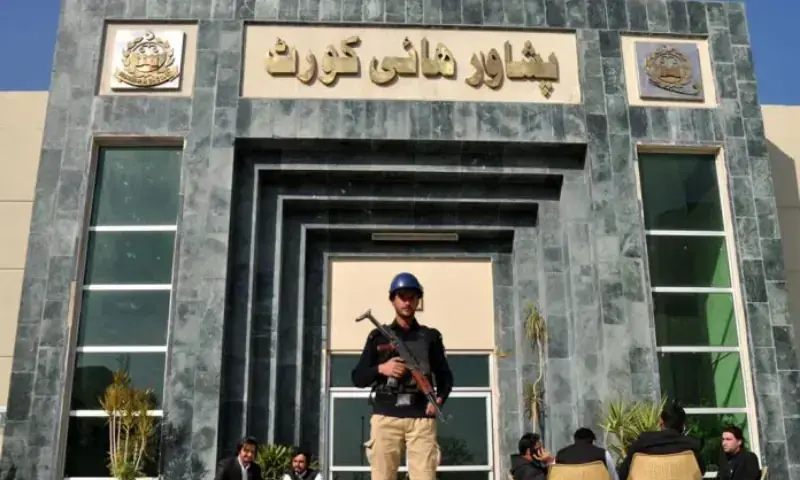
PESHAWAR: Peshawar High Court has on humanitarian grounds stopped law enforcement agencies for a period of 30 days from arresting or deporting an Afghan cancer patient, undergoing treatment in Pakistan, and his two family members.
A bench consisting of Justice Salahud Din and Justice Qazi Jawad Ehsanullah disposed of a petition filed by the patient named Anar Gul, his wife and a son. The bench directed them to instantly approach competent authorities for grant of medical visa or submit an appropriate application before ministry of interior to seek permission to remain in Pakistan until completion of his medical treatment.
“Upon receipt of such application, competent authorities shall consider and decide the same expeditiously strictly in accordance with law and on its own merits after taking into consideration the medical condition of petitioner No.1 and material place before them,” the bench directed.
“In the meanwhile, having regard to the ongoing medical treatment of petitioner No.1, it is directed that petitioners shall neither be arrested nor deported back to Afghanistan for a period of 30 days from the date of this order, thereby enabling them to avail the remedy as indicated above,” the bench ordered.
Directs petitioners to approach govt for medical visa
The bench observed: “It is evident that although petitioners presently lack a valid immigration status, their claim is founded upon an ongoing and serious medical condition of petitioner No.1 for which he is receiving specialised treatment at a recognised medical institution in Pakistan.”
“Whether petitioners should be permitted to remain in Pakistan on medical grounds squarely falls within the domain of competent authorities, who are vested with the statutory power to consider such request in accordance with the applicable immigration laws and policy,” the bench ruled in its four-page detailed order.
“At this stage, this court considers it appropriate to offer the petitioners an opportunity to avail the remedy available to them under the law by approaching the competent forum rather than the court itself adjudicating upon the merit of such requests in its constitutional jurisdiction,” the bench maintained.
Petitioners’ counsel Imran Khan stated that his clients had been residing in Swat district on basis of Proof of Registration (PoR) cards, which were no longer valid documents for staying in Pakistan. He said that petitioner Anar Gul was diagnosed with high-grade B-cell lymphoma involving the left temporal lobe.
He stated that the patient had been under continuous medical treatment at Aga Khan University Hospital, Karachi. He added that presently the petitioner had been receiving chemotherapy on a weekly basis at Shifa International Hospital, Islamabad.
He argued that the treatment of the petitioner was ongoing and critical as medical reports clearly established that any interruption or discontinuation of the treatment was likely to result in irreversible deterioration of his health and may seriously endanger his life.
The counsel stated that the respondents including the federal government and its law enforcement agencies had initiated coercive measures for the deportation of petitioners, which, if carried out, would forcibly interrupt the lifesaving medical treatment of Anar Gul and expose him to an imminent risk to his life and health.
He said that deportation to Afghanistan, where access to equivalent specialised oncological care was practically non-existent amid the current humanitarian and healthcare crisis, would make the petitioner’s treatment impossible.
He stated that superior courts had repeatedly held that the state couldn’t take action that endangered the life of any person within its territory.
The assistant attorney general, Said Jamil Shah, stated that since PoR cards of petitioners stood cancelled, they had no lawful authority to continue residing in Pakistan.
He added that they were at liberty to approach competent authorities for the grant of medical visa or to seek appropriate permission from the ministry of interior to remain in the country until treatment of the petitioner No.1 was completed.
Published in Dawn, July 27th, 2026