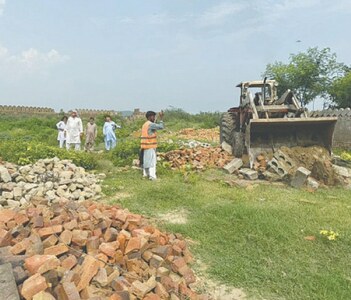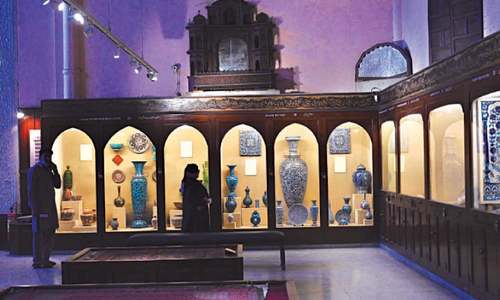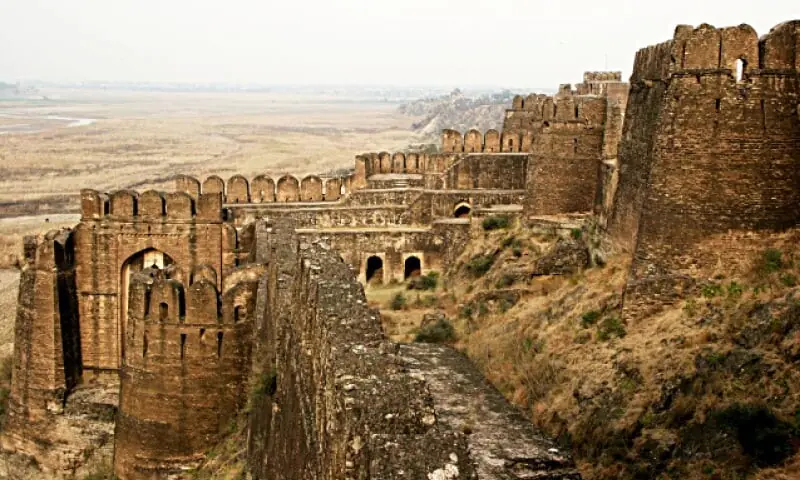
ISLAMABAD: The United Nations Educational, Scientific and Cultural Organisation (Unesco) has undertaken a technical visit to Rohtas Fort to assess the situation upon receiving information about the ongoing restoration works at the site.
Unesco’s team visited the premises on Tuesday, following information received from a third party regarding restoration works that allegedly violated international standards.
While sources in the heritage ministry claimed Unesco had raised concerns about certain works, the UN body later challenged the assertion.
According to sources in the ministry, Unesco sought to examine the ongoing work to collect information and report to the World Heritage Centre.
Unesco’s Pakistan office had requested the Ministry of National Heritage and Cultural Division to assist the visit to Rohtas Fort to inspect the ongoing project by the Punjab Directorate General of Archaeology and Museums (DOAM).
The ministry source claimed that the restoration work was not in compliance with Unesco’s approved guidelines.
However, Unesco clarified that it had not issued any finding or conclusion stating that the ongoing works at Rohtas Fort were not in compliance with its guidelines or international conservation standards.
The ministry source contended that this was “the second time Unesco has expressed concern with the government of Punjab over its so-called conservation methods”.
Meanwhile, Unesco stressed: “Any correspondence with state authorities forms part of Unesco’s routine technical advisory role and should not be characterised as formal objections unless officially communicated by Unesco.”
The UN’s cultural arm clarified that its interactions with the Punjab government were based on “constructive technical cooperation”.
Unesco says it did not give any warning that Taxila could lose status
Last month, Unesco reportedly cautioned the Pakistan government over the Punjab Archaeology Department’s major reconstruction at Taxila’s Mohra Moradu and Sirkap. During its visit, the UN agency apparently found ancient stone walls were covered with fresh masonry and structures were artificially heightened, creating an obvious mismatch with the original fabric.
Unesco subsequently asked Pakistan to reverse the changes and submit full documentation, such as before and after pictures.
Sources in the Ministry of National Heritage had told Dawn that Unesco warned Taxila could be put on the danger list or lose its heritage status altogether if the changes were not reversed.
However, Unesco refuted this claim too, stressing that it had “not communicated to the government of Pakistan that Taxila would be placed on the List of World Heritage in Danger or that it could lose its World Heritage status”.
The UN body emphasised that its engagement with the government was focused on providing “technical advice and encouraging the implementation of appropriate conservation and management measures”.
Explaining that changing the design of ancient remains was a serious violation of international laws, a ministry official told Dawn that the Punjab government had not responded to specific queries allegedly raised by Unesco.
“Restoration, such as a retaining wall, is only permissible to some extent to prevent an ancient remain from collapsing. Altering the design of a historical property that has universally significant value can compromise its authenticity,” he said.
“In some places, original walls have been replaced with new ones erected at Mora Moradu and Sirkap. Restoration and using cement to erect walls of World Heritage sites is a serious violation of Unesco rules for conservation of archaeological monuments of historical value,” the official said.
Although the heritage ministry source said a request from DOAM to enlist Rani Ghat and Bhambhor has been accepted by the UN agency, Unesco said: “No nomination of Rani Ghat is currently under review for inscription on the World Heritage List.”
While the ministry source said Pakistan was trying to have 24 more heritage sites listed, Unesco pointed out the country currently has 29 properties on its Unesco Tentative List, which represents an inventory of sites that may be considered for future nomination to the World Heritage List.
Contrary to the ministry source, Unesco said it has “not indicated that these properties are ‘at risk’ as a result of issues relating to any individual World Heritage property”.
Unesco reaffirmed its commitment to working closely with the federal and Punjab governments, as well as all relevant stakeholders, to ensure that the conservation of Rohtas Fort is undertaken in accordance with the principles of the 1972 World Heritage Convention and internationally accepted conservation standards.
Despite repeated requests for comments on conservation efforts at Rohtas Fort, the office of the Ministry of National Heritage and Culture Division Secretary Asad Rehman Gilani did not respond.
The online version of this report, originally published in Dawn on July 23, 2026, has been updated to reflect Unesco’s stance regarding restoration works at Rohtas Fort and its views on Taxila.