0
0

NATIONS should never join blocs whose acronym ends with the letter ‘o’ — Seato, Cento, Nato. It is an invitation to collective suicide. Seato and Cento were dissolved in 1977 and 1979 respectively, while Nato is in the throes of debilitating disintegration. Turkiye has been a member of Nato since 1952 and was a member of Cento since its inception as the Baghdad Pact in 1955. It lay too far west to join an East-centric Seato. Turkiye has the second-largest military within Nato. The Nato secretary general described it as among the world’s best. Despite that, it has never been admitted into that other Western club — the European Union.
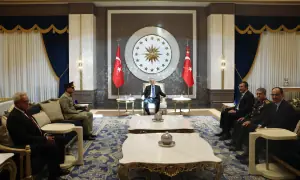
Turkiye’s President Recep Tayyip Erdogan acted as host at the last meeting of Nato leaders over July 7-8 in Ankara. He could have impressed his colleagues with a display of Turkiye’s military prowess and a grand parade. Instead, he chose to give them a portable reminder: a box containing a Magnum revolver engraved with the name of the recipient and six live bullets.
Canadian Prime Minister Mark Carney’s modest gift of maple syrup, by comparison, seemed “undermatched”. EU President Ursula von der Leyen thanked Erdogan, telling him that the revolver would be “decommissioned and donated to a military museum”.
Others left the weapons with their embassies in Ankara. The Polish president, Karol Nawrocki, took his gun home but cautiously. He remembered that in December 2022, Poland’s police chief had brought back to Warsaw a gift from the Ukraine — an anti-tank grenade launcher. It exploded in his office, injuring him and causing extensive damage to his headquarters.
Gifts exchanged between leaders have a long tradition.
Gifts exchanged between leaders have a long tradition. The East India Company, for example, kept a list of presents given and received, often recycling them between rulers.
In 1972, at the Indo-Pak summit in Shimla, Zulfikar Ali Bhutto presented Indian prime minister Indira Gandhi with an embroidered Sindhi cap and a block-printed ajrak. She reciprocated by ensuring that he had a stock of his favourite cigars in his bedroom. Later, president Gen Ziaul Haq hoped to sweeten Mrs Gandhi by giving her bottles of lychee juice. She found his gift (and him) “too sour”.
During A.B. Vajpayee’s bus yatra in 1999, he gave Nawaz Sharif a collection of his Hindi poetry, translated into English. Sharif reciprocated with vintage CDs of South Asian musicians. In 2014, prime minister Nawaz Sharif attended Narendra Modi’s inauguration as PM. They exchanged gifts as if it was Mother’s Day. Modi gave a shawl for Sharif’s elderly mother and Sharif responded with a white sari for Modi’s mother. In December 2015, Modi surprised Nawaz Sharif by making an unscheduled stop in Lahore. He brought for him a pink Rajasthani turban and another shawl for Sharif’s mother.
The late Pervez Musharraf and Modi never warmed to each other. That chill has continued into Shehbaz Sharif’s prime minister-ship. He is finding that it will take more than saris or lychee juice to mollify Modi.
It will also take more than conferences in Islamabad, or impassioned legal arguments in the press, for PM Modi to open the sluice gates and allow Pakistan its contractual share of river waters. Pakistan and India have been locked since 1947 in a dispute over Jammu & Kashmir. The UN has proved ineffective as a peace-broker. Hopefully, it will not take another 79 years for the parties to implement a fraying UN resolution.
Meanwhile, it is clear that PM Modi has no interest in losing his constituencies within India by conceding water to Pakistan. Is there any way he can be brought to the negotiating table to discuss the Indus Waters Treaty, or to implant a replacement? If and when such negotiations take place, Pakistan as the lower riparian will be in the weaker position. As the upper riparian, India looks down, both physically and metaphorically, from what it perceives as its natural position, a commanding height. River waters have a number of interested parties who coexist because they need to. In our case, the most significant party is less India and Pakistan than China. From the uppermost riparian — the Tibetan plateau — China controls the waters flowing through Indian states and Indian-held territory into Azad Kashmir, Gilgit-Baltistan and mainland Pakistan. China has always taken a long view of Pakistan’s future, beyond the myopic vision of Pakistan’s revolving-door rulers. The future China sees for Pakistan is not of a parched wasteland but a viable, arable agro-economy — a potential bread and rice basket for the region.
Pakistan should persuade China to use its clout to be included in any new Indus waters sharing arrangement. Of all China’s past beneficences, notably the HMC, HFF and HEC projects at Taxila and now CPEC, that would be China’s most enduring gift to Pakistan.
The writer is an author.
Published in Dawn, July 16th, 2026