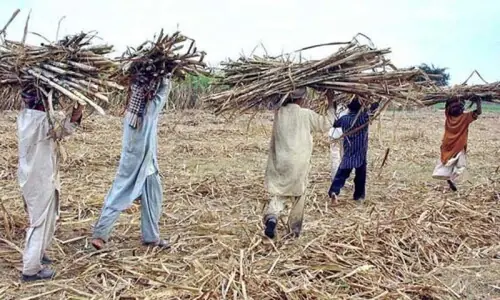
One more sugar factory has begun trial operations for this year’s cane crushing season, processing around 92,000 tons of sugarcane. Located in the cotton-producing district of Ghotki, it raises the number of sugar mills in the area from five to six. This development, perhaps, underscores the steady expansion of sugarcane cultivation into Sindh’s traditionally cotton-rich belt, a shift that appears to be continuing without pause.
Cotton is increasingly struggling to survive in both Punjab and Sindh. In Punjab, largely the expansion of rice cultivation has eroded cotton acreage, while in Sindh similar pressures are also visible.
At the same time, the steady increase in the number of sugar factories suggests that the sugar business continues to yield substantial returns for powerful millers, despite their frequent assertions of losses in the industry.
Historically, Ghotki was known as a cotton-producing area until the early 2000s. Five sugar factories were set up in a row in this area. The district on the left bank began to see this wave of sugar mill development, particularly during the Pervez Musharraf era, when policy space was perceived as more accommodating of powerful millers.
Shifting from cotton to cane means more water is locked into one crop for the whole year
In contrast, Badin district once hosted five functioning sugar factories. Two of them, Pangrio and Mirza, have been shut for a considerable time due to various operational and financial reasons.
Ghotki borders Punjab, allowing millers to access relatively uninterrupted sugarcane supplies from southern Punjab alongside Sindh. They have also expanded cultivation by acquiring riverine lands under contractual arrangements, strengthening the supply base for this high delta cane crop and ensuring steady flows to the factories.
These thousands of acres of land, mostly owned by Sindh’s landowners, were under sugarcane and wheat cultivation, as witnessed by this writer in 2021. The agricultural landscape of Ghotki district has clearly shifted from a once-rich cotton zone to a hub of sugarcane production.
A farmer’s economy revolves around cash flows, so economic security takes precedence. Sugarcane has long been treated as a protected crop under legislation that guarantees an annually fixed support price, along with a quality premium. Cotton does not offer these benefits. However, over the past two years, the government has not fixed the sugarcane price under IMF-linked conditions.
Sugarcane is also a long-duration crop, taking close to a full year compared to paddy, cotton, and wheat, and it is highly water-intensive, similar to rice. “An increase in sugarcane cultivation in cotton-growing areas can provide farmers with short-term cash security, but it is harmful to cotton’s survival, water equity, and long-term irrigation sustainability”, observed Sindh Agriculture University Tandojam vice chancellor Prof Dr Altaf Ali Siyal.
Dr Siyal has analysed the water requirements of major crops, finding that sugarcane requires 66.9 inches of water per acre, followed by rice at 45.3 inches, cotton at 31.5 inches, and wheat at 16.7 inches per acre. Sugarcane’s demand alone exceeds the combined water needs of wheat and cotton.
Dr Siyal believed that sugarcane expansion weakens cotton ginning, textile and oilseed chains. It needs water, including during periods when canal supplies are already very low, reducing the reliability of irrigation water for cotton, wheat, fodder, and vegetables.
According to him, shifting from cotton to cane means more water is locked into one crop for the whole year in a water-stressed province. “Excessive cane cultivation can reduce overall water productivity and damage cotton-based rural industry at district level,” he noted.
He terms such expansion unfit from a water-management perspective, as it increases irrigation demand, undermines cotton acreage, and heightens the risks of salinity and waterlogging. “Sugarcane should be limited to areas with reliable drainage and assured water while cotton zones should be protected through better cotton prices, pest control, quality seed, and timely canal water,” he said.
Over the past decade, several mills have significantly expanded their crushing capacity, naturally increasing demand for sugarcane. Most Ghotki-based mills are considered efficiency-driven, with improved recovery ratios.
SGM Sugar Mills, one of six in Ghotki, raised its capacity from 8,000 tons in 2015 to 14,000 tons from 2020 onwards, while JK (Gulf) expanded its capacity from 8,000 tons to 13,000 tons by 2019. Similarly, mills in Mirpurkhas, Thatta, and Khairpur have increased capacity: Shah Murad in Thatta from 6,000 to 11,000 tons; Mirpurkhas from 4,000 to 12,500 tons; Khairpur from 4,000 to 7,000 tons by 2025; and Ranipur from 3,500 to 12,500 tons. The expansion suggests relative confidence in the availability of sugarcane supplies.
“Growth in the number of sugar mills is beyond comprehension, when the raw material (sugarcane) is not enough for even existing sugar mills”, argued President Sindh Abadgar Board, Mahmood Nawaz Shah. He, however, said loss of cotton acreage or its revival should not be attributed to mere surge in the number of sugar mills in Sindh. “Cotton has its own issues. It needs policy patronage and support. It involves challenges of production, prices, susceptibility to adverse climate, etc”, he said.
A look at the Sindh agriculture department’s figures for cotton and sugarcane crops shows that cotton’s acreage declined over the years, whereas sugarcane’s acreage showed an upward trend. When Sindh achieved the highest cotton bales production of 4.2 million in FY10, it was sown on 634,714ha. Sugarcane had 233,949ha acreage the same year.
Cotton is also under pressure from paddy cultivation, which has expanded in the left-bank areas of the Indus despite weak enforcement of crop zoning laws. Under the law, paddy is banned in these regions, yet violations persist. In Punjab, growers are seen taking two paddy crops in a single season at the expense of cotton, while in Sindh it has also spread in cotton belts such as Mirpurkhas and Sanghar. The resulting loss of cotton acreage has downstream effects on oilseed output, deepening Pakistan’s reliance on imported edible oil.
Dr Yusuf Zafar, former chairman of the Pakistan Agricultural Research Council, expresses concern over cotton’s decline. He notes that Vehari, once a major cotton district in Punjab, now shows virtually no cotton cultivation, as farmers are pushed towards alternative crops. He also points to a policy imbalance in which the domestic cotton sector faces taxes while imports remain duty-free.
Published in Dawn, The Business and Finance Weekly, July 6th, 2026