0
0

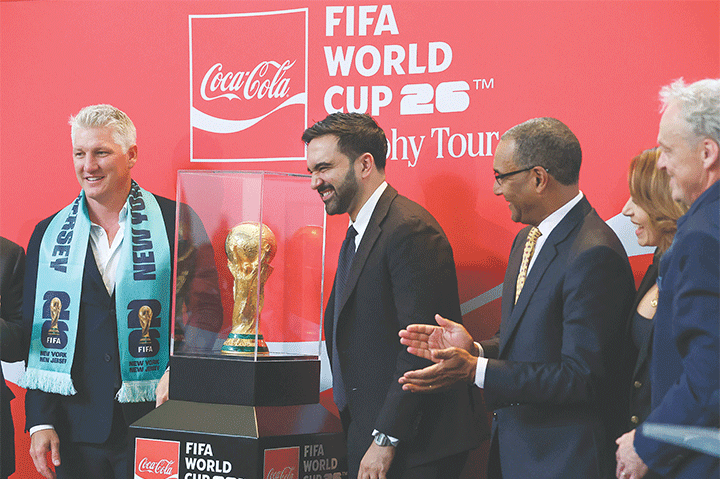
For the first time ever, the FIFA World Cup will feature 48 teams divided into 12 groups of four. In this new format, the top two teams from each group and the eight best third-place finishers will advance to the knockout stage, promising more drama and surprises than ever before.
From traditional giants like Brazil, France and Argentina to ambitious contenders like the Netherlands, Spain and England, every nation hopes to make history.
Here is a closer look at all 12 groups and their rankings ahead of the mega event.
GROUP A Teams: Mexico (15), South Korea (25), Czechia (41), South Africa (60)
Co-hosts Mexico look strongest on paper, but a recent wave of player injuries could open the door for South Korea or Czechia to cause problems. The safety net of the third-place rule will make this group highly competitive.
GROUP B Teams: Switzerland (19), Canada (30), Qatar (55), Bosnia & Herzegovina (65)
Switzerland enters as one of recent years’ most consistent sides. They face tough competition from co-hosts Canada and a resilient Bosnia and Herzegovina side that knocked out Italy in the qualifiers. Qatar face an uphill battle to keep pace.
GROUP C Teams: Brazil (6), Morocco (8), Scotland (43), Haiti (83)
Featuring two top-ten heavyweights, this group belongs to Brazil and Morocco. Scotland and Haiti will need a footballing miracle to upset these dominant opponents and advance.
GROUP D Teams: United States (16), Türkiye (22), Australia (27), Paraguay (40)
Co-hosts United States hold a major advantage with passionate home crowds and familiar stadiums. However, tournament comeback kings Türkiye remain a tricky opponent, while Australia and Paraguay will hunt for surprises.
GROUP E Teams: Germany (10), Ecuador (23), Ivory Coast (34), Curaçao (82)
Four-time champions Germany headline this group alongside Ecuador, who possess one of South America’s toughest defences. Ivory Coast and debutants Curaçao must significantly raise their game to stand a chance.
GROUP F: Speed and Tactics
Teams: Netherlands (7), Japan (18), Sweden (38), Tunisia (44)
The tactically sharp Netherlands and fast-paced Japan are clear favourites to advance. Sweden and Tunisia must capitalise on any slip-ups from the top two to keep their tournament alive.
GROUP G Teams: Belgium (9), Iran (21), Egypt (29), New Zealand (85)
Belgium are heavily tipped to advance comfortably. This leaves Mohamed Salah’s Egypt and a disciplined Iran side to battle for second place, while lowest-ranked New Zealand rely on teamwork to surprise.
GROUP H Teams: Spain (2), Uruguay (17), Saudi Arabia (61), Cape Verde (69)
Former winners Spain enter as tournament favourites, with two-time champions Uruguay expected to follow them into the next round. Cape Verde and Saudi Arabia will aim for spirited displays but face a massive task.
GROUP I Teams: France (1), Senegal (14), Norway (31), Iraq (57)
Top-ranked France are well-prepared to dominate this group. The real battle is for second place; Senegal are favourites, but Norway—led by Erling Haaland and Martin Ødegaard—and a fearless Iraq side will fight hard. GROUP J: Teams: Argentina (3), Austria (24), Algeria (28), Jordan (63)
Defending champions Argentina should comfortably top this group, even with Lionel Messi expected to play a reduced role. Austria and Algeria will fight for the second automatic spot, leaving Jordan with a steep learning curve. GROUP K: Teams: Portugal (5), Colombia (13), Congo DR (46), Uzbekistan (50)
This group offers a blockbuster clash between Cristiano Ronaldo’s Portugal and Luis Díaz’s Colombia. While Portugal navigate their veteran star’s farewell, a balanced Colombia could snatch top spot. Congo DR and Uzbekistan will eye third-place qualification. GROUP L: Teams: England (4), Croatia (11), Panama (33), Ghana (74)
The final group is incredibly tough to call, headlined by Harry Kane’s England and Luka Modric’s Croatia. Both possess deep tournament experience, though Panama and Ghana are entirely capable of pulling off an upset.
Published in Dawn, Young World, June 6th, 2026