In 2016, when most people took bank loans to build homes, buy vehicles or start businesses, Ashraf Ali Samoon borrowed money for a different reason entirely: books.
The 55-year-old bibliophile from Tharparkar travelled to India to attend the World Book Fair, organised by India’s National Book Trust, where 1,380 stalls and publishers from 14 countries had gathered under one roof. For Samoon, the trip was less a luxury than a pilgrimage. He returned carrying books worth more than Rs150,000 — close to the same amount that he had borrowed.
What awaited him at home, however, was not celebration. Soon after his return, Samoon was suspended from his government job for not acquiring formal permission to leave — the suspension lasted 32 months.
Yet even that did not loosen his grip on books.
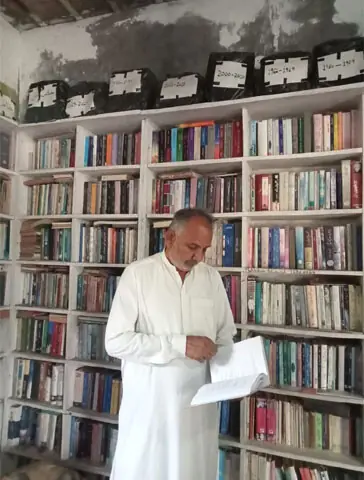
In a modest home in Islamkot, Ashraf Ali Samoon has spent decades building a private library of more than 16,000 books — often at great personal cost
Today, in the desert town of Islamkot, where coal projects and dusty roads dominate the landscape, Samoon has quietly built one of the region’s most remarkable private libraries: a sprawling collection of over 16,000 books, housed inside his modest home.
THE BOOKWORM
Samoon was born in the small village of Peeloro Samaan — now called Ahmedabad — near Islamkot, into a religious family. His early education took place in Diplo, before he completed matriculation in Jhuddo, intermediate studies in Mithi and a bachelor’s degree in Matiari.
Samoon’s relationship with books began in childhood, while living with his elder brother, Molvi Muhammad Ahmed, who taught religious studies and kept a small collection of religious texts at home. Curious at first, Samoon soon became consumed by reading.
As a student, Samoon often sacrificed meals to save money for books. His parents would send him money for food and clothing. Samoon, however, would buy second-hand clothes and skip meals to stretch every rupee further. At one point, the habit became so severe that he developed tuberculosis.
“Books became more important than comfort,” he says.
SILVER TINS AND IRON TRUNKS
When Samoon secured a government job as a primary school teacher in 1989, his modest salary began feeding a growing obsession.
At first, his books were stored in silver tin containers, iron trunks and mud cabinets. But by 1990, he had established a small library in his native village. A decade later, he shifted the collection to his home in Islamkot, where two rooms are now dedicated entirely to books. A third room — where he sleeps and reads — is also lined wall-to-wall with them.
The library, named the Bilawal Makhdoom Library after the 15th century Sufi saint, contains thousands of works spanning philosophy, history, fiction, poetry, biographies, autobiographies and international literature.
Nearly every title has been purchased by Samoon himself, with only a handful donated by authors. Visitors arrive regularly to borrow books, returning them once finished before picking up another. In a region where public libraries are scarce and reading spaces nearly nonexistent, the home has become an unlikely intellectual refuge.
A FADING READING CULTURE
Currently, the two-room Islamkot Town Library is the only such place in Islamkot. The city once had another library: the Shah Abdul Latif Library, established by the Lohana community, which has been shut for a while. According to Samoon, it reflected a stronger reading culture that has gradually eroded over time. He does not blame technology alone.
“It is not just the digital era,” he tells Eos. “We ourselves are responsible, because we do not manage our time effectively,” he continues. “In developed countries, people use digital platforms alongside reading and publishing books. They do not spend all their time scrolling.”
The library has also become a resource for researchers. Samoon recalls two students — Asad Abbasi from Kotri, studying in Finland, and another named Usman from Lahore, studying in the United Kingdom — who stayed at the library for two months while researching Tharparkar’s climate.
Qurban Ali Unar, a teacher from Islamkot and one of the library’s regular visitors, describes the collection as “nothing less than a treasure.” The books at Samoon’s library, he tells Eos, are invaluable for students, researchers and general readers. “In a small city like Islamkot, this library quenches the thirst of readers.”
THE BOOK HUNTER
For nearly three decades, Samoon has travelled across Pakistan in search of books.
He frequents Lahore’s Anarkali Bazaar, Rawalpindi’s Raja Bazaar, Karachi’s Regal Chowk and the book stalls around Frere Hall. By his own count, he has attended 17 book fairs at the Expo Centre Karachi, missing only two editions in nearly two decades.
The pursuit has become a lifelong routine.
At some point during our meet-up, he gestures towards the towering shelves surrounding him and says there are still books he longs to own. Among them
are the complete volumes of the Encyclopaedia Britannica and Will Durant’s The Story of Civilisation.
“If anyone wants to donate them happily,” he says with a smile, “the library will welcome them.”
MORE THAN A COLLECTOR
Samoon is not merely a collector of books; he is also a writer and translator.
He has translated into Sindhi Tareekh-i-Sindh [A History of Sindh] by Abdul Halim Sharar and Women’s Rights in Islam by Zakir Naik. He has also authored three books, including Tharparkar: An Annotated Bibliography — which contains short reviews of more than 500 books and over 700 articles related to Tharparkar. The work serves as a guide for researchers seeking to understand the region.
Samoon says he has repeatedly refused financial assistance for the library.
He recalls a visit by Syeda Sabin Shah, the sister of Sindh Chief Minister Murad Ali Shah, who offered him money to improve the space. “I told her that her visit itself was the greatest honour,” he says.
The library currently has around 60 permanent readers, though only 10 to 15 visit regularly.
Still, Samoon dreams of expansion. He plans to construct a large reading hall above the existing rooms, so more visitors can sit and read comfortably.
Others believe the library deserves institutional support. Hafiz Abdul Gani Bajeer, a local reporter, argues that the home library should eventually be converted into a public one. “Young people are especially drawn toward novels, motivational books and storybooks,” he tells Eos. “There should be designated sections for different genres, reading clubs and monthly discussions.”
THE LAST PAGES
In Tharparkar, where conversations often revolve around drought, migration and coal extraction, Samoon’s library stands as a quieter kind of resistance. Its shelves hold thousands of worlds far removed from the desert outside.
And for decades, one man has sustained it through personal sacrifice: skipped meals, second-hand clothes, borrowed money and relentless travel in pursuit of books. Before our meeting ends, Samoon offers one final thought — less a statement than a hope.
“May this library become a source of inspiration,” he says, “so that people establish libraries everywhere, from villages to cities, and help revive a reading culture that spreads far and wide.”
The writer is a teacher and a rights activist
based in Mithi. X: @ChandaniDolat
Published in Dawn, EOS, May 31st, 2026