WASHINGTON: A British-Pakistani scientist based in Qatar has developed a groundbreaking artificial intelligence-powered eye scan that can detect dementia, Parkinson’s disease, diabetic nerve damage and other neurodegenerative disorders years before symptoms appear.
Professor Rayaz Malik, a leading researcher in diabetic neuropathy and neurodegenerative diseases at Weill Cornell Medicine-Qatar, told Dawn that the non-invasive scan may now become widely accessible, particularly in developing countries, as new manufacturers begin producing the technology at lower cost.
He said the groundbreaking method, which takes just two to three minutes, could transform the early diagnosis and treatment of neurological diseases, especially in countries such as Pakistan, where diabetes and dementia rates are rising rapidly.
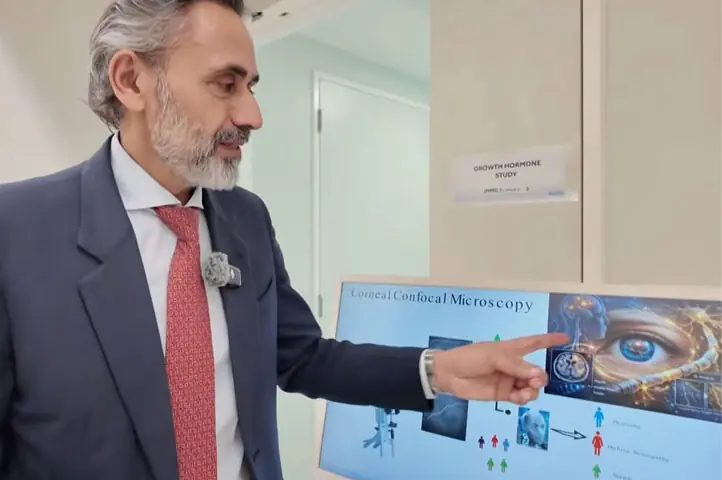
Speaking to Dawn, he explained how researchers at Weill Cornell are using this technology, known as corneal confocal microscopy (CCM), to identify nerve damage years before patients begin showing symptoms.
Qatar-based researcher Rayaz Malik says non-invasive test uses AI to spot dementia, Parkinson’s, diabetic neuropathy within minutes
“The cornea has the richest sensory innervation in the body,” he said, explaining why the eye offers a unique window into diseases affecting the nervous system.
“We evolved to protect vision, so the cornea contains a dense network of nerves that can reveal damage occurring elsewhere in the body.”
Traditionally, CCM was used by ophthalmologists and optometrists to diagnose infections and abnormalities in the front surface of the eye.
But Professor Malik and his colleagues discovered that the same technology could detect microscopic nerve fibre damage linked to diseases far beyond the eye itself.
The breakthrough dates back to 2001, when he discussed the technology with Prof Nathan Efron, a world-renowned optometrist. At the time, Prof Malik was researching diabetic neuropathy — a debilitating complication of diabetes that damages the nerves.
“Many experts thought we were crazy,” Prof Malik recalled. “But in 2003, we published the first paper showing corneal nerve loss in patients with diabetic peripheral neuropathy.”
That study opened the door to more than two decades of research. Since then, investigators around the world have shown that CCM can detect nerve damage associated with diabetes, chemotherapy, inflammatory disorders and infectious diseases.
Research conducted in Qatar over the last 12 years has also demonstrated its ability to identify neurodegeneration linked to dementia, Parkinson’s disease, multiple sclerosis, schizophrenia and autism.
Professor Malik said one of the most significant applications of the technology lies in detecting dementia years before symptoms appear.
“When patients come to the doctor with memory loss and are diagnosed with dementia, the underlying nerve damage has usually been developing for 10 to 15 years,” he explained. “At that stage, treatments are largely ineffective.”
He said the challenge in modern medicine is identifying patients during the earliest phases of cognitive decline, known as mild cognitive impairment.
“MRI scans usually become abnormal only in advanced dementia,” Prof Malik noted. “But we have shown that some people with mild cognitive impairment already have abnormal corneal nerves on CCM, and many of these patients develop dementia within five years.”
The implications could be particularly important for countries facing ageing populations and rising rates of neurological disease.
Professor Malik also highlighted the technology’s potential in diabetes care. According to him, diabetic neuropathy can be detected up to five years earlier through CCM scans.
“This is crucial because we now know that weight loss, controlling blood glucose, lowering lipids and reducing blood pressure can actually lead to nerve repair — especially when treatment begins early,” he said.
Artificial intelligence has dramatically enhanced the power of the technology. What once required lengthy manual analysis can now be processed in seconds.
“AI has been a game changer,” Professor Malik said. “When I look at a nerve image, I may identify three or four features. AI can analyse more than 2,500 features and learn patterns associated with specific diseases.”
He said AI systems can now identify the underlying neurodegenerative disease with 90 to 95 per cent certainty.
In some studies involving diabetic neuropathy and Parkinson’s disease, researchers achieved nearly 100pc sensitivity and specificity.
Interestingly, he noted, the origins of both AI and confocal microscopy intersect in the work of Marvin Minsky, one of the pioneers of artificial intelligence at Massachusetts Institute of Technology, who also invented the confocal microscope in the 1950s.
Despite the promising results, Professor Malik acknowledged that widespread adoption has faced resistance.
“One major roadblock has been convincing neurologists that an endocrinologist could use an eye scan to diagnose neurological disease,” he said with a smile.
“Twenty-five years later, we have largely convinced them, although there are still some dinosaurs who refuse to believe — and we all know what happened to the dinosaurs.”
Another obstacle has been the limited availability of CCM machines. For years, only one German manufacturer produced the technology.
However, Prof Malik said a Chinese company has now begun manufacturing new CCM devices, potentially making them more accessible and affordable worldwide.
Published in Dawn, May 23rd, 2026