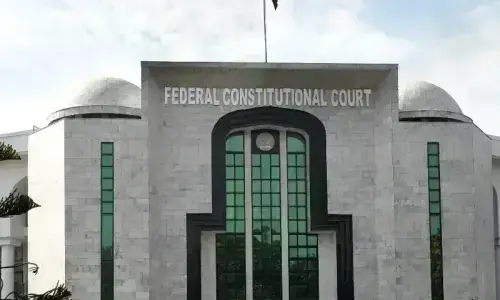
ISLAMABAD: The Pakistan Business Forum (PBF) on Thursday called for the agriculture and industrial sectors to return to federal policymaking under the purported 28th Constitutional Amendment, to correct “mis-steps” made under the 18th Amendment almost two decades ago.
In a letter to the various political parties and the government, the Punjab-based nonpartisan body said the country’s long-term economic interests could only be safeguarded through a national policy structure on both central production sectors of the economy.
It asked major parties to include comprehensive economic safeguards in the proposed amendment to ensure long-term economic stability and policy continuity in the country, and strongly advocated the need for a stable, predictable and growth-oriented economic framework, stating that frequent policy changes have negatively affected investor confidence and hampered sustainable economic progress.
PBF President Khawaja Mehboobur Rehman said the business community was increasingly seeking consistency and continuity in economic policymaking to support long-term investment and industrial planning.
He emphasised the importance of strengthening national coordination in agriculture and industry through an improved constitutional framework.
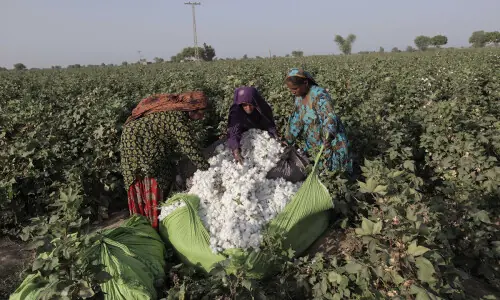
“The transfer of agriculture and industrial sectors to the provinces under the 18th Constitutional Amendment did not produce the desired outcomes”, the PBF claimed, noting that Pakistan’s annual cotton production, which stood at around 12 million bales before the amendment, had now declined to nearly 5 million.
Likewise, the PBF further observed that the wheat sector had faced persistent challenges in recent years, including policy uncertainty, import-related issues and weak inter-provincial coordination.
It argued that in many major economies, the agriculture sector remained closely coordinated at the federal level to ensure national cohesion and food security.
The body stressed that parliament should utilise the opportunity presented by the proposed amendment to introduce constitutional protections for key economic principles, including fiscal discipline, currency stability and the continuity of long-term economic policies.
According to the PBF, the current governance structure contributed to fragmented policymaking and regulatory inconsistencies among provinces, affecting productivity, investment flows, and industrial growth.
The forum highlighted that farmers, industrialists, exporters and investors continued to rely on the federal government for direction on taxation, incentives, trade policies and broader economic planning, while provincial administrations often faced limitations in delivering coordinated responses.
At times, Punjab and Sindh behaved in contradictory directions on similar matters of interest to both agriculture and industry.
In view of these concerns, the PBF recommended developing a stronger national coordination mechanism for agriculture and industry to ensure uniform policy implementation and greater economic coherence across the country, maintaining that such measures would help reduce uncertainty, improve investor confidence, and support sustainable economic growth.
The PBF further warned that overlapping federal and provincial regulations continue to create procedural complications and discourage new investment, resulting in what it termed as “jurisdictional confusion” in economic governance.
The PBF president further expressed that parliamentary leadership uses the 28th Amendment to advance meaningful economic reforms, particularly the restoration of agriculture and industry under federal government control to ensure stronger, more coordinated economic governance.